


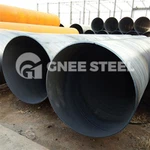


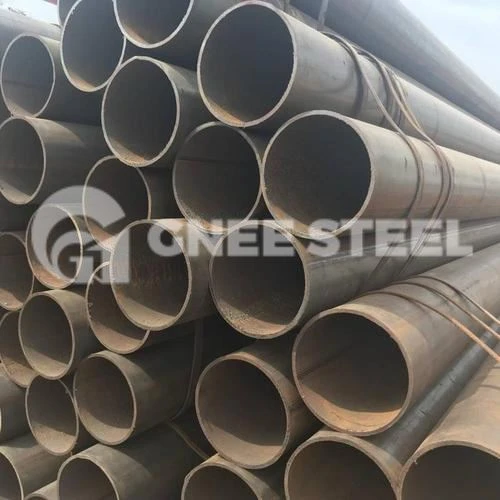

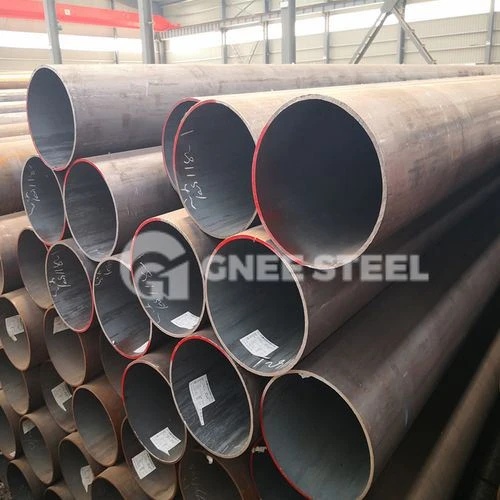
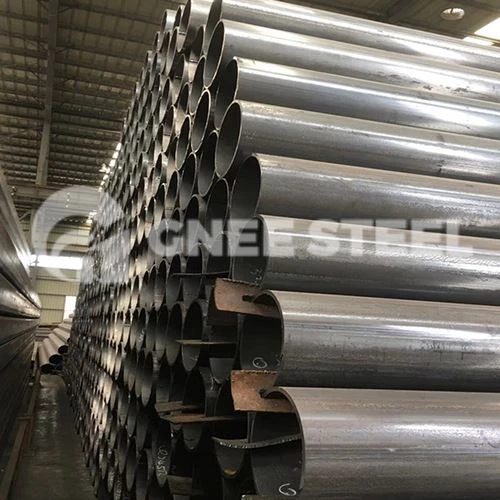
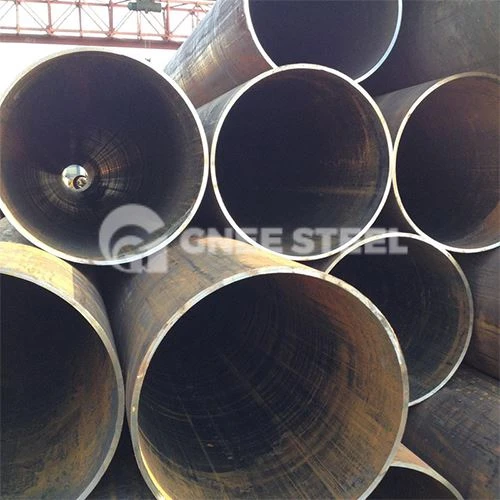
EN 10217-3 P275NL2 Welded Steel Pipe — Normalized Fine-Grain Low-Temperature Pipe
P275NL2 welded steel pipe is a pressure-purpose tube made by electric or submerged-arc welding from normalized, weldable fine-grain steel plate conforming to EN 10028-3:2017. The tube itself is supplied to EN 10217-3:2014. Its defining feature is the Charpy V-notch impact test at −50 °C with a minimum of 27 J - the lowest test temperature in the P275 family, which makes it the grade of choice for Arctic, offshore and other extreme low-temperature pressure services.
Buyers frequently meet P275NL2 only as a steel plate grade. For pipe, two European standards must appear on the purchase order together: EN 10028-3 defines the steel chemistry and properties of the base material, while EN 10217-3 defines the welded tube made from it. This page covers the welded tube; the seamless counterpart is covered separately under EN 10216-3.
Chemical composition % of steel P275NL2 (1.1104): EN 10028-3-2009
| According EN 10216-3:2014: 0.5=< Mn=<1.5; S=<0.005; N=<0.02; Ti=<0.04; |
| C | Si | Mn | Ni | P | S | Cr | Mo | V | N | Nb | Ti | Al | Cu | Nd | - |
| max 0.16 | max 0.4 | 0.8 - 1.5 | max 0.5 | max 0.02 | max 0.01 | max 0.3 | max 0.08 | max 0.05 | max 0.012 | max 0.05 | max 0.03 | max 0.02 | max 0.3 | max 0.05 | Nb+Ti+V < 0.05 |
Mechanical properties (normalized, longitudinal, EN 10028-3:2017)
Yield strength decreases with wall thickness
| Thickness (mm) | ReH min (MPa) |
|---|---|
| ≤ 16 | 275 |
| > 16 – 40 | 265 |
| > 40 – 60 | 255 |
| > 60 – 100 | 235 |
| > 100 – 150 | 225 |
| > 150 – 250 | 215 |
Tensile strength and elongation
| Thickness (mm) | Rm (MPa) | A min (%) |
|---|---|---|
| ≤ 60 | 390 – 510 | 24 |
| > 60 – 100 | 370 – 490 | 23 |
| > 100 – 150 | 360 – 480 | 23 |
| > 150 – 250 | 350 – 470 | 23 |
For the finished welded tube (EN 10217-3:2014) the tensile band is 390 – 530 MPa - slightly wider than the plate band because the tube standard permits the upper margin. Yield follows the same thickness curve above.
Low-temperature impact - the NL2 differentiator
The single property that separates P275NL2 from its siblings is the Charpy V-notch impact test temperature. All P275 grades share the 275 MPa yield; only the verified service temperature differs.
| Grade | Material no. | Impact test temp. | Min. impact energy (longitudinal, avg) |
|---|---|---|---|
| P275N | 1.0486 | 0 °C (room-temp quality) | ≥ 27 J |
| P275NH | 1.0487 | 0 °C (high-temp quality) | ≥ 27 J |
| P275NL1 | 1.0488 | −40 °C | ≥ 27 J |
| P275NL2 | 1.1104 | −50 °C | ≥ 27 J |
Because the chemistry of NL1 and NL2 is identical, selecting NL2 is a low-temperature safety upgrade: you gain a verified −50 °C toughness margin with no change to strength, chemistry or weldability. The weld seam and HAZ of the welded tube must also meet the −50 °C requirement.
Dimensions and wall thickness (EN 10217-3 welded tube)
EN 10217-3 covers a very wide size envelope, which is the main reason to choose welded over seamless for large diameters.
| Parameter | Typical range (EN 10217-3) |
|---|---|
| Outside diameter (OD) | 10.2 – 2540 mm |
| Wall thickness | 2.3 – 40 mm (depending on OD) |
| Length | Up to ~18 m, or cut-to-length |
| Tolerance | Per EN 10217-3 / EN ISO 1127 |
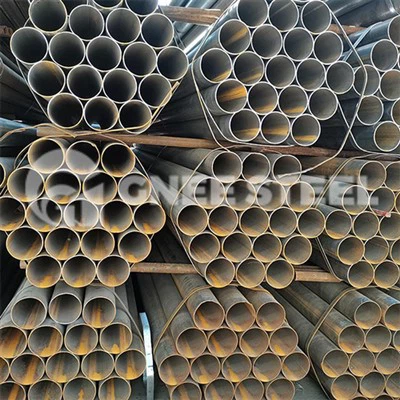
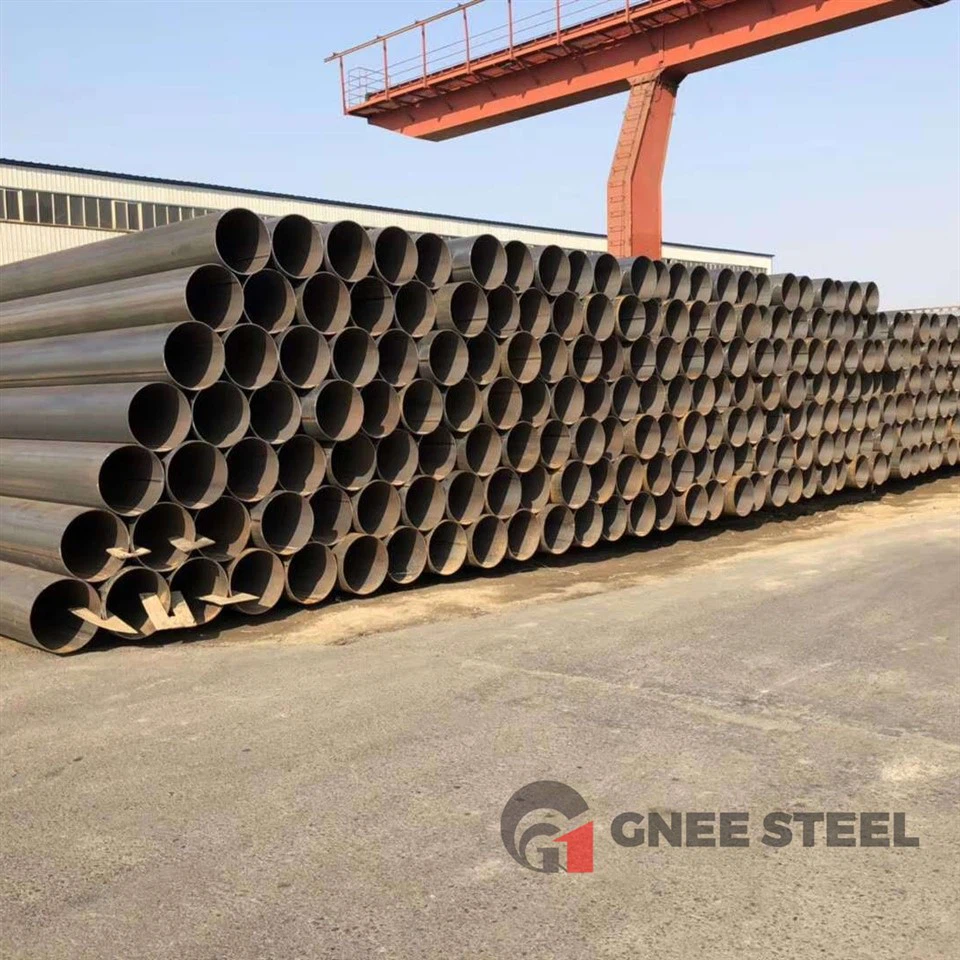
Smaller diameters (roughly ≤ 610 mm) are usually electric-resistance/induction welded (ERW/HFW); large diameters are longitudinally (LSAW) or helically (HSAW) submerged-arc welded. Confirm the exact envelope against your order and the mill's calibre.
Equivalent and comparison grades
| System | Nearest grade | Comment |
|---|---|---|
| European (same std.) | P275NL1 (1.0488) | Same chemistry; −40 °C instead of −50 °C |
| ASTM (pipe, low-temp) | ASTM A333 Gr. 6 | Closest low-temperature pipe analogue; not a 1:1 equivalent |
| ASTM (plate) | ASTM A516 Gr. 70 / A737 Gr. B | Pressure-vessel plate; different impact basis |
| Chinese (GB) | 16MnDR (GB 3531) | −40 °C low-temp plate; weaker low-temp margin than NL2 |
| DIN / Werkstoff | 1.1104 | Same material number |
Equivalents are for reference only. Before substitution, confirm chemistry, impact temperature and approvals (e.g. PED, NORSOK) with a metallurgist or the end client.
Welded (EN 10217-3) vs seamless (EN 10216-3)
| Aspect | Welded - EN 10217-3 (this page) | Seamless - EN 10216-3 |
|---|---|---|
| Blank | Normalized plate / coil | Hot-formed hollow |
| Max OD | Very large (up to ~2540 mm) | Limited (typically ≤ ~660 mm) |
| Cost | Lower for large dia. / long length | Higher |
| Integrity | Seam is the controlled feature (100% NDT) | No seam; uniform for critical duty |
| Choose when | Large diameter, moderate pressure, cost-sensitive | High-integrity / cyclic / critical service |
Both routes use the same EN 10028-3 P275NL2 base steel, so chemistry and low-temperature toughness are identical - the choice is about geometry, integrity and cost, not grade.
Applications and service boundaries
P275NL2 welded pipe is used wherever pressure containment meets extreme cold:
Arctic and sub-Arctic offshore platforms, wellhead and topside piping
Cryogenic and low-temperature process lines, separators, accumulators
LNG terminal support structures and cold-service piping (see boundary below)
Pressure vessels, boilers and heat exchangers operating at low ambient
General mechanical and apparatus engineering in cold climates
Do not over-specify: P275NL2 is qualified to −50 °C. It is not a liquid-LNG material - LNG is stored and transported at about −162 °C, which requires 9% nickel steel (e.g. EN 10028-4 / ASTM A553). Use P275NL2 for Arctic ambient, support structures and cold-process piping, not for the cryogenic liquid phase itself.
Welding and post-weld heat treatment
P275NL2 welds readily thanks to low C (≤ 0.16) and CEV ≤ 0.43. Practical guidance (confirm against your WPS / EN 1011-1):
| Step | Guidance |
|---|---|
| Preheat | Generally not required for t ≤ 30 mm; 100 – 150 °C for thicker sections or cold ambient |
| Interpass temp. | ≤ 250 °C |
| Heat input | Controlled, typically ~15 – 35 kJ/cm |
| PWHT | Stress-relief annealing 580 – 620 °C when required by the design code (e.g. thick-walled vessels) |
| Consumables | Low-hydrogen; match toughness to the −50 °C service (e.g. AWS E5515-C1 / ER50-6 class, verified) |
Weld seam inspection and testing (EN 10217-3)
The quality of a welded tube lives or dies at the seam. EN 10217-3 requires, as a minimum:
100% non-destructive testing of the weld seam - typically ultrasonic testing (UT) or radiographic testing (RT).
Hydrostatic test to a pressure derived from wall, diameter and specified yield.
Mechanical tests on the parent metal and, where specified, the weld/HAZ (tensile, bend,Charpy at −50 °C for NL2).
Visual and dimensional inspection of OD, wall, length and straightness.
Chemical verification of the base material to EN 10028-3.
Inspection document to EN 10204 - usually 3.1, with 3.2 available on request.
GNEE Customers

GNEE Exhibition

Test and inspection

Packaging and Shipping

GNEE supplies EN 10217-3 P275NL2 welded pipe in normalized condition with EN 10204 3.1 / 3.2 and full weld-seam NDT. Send your OD, wall, length and impact requirement.
Request a P275NL2 welded pipe quotation
FAQ
What is EN 10217-3 P275NL2 welded pipe?
It is a pressure-purpose welded tube made from normalized fine-grain steel P275NL2 (material no. 1.1104). The steel grade is defined by EN 10028-3:2017 and the finished welded tube by EN 10217-3:2014. Its key property is Charpy impact toughness verified at −50 °C with a minimum of 27 J.
What is the difference between P275NL2 and P275NL1?
They share the same chemical composition and the same 275 MPa yield. The only difference is the verified impact test temperature: P275NL1 is tested at −40 °C, P275NL2 at −50 °C. Choosing NL2 is therefore a low-temperature safety upgrade with no penalty to strength or weldability.
What is the chemical composition of P275NL2?
Per EN 10028-3:2017 (ladle analysis, max %): C ≤ 0.16, Si ≤ 0.40, Mn 0.80–1.50, P ≤ 0.020, S ≤ 0.010, Al ≥ 0.020, Ni ≤ 0.50, Cr ≤ 0.30, Mo ≤ 0.08, Nb ≤ 0.05, Ti ≤ 0.03, V ≤ 0.05, with Nb+Ti+V ≤ 0.05. Carbon equivalent CEV is ≤ 0.43 for thickness up to 60 mm.
What are the mechanical properties and yield strength of P275NL2?
Yield (ReH, min) falls with thickness: 275 MPa at ≤ 16 mm, 265 at 16–40 mm, 255 at 40–60 mm, 235 at 60–100 mm, 225 at 100–150 mm, 215 at 150–250 mm. Tensile (Rm) is 390–510 MPa up to 60 mm. The welded tube (EN 10217-3) allows Rm up to 530 MPa. Minimum impact energy is 27 J at −50 °C.
What dimensions and wall thickness are available for P275NL2 welded pipe?
EN 10217-3 covers outside diameters from about 10.2 mm up to 2540 mm and wall thicknesses from 2.3 mm to 40 mm, depending on diameter. Smaller sizes are typically ERW/HFW welded; large diameters are LSAW or HSAW. Exact envelopes should be confirmed against the mill's capability and your order.
How is P275NL2 welded pipe manufactured and tested?
It is made from normalized plate or coil by electric (ERW/HFW) or submerged-arc welding (LSAW/HSAW). EN 10217-3 requires 100% non-destructive testing of the weld seam (UT or RT), a hydrostatic test, mechanical and chemical verification, and an EN 10204 inspection document (usually 3.1, with 3.2 on request).
What is the equivalent grade of P275NL2?
There is no exact 1:1 equivalent. The closest low-temperature pipe analogue is ASTM A333 Gr. 6; related plate grades are ASTM A516 Gr. 70 / A737 Gr. B and Chinese 16MnDR (GB 3531). All substitutions must be confirmed by a metallurgist against the impact temperature and project approvals.
Can P275NL2 welded pipe be used for LNG or cryogenic service?
P275NL2 is qualified to −50 °C, suitable for Arctic ambient, offshore and cold-process piping and support structures. It is not a liquid-LNG material: LNG is handled at about −162 °C and requires 9% nickel steel (EN 10028-4 / ASTM A553). Use P275NL2 for the cold environment and structure, not the cryogenic liquid phase.
Hot Tags: EN 10217-3 P275NL2 Welded Steel Pipe — Normalized Fine-Grain Low-Temperature Pipe, China EN 10217-3 P275NL2 Welded Steel Pipe — Normalized Fine-Grain Low-Temperature Pipe manufacturers, suppliers, Alloy Mechanical Tube, ERW welded pipe, A691 Electrofusion Pipe, Pipe Fusion Welding, A519 Pipe, A513 ERW Steel Pipe
Previous
L245 L290 ERW PipeYou Might Also Like


Send Inquiry