




Finned Tube
Your Professional Finned Tube Supplier
Our goal is to become your true partner in the field of finned tube in China. GNEE Group has more than 200 professional staff. With high quality steel pipes and professional services, GNEE Group has won the recognition and support of customers at home and abroad in the industries and has become a globally renowned steel pipe supply group. Our company is committed to applying advanced manufacturing technology and strict quality control standards to every product. The price is competitive and the product is quality-assured, which is a good choice for your long-term cooperation.


Why Choose Us
Production market
GNEE Group exports steel to more than 160 countries including Thailand, Vietnam, South Korea, the United States, Chile, the United Kingdom, Saudi Arabia, the United Arab Emirates and Canada.
Our certification
The company has passed ISO9001, SGS, CE and other certifications.
Quality control
GNEE Group is committed to providing high-quality products to global customers. From the signing of the contract, from raw material procurement, production to inspection, the entire process is strictly in accordance with national standards such as ASTM, ASME, JIS, EN, DIN, etc.
Our service
The company has a professional sales team to provide you with high-quality pre-sales consulting services. During the order production process, customers can communicate with us at any time to understand the production progress. At the same time, we provide high-quality after-sales service to meet the different needs of customers.
Advantages of Finned Tube
Efficient heat transfer performance: Fin tubes are designed to significantly increase the external surface area of the tube, thereby improving heat transfer efficiency. Compared with ordinary smooth tubes, finned tubes increase the surface area for heat transfer by attaching fins to the outer surface of the tube, making it easier to transfer heat from the fluid to the outside of the tube, or from the outside of the tube to the fluid.
Significant energy saving effect: The efficient heat transfer performance directly brings significant energy saving effects. By transferring heat more efficiently, finned tubes can achieve better heat exchange effects under the same conditions, thereby reducing energy consumption.
Wide scope of application: Fin tubes have a very wide range of applications and can be used in various heat exchange equipment, including air conditioners, condensers, evaporators, boilers, water heaters and industrial heat exchangers. Its broad applicability makes it the component of choice in a variety of heat exchange applications.
Easy maintenance and cleaning: Modern finned tubes also have significant improvements in ease of maintenance and cleaning. For example, some fin tube designs make the fin spacing more reasonable, which facilitates cleaning and reduces the impact of dirt accumulation on heat transfer efficiency.
Improve equipment performance: The application of finned tubes can significantly improve the overall performance of the equipment.
Flexible design application: Fin tubes can be designed in different shapes and sizes depending on specific application requirements, providing a high degree of flexibility.
|
Parameter |
Description |
|
Surface Treatment |
Pickling, Sand Blasting, Galvanizing, Etc. |
|
Fin Pitch |
Customized |
|
Size |
Customized |
|
Package |
Wooden Cases, Pallet, Etc. |
|
Length |
Customized |
|
Shape |
Round, Square, Rectangle, Oval, Finned, Etc. |
|
Fin Height |
Customized |
|
Material |
Carbon Steel, Alloy Steel, Stainless Steel, Copper, Aluminum, Etc. |
|
Thickness |
Customized |
Types of Finned Tube
Elfin Finned Tubes: Elfin finned tubes have found takers and wide-scale usage in hydropower generator coolers. They are typically used to cool the generator used in these stations.
Bulleted Fins: Bulleted fins are similar to Elfin tubes and have become popular as a convenient and cost-effective method to attach strip fins to tubes. They are manufactured by manually placing fins over the tubes and pushing and pulling a bullet through the tube to expand the tube wall out into the fins.
L Finned Tubes: The L finned mechanical tube receives its name from the letter L, which it creates from the cross-sectional view. L finned tubes maximize the heat transfer capacity and enhance corrosion protection.
LL Finned Tubes: LL finned tubes are manufactured in the same way the L fins. However, they have LL fins that have overlapping feet and completely enclose the base tube. As a result, they are more resistant to corrosion.
KL Finned Tubes: The KL in the name of this category of tubes stands for Knurled Finned. The fin in these tubes is wrapped around the tube and the foot is rolled out into the outer surface of the pre-knurled tube and secured at each end.
G Embedded Finned Tube: The G embedded finned tube has a unique design feature wherein the fin is inserted and welded into a helical groove cut into the tubes. These mechanical tubes are perfect for higher temperatures.
Extruded Finned Tube: Two metals are used to manufacture extruded finned tubes. The outer surface is usually aluminum, while the inner tube is of any material. These heat exchanger tubes are quite popular because they offer excellent corrosion protection of the base tube.
Wire Finned Tube: The wire loop tube offers excellent heat transfer because it promotes turbulence in the fluid passing over it. These tubes consist of an elongated wire loop that increases the surface.
Application of Finned Tube

Heat exchangers
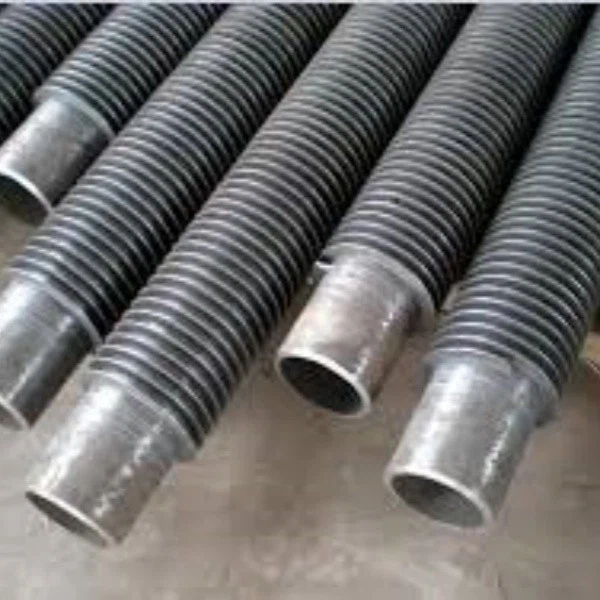
Finned tubes are widely used in heat exchangers across various industries. They are specifically utilized in applications that involve air-cooled heat exchangers, where natural convection is the primary cooling mechanism.
HVAC systems
Heating, ventilation, and air conditioning (HVAC) systems rely on finned tubes to facilitate effective heat transfer. By incorporating finned tubes into the heat exchangers of HVAC units, the systems can efficiently heat or cool air, ensuring comfortable indoor environments.

Refrigeration
Finned tubes are extensively used in refrigeration systems to enhance the heat transfer process. They are employed to remove heat from the refrigerant and facilitate its condensation, enabling efficient cooling and maintaining optimal temperatures.

Power generation
In power plants, finned tubes play a crucial role in condensers and boilers. By maximizing heat transfer, they improve the overall efficiency of power generation processes.
Production Process of Finned Tube
Tube preparation
The process begins with selecting the base tubes, which are usually made of steel due to its durability and thermal conductivity. The tubes are cut to the desired length and prepared for further processing.
Fin fabrication
There are several methods to create fins on the surface of the tubes.
Fin bonding
If the fins are not integrated with the tube material during the fabrication process, a separate bonding step might be necessary. Bonding methods include welding, brazing, or adhesive bonding, depending on the materials used for the tube and fins.
Heat treatment
After the fins are bonded to the tube, the assembly May undergo heat treatment to relieve any residual stresses and improve the overall structural integrity of the finned tubes.
Finned Tube Quality Control
Various quality checks are performed to ensure the integrity of the finned tubes. These checks can include visual inspection, measurements of fin dimensions, bond strength tests, and non-destructive testing techniques such as ultrasonic or X-ray testing.
Packaging and Shipping of Finned Tube
|
Packing |
In bundle |
|
Shipping |
Shipped by road, sea, rail or air |
FAQ