


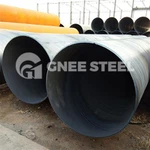


P355N Steel Welded Pipe — Normalized Fine-Grain Pressure Tube to EN 10217-3
P355N steel welded pipe is a normalized, weldable fine-grain pressure tube supplied to EN 10217-3, with a minimum yield strength of 355 MPa (51,500 psi) for wall thickness up to 16 mm and a tensile range of 490–630 MPa (71,100–91,400 psi). It is impact-tested at 0°C and used for pressure vessels, boilers, process piping and storage tanks at ambient to moderately elevated temperatures. The single number that decides your wall thickness is the design yield - and it steps down as the wall gets thicker, so the grade name alone does not fix the value.
P355N is a European pressure-vessel steel in the EN 10027 / EN 10028 family. Read the name in three independent parts: P marks a pressure-purpose steel, 355 is the minimum yield strength in MPa, and N means the steel is delivered normalized with room-temperature (0°C) impact qualification. It is not a structural grade and it is not a low-temperature grade - those are different suffixes in the same family.
Technical Specifications
| Parameter | Capability |
|---|---|
| Standard | EN 10217-3:2019 (welded pressure tubes, fine-grain steel) |
| Grade / material no. | P355N / 1.0562 (former DIN: StE 355) |
| Welding process | HFW (ERW, longitudinal) · SAWL (submerged arc, longitudinal) · SAWH (submerged arc, helical) |
| Outside diameter (OD) | HFW: ~10.2–610 mm (0.40–24 in); SAWL up to ~1626 mm (64 in); SAWH up to ~2540 mm (100 in) |
| Wall thickness (WT) | HFW: ~0.5–20 mm; SAW: up to ~40 mm (process-dependent) |
| Length | 6–12 m (20–40 ft) or cut to order |
| Ends | Plain, beveled (for welding), or threaded on request |
| Surface / coating | Black, varnished, or FBE / 3LPE / 3LPP / HDG / CWC on request (coating is a separate specification) |
| Delivery condition | Normalized (+N) |
| Test category | TC1 (standard) or TC2 (mandatory weld-seam UT) |
| Certification | EN 10204 3.1 MTC; third-party inspection (SGS / TÜV / BV) available |
Chemical Composition
| Element | P355N (1.0562) | Note |
|---|---|---|
| Carbon (C) | 0.20 | Welded-tube limit per EN 10217-3; the plate standard EN 10028-3 is tighter at 0.18 |
| Silicon (Si) | 0.50 | Deoxidation / strength |
| Manganese (Mn) | 0.90–1.70 | Primary strengthening element |
| Phosphorus (P) | 0.025 | Tight control for toughness & weldability |
| Sulfur (S) | 0.020 | Critical for weld-seam integrity |
| Aluminum total (Al), min | 0.020 | Grain refinement |
| Nitrogen (N) | 0.012 | - |
| Chromium (Cr) | 0.30 | - |
| Copper (Cu) | 0.30 | - |
| Molybdenum (Mo) | 0.08 | - |
| Niobium (Nb) | 0.05 | Micro-alloying |
| Nickel (Ni) | 0.50 | - |
| Titanium (Ti) | 0.03 | Micro-alloying |
| Vanadium (V) | 0.10 | Micro-alloying |
| Nb + Ti + V (combined) | 0.12 | Micro-alloying budget |
Each controlled element protects a specific property: low C and low S/P keep the weld sound, Mn and the micro-alloying elements (Nb/Ti/V) carry the strength, and Al fixes the fine grain that delivers the impact toughness.
Mechanical Properties
| Property | P355N value | Basis |
|---|---|---|
| Yield strength Rp0.2 | 355 MPa (≤16 mm wall); steps to 345 / 335 / 325 / 315 MPa with thickness | EN 10217-3 Table 3 |
| Tensile strength Rm | 490–630 MPa (71,100–91,400 psi) | EN 10217-3 |
| Elongation A | 22 % (longitudinal), 20 % (transverse), min | Test piece per EN ISO 6892-1 |
| Impact (Charpy V) | 0°C: 40 J longitudinal / 27 J transverse, min average | Reference test temperature for the N grade |
| Test standards | Tensile EN ISO 6892-1; Impact EN ISO 148-1; UT EN 10246 | - |
A common error is quoting the tensile ceiling as 650 MPa. The EN 10217-3 upper limit is 630 MPa. Also note the yield is thickness-dependent: the 355 MPa figure is only valid up to 16 mm wall, so a 40 mm wall designs to 345 MPa and a 63 mm wall to 335 MPa.
Grade Ladder - P355N vs P355NH vs P355NL1 vs P355NL2
| Grade | Impact test temp | Typical service |
|---|---|---|
| P355N | 0°C | Ambient / mildly cold, general pressure |
| P355NH | −20°C (+ elevated-temp properties) | Normal to elevated temperature, colder sites |
| P355NL1 | −40°C | Cold-exposed installations, refrigeration processes |
| P355NL2 | −50°C | Offshore, arctic, LNG-class storage |
Selecting the Right Grade and Product Form
Within the P355 family
| Condition | Choose |
|---|---|
| Ambient / mildly cold, general pressure | P355N (0°C) |
| Elevated temperature or colder site down to −20°C | P355NH |
| Outdoor unheated / refrigeration to −40°C | P355NL1 |
| Offshore / arctic / LNG-class to −50°C | P355NL2 |
| Need more design stress / wall saving | P460N family (460 MPa yield) |
| Lower strength is acceptable | P275NL1 / P265NL (265–275 MPa) |
Decision criterion: pick by the service temperature first (which fixes the suffix), then confirm the 355 MPa yield is enough for the wall/weight target; if not, move to the P460 family rather than over-speccing the impact grade.
Welding route: HFW vs SAW
| Route | Size suitability | Strength of the route |
|---|---|---|
| HFW / ERW (longitudinal) | Small–medium OD, thin–medium wall | Lower cost, smooth seam, good for high-volume runs |
| SAWL (submerged arc, longitudinal) | Large OD, heavy wall | Deep, inspected seam; suits thick-wall pressure |
| SAWH (submerged arc, helical) | Very large OD | Economical for large-diameter, low/medium pressure |
All three satisfy the same P355N chemistry and mechanical envelope; only the seam geometry, achievable diameter and the TC2 UT requirement differ. The seam is the variable a seamless grade (EN 10216-3) removes entirely.
Quality Control and Testing
Hydrostatic / leak test on every tube per EN 10217-3.
Weld-seam ultrasonic testing - mandatory for TC2 (EN 10246), optional for TC1; specify TC2 for any pressure duty.
Tensile and impact tests from representative test pieces; impact at 0°C for the N grade.
Flattening / bend and weld-bend tests for SAW seams to prove seam soundness.
Dimensional and visual inspection, plus heat-number marking for full traceability.
EN 10204 3.1 MTC with heat analysis and test results; third-party witness (SGS / TÜV / BV) on request.
Advantages
The commercial value of P355N comes from measurable properties, not adjectives:
High strength-to-wall ratio. At 355 MPa it carries roughly 35 % more hoop stress than a 260 MPa grade such as P265NL at equal wall, so walls and weight come down.
Reliable welding. Fine-grain, low-impurity chemistry keeps preheat requirements modest and the HAZ tough; conventional SMAW, GMAW and SAW all work.
Traceable pressure certification. Supplied with EN 10204 3.1 MTCs and, for TC2, mandatory weld-seam UT - directly usable for PED / code dossiers.
Flexible welding routes. HFW covers smaller diameters at lower cost; SAW reaches large diameters and heavy walls, so the same grade fits many layouts.
Predictable impact at 0°C. Guaranteed 40 J (longitudinal) / 27 J (transverse) at 0°C gives margin for unheated outdoor or swing-temperature service.
Applications
P355N welded tubes are chosen wherever a closed pressure boundary must carry fluid or gas at ambient to moderately elevated temperature without stepping up to alloy or creep-resistant grades. Five application groups cover most orders:
Pressure vessels and process equipment
Shell courses, nozzles and internals in chemical and petrochemical plants where design temperature stays around ambient to roughly 350–400°C (660–750°F).
Boilers and heat exchangers
Headers, collecting tubes and shell-side passes. Note: P355N is a fine-grain C-Mn steel, not a creep-grade; for sustained service above about 400°C switch to P355NH or a low-alloy grade such as 16Mo3 / 13CrMo4-5.
Industrial pipelines
Plant piping and utility lines carrying non-corrosive gas or liquid at moderate pressure, including the welded equivalent of line-pipe runs inside battery limits.
Storage tanks and reactors
Vertical and horizontal pressure tanks, separators and reactor shells where weldability and traceable MTCs matter more than ultra-low temperature.
Load-and-pressure hybrid structures
Support frames or skids that simultaneously carry external load and an internal pressure boundary - a case where the pressure certification is non-negotiable.
Why Source P355N Steel Welded Pipe from GNEE
Integrated supply. HFW and SAW routes available from one source, so the grade is consistent across diameters on one project.
Certified quality. EN 10204 3.1 MTCs as standard, with TC2 weld UT and third-party inspection (SGS / TÜV / BV) on request.
Engineering support. Our technical team confirms grade, wall and impact temperature against your design code before quotation.
Coating options. FBE, 3LPE, 3LPP, HDG and CWC can be quoted as a separate specification when corrosion or buried service applies.
Responsive delivery. Quotation with lead time returned within 24 hours of a complete inquiry.
P355N Steel Welded Pipe Supplier-GNEE Team

GNEE Customers

GNEE Exhibition

Test and inspection

Packaging and Shipping

Request a P355N Welded Pipe Quote
Send your OD × wall, quantity, welding process and destination port - our technical team confirms the specification and returns a quotation with lead time within 24 hours. Contact GNEE Pipe today.
FAQ
What is P355N steel welded pipe?
It is a welded pressure tube made from P355N, a normalized weldable fine-grain steel (material number 1.0562) supplied to EN 10217-3. Minimum yield is 355 MPa for wall thickness up to 16 mm and tensile range is 490–630 MPa. It is used for pressure vessels, boilers, piping and storage tanks at ambient to moderately elevated temperatures.
Is P355N the same as S355 (S355JR / S355J2)?
No. S355 is a structural steel under EN 10025 with no pressure-equipment certification and no guaranteed impact energy at 0°C by default. For pressure service the correct European grade is P355N (room temperature), P355NH (−20°C / elevated), P355NL1 (−40°C) or P355NL2 (−50°C) under EN 10217-3 / EN 10028-3.
What is the difference between P355N, P355NH and P355NL1 / P355NL2?
They share the same 355 MPa yield but differ by guaranteed impact temperature: P355N at 0°C, P355NH at −20°C (with elevated-temperature properties), P355NL1 at −40°C, P355NL2 at −50°C for offshore/arctic service. Specifying the wrong suffix means the impact qualification does not match the service temperature.
Can P355N be used at low temperature?
P355N is the room-temperature grade, impact-qualified at 0°C (40 J longitudinal / 27 J transverse minimum average). For sub-zero design specify P355NH (−20°C), P355NL1 (−40°C) or P355NL2 (−50°C). Using P355N below 0°C means the toughness is no longer guaranteed by the standard.
What welding process is used for EN 10217-3 P355N pipe?
EN 10217-3 covers electric (HFW / ERW, longitudinal seam) and submerged-arc welded tubes (SAWL longitudinal, SAWH helical). HFW suits smaller diameters; SAW reaches larger diameters and heavier walls. For pressure service specify test category TC2, which makes weld-seam ultrasonic testing mandatory.
What is the difference between EN 10217-3 (welded) and EN 10216-3 (seamless)?
Both define the same fine-grain pressure grades (P355N/NH/NL1/NL2) but by different routes: EN 10217-3 is welded (HFW or SAW), EN 10216-3 is seamless. The weld is the key variable - welded pipe must declare the welding process and TC1/TC2 weld examination; seamless pipe has no longitudinal weld. A specification that says "EN 10217-3 seamless" is contradictory.
What pressure can P355N pipe carry?
It depends on outside diameter, wall thickness and the governing design code. As a screening check at OD 323.9 mm, design stress 0.7 × 355 = 249 MPa and joint efficiency 1.0: 25 bar needs about 1.6 mm wall, 50 bar about 3.3 mm, 100 bar about 6.8 mm (before corrosion allowance). Final wall must come from EN 13445 / ASME VIII / PD 5500 using the code allowable stress.
What certificate and inspection come with P355N welded pipe?
Each order ships with an EN 10204 3.1 mill test certificate (heat analysis, mechanical test results, heat number). Hydrostatic/leak test and, for TC2, mandatory weld-seam UT per EN 10246 are performed. Third-party inspection by SGS, TÜV, BV or similar is available on request.
Hot Tags: P355N Steel Welded Pipe — Normalized Fine-Grain Pressure Tube to EN 10217-3, China P355N Steel Welded Pipe — Normalized Fine-Grain Pressure Tube to EN 10217-3 manufacturers, suppliers, HDPE Plastic Water Supply Pipe, Black With Blue Strip Pipe, Butt Fusion Welded Pipe, A358 TP321 TP321H Welded Pipe, SAW Pipe, Submerged Arc Welding
Previous
P355NH Steel Welded PipeYou Might Also Like



Send Inquiry