


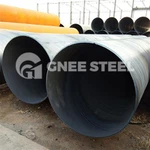


P355NH Steel Welded Pipe
P355NH steel welded pipe is a normalized, weldable fine-grain pressure tube to EN 10217-3 (material number 1.0565) with a 355 MPa minimum yield and a 490–630 MPa tensile range. Its defining feature - the "H" - is a tabulated elevated-temperature proof strength from 100 °C to 400 °C (304 MPa down to 167 MPa at the yield), so one grade spans ambient service and heated pressure equipment. Specify it with 100% weld-seam NDE and Charpy impact at −20 °C.
Rolled, welded steel pipes according to DIN EN 10217-3, in the version with normalised weld seam (NW), completely normalised (NP) or normalising rolled or hot stretch reduced (NR), in round dimension.
The capital letter P stands for compressive stress, the NH indicates the material as suitable for higher temperatures. Pipes according to this standard are typically electrically or submerged arc welded. Common applications for this material are compressive stresses at elevated temperatures with moderate requirements, such as in pressure vessels or boilers. The good welding properties make it possible to use it in welded constructions.
The pipe is made from hot-rolled fine-grain strip with a controlled carbon-manganese chemistry plus micro-alloy grain refiners (Nb, V, Ti, Al), giving good weldability without routine post-weld heat treatment on thinner walls. It is the workhorse pressure grade when the design references allowable stresses above ambient temperature.
We supply P355NH welded pipe in outside diameters from 21.3 mm to 610 mm (½"–24"), wall thicknesses 2.0–40.0 mm, and lengths up to 24 m, with plain, beveled or threaded ends and EN 10204 3.1 or 3.2 certificates; third-party inspection (SGS, BV, TÜV) is available.
Technical Specifications
| Parameter | Capability |
|---|---|
| Standard | EN 10217-3:2019 (welded fine-grain pressure tube); seamless counterpart EN 10216-3:2014 |
| Grade / material no. | P355NH / 1.0565 |
| Outside diameter | 21.3–610 mm (½"–24"); larger diameters on SAW request |
| Wall thickness | 2.0–40.0 mm (0.079"–1.575") |
| Length | Up to 24 m; random or fixed cut lengths |
| Weld method | ERW/HFW longitudinal; SAW for large diameter |
| Delivery condition | Normalized - NP (fully normalized), NW (normalized weld), or NR (normalizing rolled) |
| Ends | Plain, beveled, or threaded |
| Test category | TC1 (standard) or TC2 (with mandatory weld-seam UT) |
| Surface / coating | Bare, varnish, primer, galvanized, FBE or 3LPE on request |
| Certification | EN 10204 3.1 or 3.2; third-party inspection (SGS, BV, TÜV) available |
Chemical Composition
| Element | P355NH | Note |
|---|---|---|
| Carbon (C) | 0.20 | Welded-tube limit per EN 10217-3 (plate EN 10028-3 is 0.18) |
| Silicon (Si) | 0.50 | Deoxidation |
| Manganese (Mn) | 0.90–1.65 | +0.05% Mn allowed per 0.01% C below max, up to 1.70% |
| Phosphorus (P) | 0.025 | Kept low for toughness |
| Sulfur (S) | 0.020 | Low S aids weldability and toughness |
| Aluminium total (Al) | 0.020 min | Grain refinement |
| Niobium (Nb) | 0.05 | Micro-alloy grain refiners; Nb+Ti+V ≤ 0.12 |
| Vanadium (V) | 0.10 | |
| Titanium (Ti) | 0.04 | |
| Chromium (Cr) | 0.30 | Residual / optional alloying |
| Nickel (Ni) | 0.50 | |
| Molybdenum (Mo) | 0.08 | |
| Copper (Cu) | 0.30 | |
| Nitrogen (N) | 0.020 |
Each controlled element manages a specific risk: low C and low S protect weldability, Al/Nb/V/Ti lock in a fine grain for toughness, and tight P/S limits prevent brittle fracture. The C–Mn trade-off rule lets mills fine-tune strength within the specified band.
Mechanical Properties (room temperature, normalized)
| Wall thickness (mm) | Yield Rp0.2 min (MPa) | Tensile Rm (MPa) | Elongation A min (%) |
|---|---|---|---|
| ≤ 16 | 355 | 490–630 | 22 |
| > 16 – 40 | 345 | 490–630 | 22 |
| > 40 – 63 | 335 | 490–630 | 22 |
| > 63 – 100 | 315 | 470–610 | 21 |
| > 100 – 120 | 305 | 460–600 | 21 |
| > 120 – 150 | 295 | 450–590 | 21 |
Charpy V-notch impact: 40 J longitudinal / 27 J transverse at −20 °C. Note the tensile range is 490–630 MPa - some supplier data sheets list 650 MPa for very thin walls, but 490–630 MPa is the specified standard range. Elongation is measured on the standard proportional specimen.
Elevated-Temperature Proof Strength - the "H" values
| 100 °C | 150 °C | 200 °C | 250 °C | 300 °C | 350 °C | 400 °C |
|---|---|---|---|---|---|---|
| 304 | 284 | 255 | 235 | 216 | 196 | 167 |
These values are what distinguish P355NH from P355N. A design referenced to 300 °C must use 216 MPa, not the ambient 355 MPa - using the room-temperature number at temperature overstates allowable stress by about 64%. The table stops at 400 °C; above that, specify P355GH or another elevated-temperature grade.
P355N / NH / NL1 / NL2 - choosing the right temperature grade
| Grade | Letter meaning | Impact (min) | Elevated-temp design values? | Service |
|---|---|---|---|---|
| P355N | Normalized, ambient | −20 °C qualified (ambient design) | No | Ambient-temperature pressure |
| P355NH | Normalized, elevated temp | −20 °C (40 J L / 27 J T) | Yes - 100–400 °C | Normal + elevated temp to ~400 °C |
| P355NL1 | Normalized, low temp 1 | −40 °C | No | Low-temperature duty |
| P355NL2 | Normalized, low temp 2 | −50 °C | No | Cryogenic / offshore |
Select by the lowest and highest temperature the component will see. P355NH is the only one of the four that also carries high-temperature design strength; the NL grades trade that away for deeper low-temperature toughness.
Advantages
The commercial value of P355NH comes from measurable properties, not adjectives.
Thinner walls than lower grades. A 355 MPa yield (vs 235–265 MPa grades) lets the same pressure rating be met with less wall, cutting weight and support cost.
Weldable without routine PWHT. Fine-grain normalized chemistry (CEV max ~0.43) keeps preheat modest on thinner sections, shortening fabrication schedules.
−20 °C toughness built in. A guaranteed 40 J longitudinal / 27 J transverse at −20 °C covers moderate cold climates without stepping down to a dedicated low-temperature grade.
Spans ambient to ~400 °C. Because the high-temperature design table is part of the grade, one material covers heated equipment that a room-temperature grade could not.
Cost-effective versus seamless. ERW/HFW welded P355NH with full weld NDE meets most stationary pressure designs at lower cost than seamless EN 10216-3 tube.
Applications
P355NH is chosen wherever pressurized media are handled at temperatures above ambient but below roughly 400 °C, and where good weldability and −20 °C toughness are also required.
Pressure vessels and storage spheres
Petrochemical and gas-handling fabricators use P355NH for reactors, separators and high-pressure storage where the wall must retain strength under sustained elevated temperature.
Boilers, steam headers and heat exchangers
In power generation and process plants, P355NH carries steam and hot process fluids; its elevated-temperature Rp0.2 values feed the design code's allowable-stress tables directly.
Industrial pressure piping
Process-plant piping, compressed-air systems, HVAC and district-heating lines use P355NH welded pipe where moderate pressure and temperature coexist with fabrication by welding.
High-pressure gas transmission and distribution
Longitudinal ERW/HFW P355NH pipe serves onshore gas lines and plant piping; 100% weld-seam NDE makes the longitudinal seam a controlled, inspected feature rather than a liability.
Fire protection and structural pressure members
Sprinkler mains and high-strength pressure-containing structural elements benefit from the combination of 355 MPa yield and fine-grain toughness at moderate cost.
Quality Control and Testing
Chemistry. Ladle analysis plus product analysis against the EN 10217-3 limits, with the C–Mn trade-off applied where relevant.
Mechanical. Room-temperature tensile and transverse/longitudinal Charpy at −20 °C verify yield, tensile and toughness.
Weld integrity. 100% weld-seam ultrasonic (EN ISO 10893-10, typically Φ3.2 mm FBH sensitivity) or radiographic examination; hydrostatic test or approved NDE alternative.
Ductility across the weld. Flattening or bend tests confirm the weld zone deforms with the base metal.
Dimensional & visual. Checked per EN 10246; marking and traceability to the heat and certificate.
Optional third-party. SGS, BV or TÜV witness and EN 10204 3.2 issue for critical or regulated projects.
About GNEE
GNEE specializes in the production of API 5L welded line pipes and has many years of experience in producing API 5L carbon steel welded pipes. We provide high quality, low cost but the best service. Therefore, our current export customers of API 5L series welded longitudinal submerged arc welded pipes cover Kuwait, Saudi Arabia, Oman, United Arab Emirates, Singapore, Malaysia, Indonesia, South Korea, Chile, Peru, Australia, Nigeria, Angola and other countries and regions. If you need it you can contact us at any time, we will provide you with the products you need as soon as possible.
- Full specification control. TC1 or TC2, normalized condition, ends and coating are all configurable per order, with EN 10204 3.1/3.2 and third-party inspection.
- Technical support. Our team confirms grade, temperature class and inspection level against your design code before shipment, and returns a quotation with lead time within 24 hours.
P355NH Steel Welded Pipe Supplier-GNEE Team

GNEE Customers

GNEE Exhibition

Test and Inspection

Packaging and Shipping

Send your standard and grade (EN 10217-3 P355NH), dimensions, test category, and destination port - our technical team will confirm the specification and return a quotation with lead time within 24 hours.
Request a P355NH Steel Welded Pipe Quote
FAQ
What does P355NH mean?
P = steel for pressure purposes; 355 = 355 MPa minimum yield strength; N = normalized (delivery condition); H = suitable for elevated/high-temperature service. The "H" is the defining letter: P355NH carries tabulated proof strength at 100–400 °C that the ambient-temperature grade P355N does not.
What is the difference between P355N and P355NH?
Both are normalized fine-grain steels with 355 MPa yield and −20 °C impact. P355NH additionally provides the elevated-temperature design values (Rp0.2 from 304 MPa at 100 °C down to 167 MPa at 400 °C), so it is the grade to specify when the design code references allowable stresses above ambient. P355N is the ambient-temperature design grade without that high-temperature table.
What temperature range can P355NH welded pipe handle?
P355NH is qualified for service from about −20 °C (Charpy 40 J longitudinal / 27 J transverse) up to roughly 400 °C, where the standard's elevated-temperature proof-strength table applies. Above ~400 °C, specify P355GH or another elevated-temperature grade; below −20 °C, move to P355NL1 (−40 °C) or P355NL2 (−50 °C).
Is P355NH the same as S355J2?
No. S355J2 belongs to EN 10025 (structural steel) and is not a pressure-tube grade. For pressure applications that need S355J2's strength and toughness, the technically correct EN 10217-3 grade is P355NH. Some tubes are dual-certified to also meet EN 10219 S355J2H for structural use, but the pressure specification must read P355NH.
What are the yield and tensile strengths of P355NH?
Minimum yield strength (Rp0.2) is 355 MPa for wall thickness up to 16 mm, stepping down to 295 MPa at 120–150 mm. Tensile strength (Rm) is 490–630 MPa for sections up to 63 mm. Impact energy is 40 J longitudinal / 27 J transverse at −20 °C.
Can P355NH welded pipe replace seamless pipe?
For most stationary pressure services where a longitudinal ERW/HFW weld with 100% weld-seam NDE (UT or RT) meets the design, yes - P355NH welded pipe is a cost-effective alternative to seamless. Seamless (EN 10216-3) is still preferred for very high cyclic/fatigue duty or where the specification forbids a longitudinal weld.
What testing and weld inspection are mandatory for EN 10217-3 P355NH?
Chemical analysis, room-temperature tensile, Charpy V-notch at −20 °C, 100% weld-seam NDT (ultrasonic per EN ISO 10893-10 or radiographic), hydrostatic test or approved NDE alternative, flattening/bend, and dimensional/visual inspection per EN 10246. TC2 adds mandatory ultrasonic examination of the weld seam; TC1 does not.
What is the ASTM or US equivalent of P355NH?
The nearest US designation is ASTM A662 Grade C. Some tubes are also dual-certified to EN 10219 S355J2H for structural use. For procurement, always state the EN 10217-3 P355NH grade and test category rather than relying on an "equivalent" alone, because impact and inspection requirements differ by standard.
Hot Tags: p355nh steel welded pipe, China p355nh steel welded pipe manufacturers, suppliers, ASTM A513 Mechanical Tube, Alloy Mechanical Tube, Electrofusion Welding HDPE Pipe For Irrigation, Mechanical Tubing, A358 TP321 TP321H Welded Pipe, SAW Pipe
Previous
P355NL1 Steel Welded PipeYou Might Also Like


Send Inquiry