


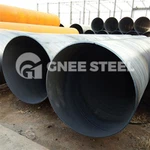


P355NL1 Steel Welded Pipe
P355NL1 steel welded pipe is a normalized, weldable fine grain pressure tube in material number 1.0566, made to EN 10217-3:2019, that carries a guaranteed Charpy impact energy of 27 J at −40 °C in the transverse direction. It delivers a minimum yield strength of 355 MPa (51.5 ksi) in thin sections, stepping down to 295 MPa (42.8 ksi) at 250 mm wall, with tensile strength of 490–630 MPa (71–91 ksi).
The grade belongs to the pressure-equipment family (EN 10028-3 / EN 10217-3), not the structural-steel family, and is the standard European choice for vessels and piping that must resist brittle cracking in cold climates or cryogenic-adjacent service.
GNEE supplies P355NL1 as ERW/HFW and SAW welded tubes from 10.2–2540 mm (0.40–100 in) outside diameter, 0.5–40 mm (0.02–1.57 in) wall, in lengths up to 12 000 mm (472 in), with EN 10204 3.1 certificates and third-party inspection on request. Send your OD × wall, quantity and impact requirement for a quote.
Technical Specifications
| Parameter | Capability |
|---|---|
| Standard | EN 10217-3:2019 (welded); grade also in EN 10028-3, EN 10216-3:2014 |
| Material number | 1.0566 |
| Outside diameter | 10.2–2540 mm (0.40–100 in) |
| Wall thickness | 0.5–40 mm (0.02–1.57 in) |
| Length | Up to 12 000 mm (472 in); fixed or random |
| Welding route | ERW/HFW for small-to-mid diameters; SAW for large diameters |
| Ends | Plain, bevelled (V or J), or capped per requirement |
| Surface / coating | Black, varnished, galvanized, FBE, 3LPE/3LPP, or as specified |
| Delivery condition | Normalized (+N) |
| Certification | EN 10204 3.1 standard; 3.2 with TÜV/SGS/BV/LR witness available |
Chemical Composition
| Element | P355NL1 (max %) |
|---|---|
| Carbon (C) | 0.18 |
| Silicon (Si) | 0.50 |
| Manganese (Mn) | 1.10–1.70 |
| Phosphorus (P) | 0.025 |
| Sulfur (S) | 0.015 |
| Nitrogen (N) | 0.012 |
| Aluminium total (Al) | ≥ 0.020 |
| Chromium (Cr) | 0.30 |
| Copper (Cu) | 0.30 |
| Molybdenum (Mo) | 0.08 |
| Nickel (Ni) | 0.50 |
| Niobium (Nb) | 0.05 |
| Titanium (Ti) | 0.03 |
| Vanadium (V) | 0.10 |
| Nb + Ti + V | 0.12 |
Every controlled element manages a specific risk: carbon and the micro-alloys keep strength and weldability in balance, aluminium provides grain refinement for toughness, and the tight sulfur/phosphorus limits protect against lamellar tearing and brittle cracking. Note that the NL grades cap carbon at 0.18 % - stricter than the 0.20 % allowed on P355N/NH - because low-temperature toughness depends on a leaner analysis.
Mechanical Properties
| Property | P355NL1 |
|---|---|
| Yield strength ReH (≤16 mm) | 355 MPa (51.5 ksi) |
| Yield strength (16–40 mm) | 345 MPa (50.0 ksi) |
| Yield strength (40–60 mm) | 335 MPa (48.6 ksi) |
| Yield strength (60–100 mm) | 315 MPa (45.7 ksi) |
| Yield strength (100–150 mm) | 305 MPa (44.2 ksi) |
| Yield strength (150–250 mm) | 295 MPa (42.8 ksi) |
| Tensile strength Rm (≤60 mm) | 490–630 MPa (71–91 ksi) |
| Tensile strength (60–100 mm) | 470–610 MPa (68–88 ksi) |
| Tensile strength (100–150 mm) | 460–600 MPa (67–87 ksi) |
| Tensile strength (150–250 mm) | 450–590 MPa (65–86 ksi) |
| Elongation A (longitudinal, ≤60 mm) | 22 % |
| Elongation A (>60–250 mm) | 21 % |
| Impact, transverse (Charpy V) | 27 J min at −40 °C (NL1 defining test) |
| Impact, longitudinal (Charpy V) | 40 J at −40 °C; 30 J at −50 °C |
| Test standards | EN ISO 6892-1 (tensile), EN ISO 148-1 (impact) |
The yield figures step down with thickness in fixed bands; designing to the headline 355 MPa at a 200 mm wall would overstate allowable stress by roughly 17 %. Impact values are the qualification temperatures - see the FAQ on why −40 °C is not automatically the design temperature.
P355 Family Selection - N, NH, NL1, NL2
| Requirement | P355N | P355NH | P355NL1 | P355NL2 |
|---|---|---|---|---|
| Temperature role | Room temp | Elevated temp | Low temp (−40 °C) | Low temp (−50 °C) |
| Impact test | 0 °C, 27 J transv. | 0 °C (no low-temp qual.) | −40 °C, 27 J transv. | −50 °C, 27 J transv. |
| Phosphorus (P) max | 0.025 | 0.025 | 0.025 | 0.020 |
| Sulfur (S) max | 0.015 | 0.015 | 0.015 | 0.010 |
| Carbon (C) max | 0.20 | 0.20 | 0.18 | 0.18 |
| Typical use | General pressure parts | Hot service to 400 °C | Cold-climate vessels/piping | Arctic / −50 °C service |
P355NL1 vs P355NH vs P355NL2
| Grade | Temperature role | Choose when |
|---|---|---|
| P355NL1 | Low temp, −40 °C qual. | Cold-climate or low-MDMT pressure equipment without extreme cold |
| P355NH | Elevated temp to 400 °C | Hot service where design stress at elevated temperature matters |
| P355NL2 | Low temp, −50 °C qual. | Arctic or where the design specifically requires −50 °C qualification |
The choice is driven by the service temperature, not by strength - all three share the same 355 MPa yield ladder. Pick the temperature class that matches the design, then confirm the impurity class only if the code or purchaser demands NL2's tighter P/S.
Welded (ERW/HFW or SAW) vs Seamless
| Route | Size suitability | Strength of the route |
|---|---|---|
| ERW / HFW welded | Small to mid diameter, thin to medium wall | Cost-effective, consistent weld, full NDT of the seam |
| SAW welded | Large diameter, heavier wall | Wide size range, economical for big bore |
| Seamless (EN 10216-3) | All diameters, no seam | No longitudinal weld; used where a seam is excluded by spec |
All routes meet the same P355NL1 chemistry and mechanical grade; the weld is the only additional variable, and it is controlled by seam NDT plus normalized heat treatment.
Advantages
The commercial value of P355NL1 is measurable, not decorative - each advantage traces to a controlled property:
Guaranteed −40 °C toughness. A qualified 27 J transverse impact at −40 °C removes the guesswork from cold-service qualification and reduces the need for premium low-temperature alloys.
355 MPa yield at a commodity price point. The grade sits in the medium-strength pressure class, so designers get meaningful margin without the cost of quenched-and-tempered or higher-alloy steels.
Excellent weldability. Low carbon (≤0.18 %) and controlled S/P plus grain-refining aluminium give a low risk of cold cracking and stable heat-affected-zone toughness under normal procedures.
Single class covers a wide thickness range. One material supports walls from a few millimetres to 250 mm, with only a predictable yield step-down, simplifying stock and procurement.
Full European certification chain. EN 10028-3 / EN 10217-3 with PED 2014/68/EU scope and EN 10204 3.1/3.2 certificates satisfies EU and many international pressure-equipment directives out of the box.
Applications
P355NL1 is selected wherever a pressurized system operates in cold ambient conditions or where a low design temperature must be qualified without changing material class. Five application groups cover the bulk of demand:
LPG, Propane and Butane Storage Vessels
Pressurized-gas storage is the classic application. The guaranteed −40 °C toughness guards against brittle fracture during cold-weather filling, emptying and transport, which is why NL1 is specified far more often than N for these vessels.
Pressure Piping in Cold Climates
Process and utility piping in northern regions, offshore topsides and Arctic-adjacent facilities uses NL1 so the line can be qualified for low design metal temperatures without stepping up to an exotic alloy.
Boilers and Steam Equipment Components
Headers, collectors and steam-system parts that see low-temperature start-up or cold standby benefit from the grade's toughness floor, complementing its pressure rating.
Shell-and-Tube Heat Exchangers and Process Gas Equipment
Channels, shells and tubesheets in cryogenic-adjacent process trains (including LNG-adjacent handling) rely on NL1 where the service temperature approaches the qualification point.
Cold-Region Oil and Gas Surface Equipment
Separators, scrubbers and compressor components exposed to winter ambient temperatures are routinely built from NL1 to satisfy local MDMT requirements cost-effectively.
Quality Control and Testing
Tensile and yield verification per EN ISO 6892-1 at the thickness-appropriate values, confirming the step-down yield ladder.
Transverse Charpy impact at the specified temperature (−40 °C for NL1) per EN ISO 148-1, the defining test of the grade.
Weld-line non-destructive testing - ultrasonic or eddy-current examination of the ERW/HFW or SAW seam as routine mill practice.
Flattening or bend test to confirm ductility and seam integrity of the welded tube.
Dimensional and visual inspection including outside diameter, wall thickness, length and end condition against the order.
EN 10204 3.1 certificate traceable to the heat number; 3.2 with third-party witness available.
Why Source P355NL1 from GNEE
Integrated supply across the P355 family - N, NH, NL1 and NL2 - with consistent chemistry and certificates so your grade change is a single source.
ERW/HFW and SAW routes in one pipeline, covering 10.2–2540 mm outside diameter without splitting the order across mills.
EN 10204 3.1 as standard, 3.2 with TÜV/SGS/BV/LR witness on request, and full heat-number traceability.
Technical review of your impact-temperature and MDMT requirement before order confirmation, so the delivered grade matches the design code.
P355NL1 Steel Welded Pipe Supplier-GNEE Team

GNEE Customers

GNEE Exhibition

Test and inspection

Packaging and Shipping

Send your outside diameter × wall thickness, quantity, length and impact requirement - our technical team will confirm the specification and return a quotation with lead time.
Request a P355NL1 Steel Welded Pipe Quote
FAQ
What is the difference between P355NL1 and P355NL2?
Both share the same 355 MPa yield class and nearly identical chemistry. The only material difference is the guaranteed impact test temperature and tighter impurity limits on NL2: P355NL1 is qualified at −40 °C (27 J transverse minimum) with P ≤ 0.025 % and S ≤ 0.015 %, while P355NL2 is qualified at −50 °C with P ≤ 0.020 % and S ≤ 0.010 %. Choose NL2 only when the design requires the −50 °C qualification; otherwise NL1 is the standard cold-climate grade.
How is P355NL1 different from P355NH?
P355NH is the elevated-temperature quality with design values up to 400 °C (Rp0.2 falls from about 304 MPa at 100 °C to 167 MPa at 400 °C). P355NL1 is the low-temperature quality, qualified by a Charpy impact test at −40 °C. They are not interchangeable by temperature role - NH for hot service, NL1 for cold service. The "H" is about high temperature, the "L" about low temperature.
Can P355NL1 be used as a structural steel like S355NL?
No. P355NL1 is a pressure-vessel steel under EN 10028-3 (and tube form EN 10217-3), with PED 2014/68/EU scope and tighter sulfur/phosphorus limits for weldability and brittle-crack resistance. S355NL is a structural steel under EN 10025-3 for general use at −50 °C. They share a 355 MPa yield but belong to different standard families, different inspection requirements, and different design codes. Write the correct designation and standard on the purchase order; do not substitute one for the other.
Why does the yield strength of P355NL1 change with wall thickness?
Like all pressure-steel grades, P355NL1 is specified by minimum yield that decreases with thickness: 355 MPa for ≤16 mm, 345 MPa at 16–40 mm, 335 MPa at 40–60 mm, 315 MPa at 60–100 mm, 305 MPa at 100–150 mm, and 295 MPa at 150–250 mm (normalized). Tensile strength also steps down above 60 mm. Always design to the value for your actual wall thickness, not the headline 355 MPa.
Does the −40 °C impact test mean the pipe can be used down to −40 °C?
−40 °C is the Charpy V-notch qualification temperature (27 J transverse minimum) that defines the NL1 class. It is not automatically the permitted Minimum Design Metal Temperature. The actual MDMT depends on the design code (EN 13445, PD 5500, ASME VIII), the component thickness, and the fabrication route including any stress-relief heat treatment. Confirm the MDMT with your design authority; the −40 °C figure proves toughness qualification, not a free design temperature.
Is P355NL1 weldable, and can it be post-weld heat treated?
P355NL1 has good weldability as a fine grain normalized steel and is welded by all common processes. The "L" grades are somewhat more sensitive to reheat (stress-relief) cracking than N/NH grades, so if post-weld stress relief is required, the holding temperature and soak time should be agreed with the mill and controlled - EN 10216-3 limits the stress-relief holding temperature for these grades. Preheat should follow the WPS; for most thicknesses a light preheat of 50–100 °C is typical, confirmed by the welding procedure.
Which standard and edition applies to P355NL1 welded pipe?
Welded tubes are covered by EN 10217-3:2019 (electric welded and submerged arc welded alloy fine grain steel tubes with specified room, elevated and low temperature properties), which replaced EN 10217-3:2002. The parent grade is defined in EN 10028-3 (plate) and EN 10216-3:2014 (seamless). Material number is 1.0566. Specify the standard with the edition year so the mill certificates match the current issue.
What certificate and inspection come with P355NL1 welded pipe?
Standard delivery is an EN 10204 3.1 inspection certificate; EN 10204 3.2 with third-party witness (TÜV, SGS, BV, Lloyd's) is available on request. Mill tests include tensile, flattening or bend, transverse Charpy at the specified temperature, and weld-line and/or full-body non-destructive testing depending on the welding route. Ultrasonic or eddy-current testing of the weld is routine for ERW/HFW and SAW tubes.
Hot Tags: p355nl1 steel welded pipe, China p355nl1 steel welded pipe manufacturers, suppliers, Submerged Arc Welding, Mechanical Tubing, A358 EFW Pipe, LSAW Pipes, A513 ERW Steel Pipe, ASTM A672 Grade B60 C65 EFW Steel Pipe
Previous
L245 L290 ERW PipeYou Might Also Like



Send Inquiry