


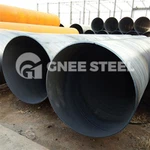


API 5L Spiral Welded Pipe
API 5L Spiral Welded Pipe: Complete Guide to Specifications, Grades, and Applications
This guide covers the manufacturing process, API 5L standard framework, steel grade selection, dimensional capabilities, quality control, applications, and how API 5L compares to alternative standards. It's written for engineers, procurement professionals, and project managers working in oil and gas, water transmission, and infrastructure.
1. What Is API 5L Spiral Welded Pipe?
API 5L spiral welded pipe starts as hot-rolled steel strip, fed into a forming unit at a controlled angle. The strip is continuously rolled into a tube, and the helical seam is welded - inside and out - using submerged arc welding (SAW). In SAW, the arc is shielded under a layer of granular flux, which keeps the atmosphere away from the weld pool.
Three things set spiral welded pipe apart from longitudinal welded pipe:
Helical weld seam: The weld runs in a continuous spiral along the pipe body. Under internal pressure and bending loads, stress distributes more evenly along a spiral than a straight longitudinal seam.
Material efficiency: Narrower steel coil can produce much larger-diameter pipes. Adjust the forming angle, and one coil width can yield multiple diameters.
Diameter range: Spiral welding dominates for pipes with outside diameters from 219.1 mm (8.625 in) up to 3500 mm (138 in). At these sizes, longitudinal welded pipe becomes economically impractical.
API 5L - formally API Specification 5L, "Line Pipe" - is the international standard for line pipe used in petroleum and natural gas transportation. Published by the American Petroleum Institute, the current 46th Edition (effective November 1, 2018) specifies chemical composition, mechanical properties, non-destructive testing, hydrostatic pressure testing, and dimensional tolerances for both seamless and welded pipe.
2. Steel Grades and Mechanical Properties
API 5L covers a range of steel grades, each identified by its minimum yield strength. The "X-grade" designation (US customary) and "L-grade" designation (ISO metric) refer to the same requirements. The most commonly specified grades for spiral welded pipe are:
| Grade (USC) | Grade (ISO) | Min. Yield Strength (MPa / ksi) | Min. Tensile Strength (MPa / ksi) | Typical Application |
|---|---|---|---|---|
| Grade B | L245 | 245 / 35.5 | 415 / 60.2 | Low‑pressure water & gas, general conveyance |
| X42 | L290 | 290 / 42.1 | 415 / 60.2 | Moderate‑pressure oil & gas gathering lines |
| X46 | L320 | 320 / 46.4 | 435 / 63.1 | Intermediate‑pressure transmission lines |
| X52 | L360 | 360 / 52.2 | 460 / 66.7 | Standard onshore gas transmission |
| X56 | L390 | 390 / 56.6 | 490 / 71.1 | Higher‑pressure onshore transmission |
| X60 | L415 | 415 / 60.2 | 520 / 75.4 | High‑pressure trunk lines |
| X65 | L450 | 450 / 65.3 | 535 / 77.6 | Major cross‑country gas transmission |
| X70 | L485 | 485 / 70.3 | 570 / 82.7 | High‑pressure long‑distance gas trunk lines |
| X80 | L555 | 555 / 80.5 | 625 / 90.6 | Ultra‑high‑pressure gas transmission; PSL2 only |
A note on PSL2: All PSL2 grades also specify a maximum yield strength and a maximum yield-to-tensile ratio (Y/T ≤ 0.93 for OD > 323.9 mm). This upper bound prevents the mill from producing pipe that's too hard for field welding. PSL1 has no such cap - a PSL1 Grade B pipe could show a yield strength of 400 MPa and still be fully compliant, which has real implications for girth weld integrity if the designer hasn't accounted for it.
Request Technical Quotation & Specification Review
3. Dimensional Specifications
API 5L spiral welded pipe offers the widest diameter range of any welded pipe method. The table below reflects typical manufacturing capabilities rather than hard standard limits - individual mill capacities may differ.
| Parameter | Typical Range | Notes |
|---|---|---|
| Outside Diameter | 219.1 mm – 3500 mm (8.625 in – 138 in) | Diameters above 2540 mm (100 in) require specialized forming equipment |
| Wall Thickness | 6 mm – 25.4 mm (0.236 in – 1.000 in) | Thicker walls up to 30 mm available on request for certain diameters |
| Length | 6 m – 18 m (20 ft – 60 ft) | 24 m (80 ft) lengths available; subject to transport constraints |
| Diameter tolerance (PSL1) | ±0.75% of OD (OD ≤ 610 mm); ±1.0% (OD > 610 mm) | Per API 5L 46th Ed., Table 9 |
| Wall thickness tolerance | +15% / −12.5% of specified WT | Per API 5L 46th Ed., Table 10 |
| Ovality (pipe body) | Max. 2% of OD (OD ≤ 610 mm); max. 1.5% (OD > 610 mm with D/t ≤ 75) | Stricter at pipe ends |
3.1 Common Diameter‑to‑Wall Thickness Combinations
| Nominal OD (in) | Nominal OD (mm) | Common Wall Thickness Range (mm) | Common Grades |
|---|---|---|---|
| 8 | 219.1 | 6 – 12 | Gr.B, X42 |
| 12 | 323.9 | 6 – 16 | X42, X52 |
| 16 | 406.4 | 6 – 20 | X52, X56, X60 |
| 20 | 508.0 | 6 – 22 | X52, X60, X65 |
| 24 | 610.0 | 6 – 25 | X60, X65, X70 |
| 32 | 813.0 | 8 – 25 | X65, X70 |
| 40 | 1016.0 | 8 – 25 | X65, X70 |
| 48 | 1219.0 | 10 – 25 | X65, X70 |
| 56 | 1422.0 | 10 – 25 | X70 |
| 64 | 1626.0 | 10 – 25 | X70 |
| 72 – 138 | 1829 – 3500 | 10 – 25.4 | X70 |

4. Manufacturing Process: How SSAW Pipe Is Produced
The SSAW process runs on a continuous production line with five main stages:
4.1 Steel Coil Preparation
Hot-rolled steel coil arrives from qualified mills with full Material Test Certificates (EN 10204 Type 3.1 or equivalent). The coil is uncoiled and leveled. Incoming inspection checks chemical composition - including carbon equivalent (CE) - against the ordered grade and PSL level. Coil edges are trimmed and beveled for welding.
4.2 Spiral Forming
The leveled strip enters the forming machine at a precisely controlled feed angle. That angle determines the relationship between strip width and finished pipe diameter: a narrower strip at a steeper angle produces a larger pipe. Modern forming units hold ovality within 1% of nominal OD for pipes up to 1422 mm, meeting API 5L dimensional tolerances.
4.3 Double‑Sided Submerged Arc Welding (DSAW)
Internal welding comes first, followed immediately by external welding. This sequence ensures full penetration and reduces the risk of incomplete fusion. The submerged arc process feeds a continuous wire electrode under granulated flux. Key parameters - welding current, arc voltage, travel speed, heat input - are monitored and recorded in real time. The heat-affected zone (HAZ) is controlled to maintain the mechanical properties of the ordered grade.
4.4 Finishing and Cutting
The continuously welded pipe is cut to ordered lengths (typically 6–18 m, with 24 m available on request). Pipe ends are beveled to standard API 5L angles for field girth welding. External weld reinforcement is held within 0.5–2.5 mm, depending on wall thickness.
4.5 Inspection and Testing
Every meter of weld undergoes online ultrasonic testing (UT). Pipe ends get radiographic testing (RT) or X-ray on top of that. Each pipe is hydrostatically tested. Samples from each production lot go through destructive mechanical testing - tensile, bend, and Charpy V-notch impact testing as required by the PSL level.
5. API 5L Standard Framework: PSL1 vs. PSL2
API 5L defines two Product Specification Levels: PSL1 and PSL2. Getting this right at the procurement stage matters. A pipe ordered as "API 5L Grade B" without specifying PSL2 defaults to PSL1 - and a PSL1 pipe cannot be upgraded to PSL2 through additional testing after the fact.
| Requirement | PSL1 | PSL2 |
|---|---|---|
| Chemical composition | Maximum limits for C, Mn, P, S | Tighter limits; mandatory carbon equivalent (CE) limit; maximum S ≤ 0.015% (vs. 0.030% for PSL1) |
| Yield strength | Minimum only | Minimum AND maximum limits |
| Tensile strength | Minimum only | Minimum AND maximum limits |
| Yield‑to‑tensile ratio | Not specified | Maximum 0.93 (for OD > 323.9 mm) |
| Charpy V‑notch impact testing | Not required | Mandatory for all pipe body and weld seam |
| Non‑destructive testing | Referenced; purchaser option | Mandatory 100% of weld seam |
| Traceability | Basic heat traceability | Full traceability from heat to finished pipe |
| Hydrostatic testing | Required | Required |
| Weld repair limits | Limited restrictions | Stricter limits; no weld repair permitted on certain grades |
When to specify PSL2: Any pipeline under high pressure, in populated areas (ASME B31.8 Class 2 or higher), in sour service, offshore, or where strain-based design applies. PSL1 is fine for low-pressure gathering lines, moderate-pressure water transmission, and non-critical applications with low risk.
6. API 5L vs. ASTM A252: Selecting the Right Standard for Spiral Welded Pipe
Both API 5L and ASTM A252 can cover spiral welded pipes made by the same process, but they serve fundamentally different purposes. Confusing the two can mean pipe gets installed where it hasn't been qualified.
| Attribute | API 5L | ASTM A252 |
|---|---|---|
| Primary application | Pipeline transportation of oil, gas, and water under internal pressure | Steel pipe piles for structural foundation and load‑bearing |
| Core design concern | Pressure containment and leak‑tightness | Axial and lateral load resistance; structural integrity |
| Chemical composition control | Strictly specified; carbon equivalent limits for PSL2 | Minimal; composition is at the manufacturer's discretion subject to meeting mechanical properties |
| Hydrostatic testing | Mandatory for every pipe | Not required |
| NDT of weld seam | 100% UT mandatory for PSL2; recommended for PSL1 | Not specified |
| Charpy impact testing | Mandatory for all PSL2 pipe | Not required |
| Grades offered | B, X42–X80 (with defined strength ranges) | Gr. 1, 2, 3 (minimum yield: 175–310 MPa) |
| Interchangeability | Not interchangeable without full technical re‑qualification. | |
Practical guidance: If the pipe carries pressurized fluid, specify API 5L. If it's going into the ground as a structural pile, specify ASTM A252. Some projects use API 5L for structural work where extra toughness and documented material properties are needed - seismic zones, for example - but this needs explicit justification in the project spec. An ASTM A252 pipe should never be substituted into API 5L pressure service without complete re-certification; it's rarely worth the cost.
7. Applications of API 5L Spiral Welded Pipe
Large diameters, high-strength grades, and rigorous quality control make API 5L spiral welded pipe the standard choice for:
Oil and gas transmission: Cross-country trunk lines moving crude oil, refined products, and natural gas at medium to high pressure. X52 through X70 dominate onshore gas transmission; X80 is specified for ultra-high-pressure lines where saving wall thickness justifies the extra welding procedure qualification.
Water transmission and distribution: Large-diameter water mains, raw water intake lines, cooling water systems for power plants. Grade B and X42 are typical for moderate-pressure water service.
Offshore and subsea pipelines: API 5L PSL2 with supplementary requirements per Annex J (offshore service) for risers, flowlines, and subsea tie-backs.
Sour service: PSL2 with Annex H requirements for H₂S environments, plus hardness testing and SSC resistance verification per NACE MR0175/ISO 15156.
Structural and piling: Where API 5L is chosen for structural work (foundation piles, marine structures, bridge piers) because of its documented toughness and weldability, often combined with ASTM A252 mechanical requirements.
Slurry and mining pipelines: Mineral slurries, tailings, dredge materials - large diameters with abrasion-resistant internal coatings.
8. Advantages of API 5L Spiral Welded Pipe
Several factors explain why spiral welded pipe dominates large-diameter pipeline construction:
Wider diameter range: A single production line can produce pipes from 219 mm to over 3000 mm OD by adjusting the forming angle. Longitudinal welded pipe (LSAW) is constrained by available plate width.
Material and cost efficiency: Narrow strip produces large-diameter pipe, cutting raw material cost. Spiral welded pipe is typically 10–15% cheaper per ton than LSAW of equivalent diameter and grade.
Flexible production: Switching from one diameter to another only takes an angle adjustment - no retooling needed. This makes small-batch and custom-size production efficient.
Structural performance: The helical weld seam distributes stress evenly under internal pressure, and the continuous forming process yields excellent roundness and wall thickness uniformity at large diameters.
Length flexibility: Continuous production allows lengths up to 24 m, which means fewer field girth welds during pipeline construction - a real cost and schedule advantage.
9. Surface Protection and Coating Options

API 5L covers the pipe in its bare condition. External coating and internal lining fall under separate standards, but they're routinely applied as part of a complete supply package:
| Coating / Lining Type | Standard Reference | Typical Application |
|---|---|---|
| 3‑Layer Polyethylene (3PE / 3LPE) | ISO 21809‑1, DIN 30670 | Buried onshore pipelines - oil and gas |
| 3‑Layer Polypropylene (3PP / 3LPP) | ISO 21809‑1 | High‑temperature service (up to 140 °C) |
| Fusion Bonded Epoxy (FBE) | ISO 21809‑2, AWWA C213 | Standard onshore and offshore anti‑corrosion |
| Coal Tar Enamel (CTE) | AWWA C203 | Water pipelines (legacy, declining usage) |
| Cement Mortar Lining (CML) | AWWA C205 | Internal lining for water transmission - provides hydraulic smoothness and corrosion protection |
| Liquid Epoxy Lining | AWWA C210 | Internal lining for water, wastewater, and some chemical service |
Need external coating & internal lining solution? Request complete coating specification sheet
10. Quality Control and Testing Requirements
API 5L imposes a thorough quality assurance framework. For spiral welded pipe in pressure service, the following stages are non-negotiable. The exact scope - especially for NDT and impact testing - depends on the PSL level and any supplementary requirements in the purchase order.
10.1 Raw Material Verification
Each coil must be traceable to a heat number with a Material Test Certificate (MTC) documenting chemical composition. Incoming inspection typically includes independent verification of carbon equivalent (CEIIW or CEPcm) to confirm weldability. For PSL2 pipe headed to sour service, additional sulfur restrictions (S ≤ 0.002–0.005%) and micro-alloying controls apply per API 5L Annex H.
10.2 Non‑Destructive Testing (NDT)
100% of the spiral weld seam goes through automated ultrasonic testing (UT) on the production line. UT catches internal flaws - lack of fusion, slag inclusions, porosity, cracks - in real time. Pipe ends (roughly 200 mm from each end) also get radiographic testing (RT) or X-ray, with images kept for customer review. For PSL2, NDT is mandatory; for PSL1, it's referenced as a purchaser option, though most modern procurement specs include it regardless.
10.3 Hydrostatic Testing
Every pipe is hydrostatically tested. Test pressure is calculated to produce a hoop stress equal to a specified percentage of SMYS - typically 60% to 95%, depending on grade, diameter, and application. Pressure is held for a minimum of 5 to 10 seconds with an automatic pressure recorder. No leakage or visible deformation is permitted.
10.4 Destructive Mechanical Testing
Samples are taken from each test lot (typically per heat, per wall thickness, per 100 pipes) and run through:
Tensile test (pipe body transverse): Verifies yield strength, tensile strength, elongation
Weld tensile test: Verifies the weld seam meets or exceeds the base material's minimum tensile strength
Guided bend test (face and root bends): Verifies weld ductility - no crack exceeding 3 mm in any direction allowed
Charpy V-notch impact test (PSL2 only): At the specified test temperature (commonly 0°C, −10°C, −20°C, or lower for arctic-grade). Minimum absorbed energy values are grade-dependent, typically starting at 27 J average per API 5L Table 17
Metallographic examination: Macro-examination of the weld cross-section to verify penetration, fusion, and absence of harmful microstructures in the HAZ
API 5L Pipe MTC

Require full MTC EN10204 3.1 / third‑party witness inspection? Tell us your inspection requirements
11. FAQ
Q1: What does API 5L stand for?
API 5L is Specification 5L from the American Petroleum Institute (API). It's the global standard for seamless and welded steel line pipe used to transport oil, natural gas, and water in the petroleum and natural gas industries. The current edition is the 46th, published April 2018, effective November 1, 2018.
Q2: What is the difference between SSAW and LSAW pipe?
SSAW (Spiral Submerged Arc Welded) pipe is formed by rolling steel coil at a helical angle and welding along the spiral seam. LSAW (Longitudinal Submerged Arc Welded) is formed by bending steel plate into a cylinder and welding a single straight longitudinal seam. SSAW can produce larger diameters from narrower raw material, handles diameter changes more flexibly, and costs 10–15% less per ton. LSAW is preferred for thick-walled pipe (above 25 mm) and grades X70 and above, where plate metallurgy is more consistent than coil metallurgy.
Q3: What is the difference between PSL1 and PSL2 in API 5L?
PSL2 takes everything PSL1 requires and adds: maximum limits on yield and tensile strength, a maximum Y/T ratio of 0.93, mandatory Charpy V-notch impact testing on every heat, mandatory 100% NDT of the weld seam, tighter chemistry limits (including mandatory carbon equivalent), and stricter traceability. PSL2 is needed for high-pressure pipelines, sour service, offshore, and any application where fracture toughness and consistent properties are safety-critical. PSL1 is fine for low-pressure, low-consequence applications.
Q4: What is the maximum diameter available for API 5L spiral welded pipe?
Major manufacturers can produce up to 3500 mm (138 in) OD. Most standard production equipment handles up to 2540 mm (100 in). Diameters above 3000 mm usually need specialized forming mills - confirm with the manufacturer during inquiry.
Q5: Can API 5L spiral welded pipe be used for structural piling?
Yes, if the project specification explicitly allows it and the pipe meets the required mechanical properties. But ASTM A252 is purpose-built for steel pipe piles, and using API 5L for piling may add cost through chemistry controls, hydrostatic testing, and NDT that don't add value structurally. The substitution works better in one direction: API 5L for structural is fine; ASTM A252 for pressure service is not - that requires complete re-qualification.
Q6: What is the typical delivery time for API 5L spiral welded pipe?
Standard sizes and grades (Gr.B to X52, standard wall thicknesses) usually ship within 30–60 days from order confirmation. Higher grades (X65–X70), PSL2 with extra testing, non-standard dimensions, and coating/lining packages can push lead times to 60–120 days. X80 or sour service (Annex H) orders need additional qualification time - allow 90–150 days.
Q7: What NDT methods are used on API 5L spiral welded pipe?
The primary methods are automated ultrasonic testing (UT) for 100% of the weld seam on the production line - catching internal flaws like lack of fusion, slag inclusions, porosity, and cracks - and radiographic testing (RT/X-ray) at pipe ends and any location flagged by UT. For PSL2, NDT is mandatory. Magnetic particle inspection (MPI) and dye penetrant testing (PT) may supplement surface inspection of weld repairs.
Q8: How do I verify that pipe delivered as API 5L actually meets the standard?
Request the manufacturer's Material Test Certificates (MTCs) to EN 10204 Type 3.1, which document chemistry and mechanical test results per heat and test lot. Third-party inspection by Bureau Veritas, SGS, or TÜV can witness mill testing and countersign certificates. For critical projects, specify API-licensed manufacturers (API Monogram program) and ask for valid APIQR certification.
Q9: Does API 5L cover coating and lining?
No. API 5L covers bare pipe. External anti-corrosion coatings (3PE, FBE, 3PP) are covered by ISO 21809, DIN 30670, and AWWA standards. Internal linings (cement mortar, liquid epoxy) are covered by AWWA C205 and AWWA C210. Coating and lining must be specified separately in the purchase order, with the applicable standard, coating thickness, adhesion test requirements, and holiday detection criteria.
Q10: What is the weight of API 5L spiral welded pipe per meter?
Nominal weight: W = (OD − WT) × WT × 0.02466, where OD is in mm, WT is in mm, result in kg/m. Example: 610 mm OD × 12 mm WT → (610 − 12) × 12 × 0.02466 ≈ 177.0 kg/m. Actual weight may vary within the −3.5% / +10% mass tolerance allowed by API 5L.
12. Conclusion
API 5L spiral welded pipe is the workhorse of large-diameter pipeline infrastructure. Its flexible manufacturing, wide diameter range, well-defined steel grades, and the quality framework of API Specification 5L (46th Edition) make it the default - and often the only practical - choice for cross-country oil and gas transmission, large-scale water distribution, and industrial piping projects needing diameters above 24 inches.
Getting procurement right comes down to three things: specifying the correct grade and PSL level, understanding the testing and documentation that come with the ordered PSL, and distinguishing API 5L from structural standards like ASTM A252. The PSL1/PSL2 distinction in particular is a common source of specification errors - and getting it wrong in pressure-critical service has real safety and compliance consequences.
When sourcing, verify that the manufacturer holds valid API Monogram licensing, request and review full MTCs for each shipment, and consider third-party inspection for critical or high-value orders. The cost of a mill audit or independent testing is negligible next to the cost of replacing or repairing non-conforming pipe after installation.
Disclaimer: This article is a technical reference guide. Always consult the full text of API Specification 5L, 46th Edition (2018), and the governing engineering code (ASME B31.4, ASME B31.8, or equivalent) for your specific project. Pipe specifications, available sizes, and lead times should be confirmed with individual manufacturers.
Hot Tags: api 5l spiral welded pipe, China api 5l spiral welded pipe manufacturers, suppliers, API 5L X52 PSL2 Spiral Welded Pipe, Welded Steel Pipe ASTM A139, SSAW Carbon Steel Tube, SSAW Steel Pipe, SSAW Pipe, Spiral Steel Pipe
You Might Also Like



Send Inquiry