


An STC thread, which stands for Short Round Thread Coupling, is a standard threaded and coupled connection governed by the API 5CT and API 5B specifications. It is one of the most traditional and widely used connections for casing in the oil and gas industry.
Searching for the most cost-effective casing connection? Get a factory-direct quote for API 5CT STC casing and slash your project budget today.
STC Thread Basic Geometric Design Parameters (API 5B)
STC uses a rounded "V" thread design aimed at improving fatigue resistance by reducing stress concentration.
| Parameter | Technical Standard | Remarks |
| Threads Per Inch (TPI) | 8 TPI | Rounded profile with fine threads. |
| Thread Profile | Rounded V | Both crests and roots are curved. |
| Included Angle | 60° | Standard symmetrical design. |
| Taper | 1:16 (0.0625 mm/mm) | Diameter change of 0.75 inches per foot. |
| Sealing Method | Interference + Thread Dope | Relies on taper compression for a metal-to-metal seal. |
STC Common Size and Dimensional Parameters (Imperial)
The "Short" in STC refers to its L4 (Total Thread Length). Below are the thread length parameters for common STC sizes:
| Pipe OD (Inches) | Total Thread Length ( L4 ) (Inches) | Hand-tight Engagement ( L1 ) (Inches) | Pitch Diameter at L1 ( E1 ) (Inches) |
| 4-1/2" | 2.000 | 1.000 | 4.412 |
| 5-1/2" | 2.125 | 1.125 | 5.412 |
| 7" | 2.250 | 1.250 | 6.912 |
| 8-5/8" | 2.500 | 1.500 | 8.537 |
| 9-5/8" | 2.625 | 1.625 | 9.537 |
| 10-3/4" | 2.875 | 1.875 | 10.662 |
| 13-3/8" | 3.125 | 2.125 | 13.287 |
| 20" | 3.625 | 2.625 | 19.912 |
STC Casing Grade and Color Identification Table
STC threads are typically used for low-load, low-to-medium strength steel grades.
| Steel Grade | Color Code | Min Yield Strength (psi) | Typical Application |
| H40 | None or Black | 40,000 | Shallow water wells, low-pressure surface casing. |
| J55 | Bright Green | 55,000 | Most common, shallow wells and standard drilling. |
| K55 | Two Bright Green | 55,000 | Similar to J55 but with slightly higher tensile strength. |
| N80-1 | Red | 80,000 | Surface or intermediate casing for medium-depth wells. |
STC vs. LTC Performance Comparison Table
This is the most common comparison in procurement. Both share the same thread shape but differ in length.
| Performance Metric | STC (Short Round) | LTC (Long Round) | Remarks |
| Engagement Length | Shorter | Longer | LTC increases thread contact area. |
| Tensile Efficiency | Lower (Approx. 60%) | Higher (Approx. 80%) | STC is prone to jump-out under heavy loads. |
| Sealing Reliability | Good | Better | LTC has a longer helical leakage path. |
| Manufacturing Cost | Lowest | Moderate | STC is the fastest and cheapest to machine. |
| Recommended Depth | < 1,500 Meters | 1,500 - 4,500 Meters | Depends on the total string weight. |
Key Characteristics
Thread Profile: It features a rounded "V" shape (where the crests and roots of the threads are curved). This design helps reduce stress concentration.
Threads Per Inch (TPI): It has 8 threads per inch.
Taper: It has a 1:16 taper, meaning the diameter of the threads narrows toward the end of the pipe, allowing them to wedge together when tightened.
Sealing: It relies on the interference fit between the tapered threads and the application of thread dope (a specialized sealant grease) to create a leak-proof seal.
Advantages
Economical: STC is the most cost-effective threading option because it is simple to machine and has the shortest threaded section.
Ease of Use: It is relatively easy to "make up" (screw together) at the rig site.
Standardization: As a basic API standard, STC pipes and couplings from different manufacturers are fully interchangeable.
Limitations
Lower Tensile Strength: Because the threaded section is "short," it has a smaller contact area compared to LTC (Long Round Thread). This makes it more susceptible to "thread jump-out" (the pipe pulling out of the coupling) under heavy weight.
Sealing Risks: Under high bending stress or extreme tension, the seal is more likely to fail compared to more robust connections like BTC or Premium threads.
Primary Applications
Shallow Wells: Ideal for wells where the casing string isn't long or heavy.
Surface Casing: Frequently used for the top-most sections of a wellbore where pressures are lower and structural requirements are standard.
Low-Pressure Environments: Suitable for water wells or low-pressure oil and gas projects.
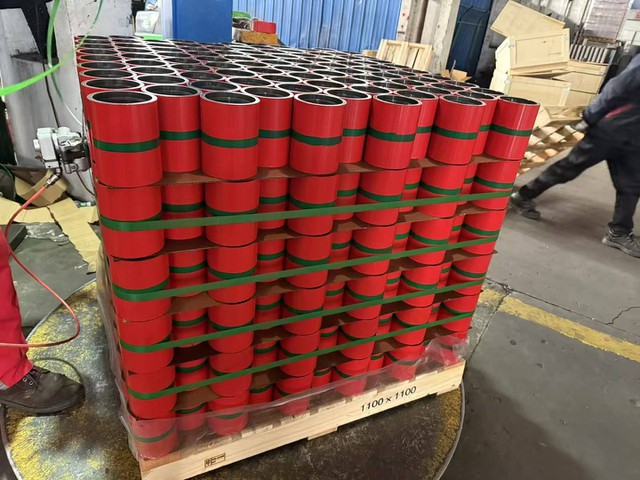
API Thread factory
FAQ
What is the difference between LTC and STC threads?
The core difference between LTC and STC lies in their thread length and tensile strength:
STC (Short Round Thread): Features a shorter threaded section. Due to its lower tensile strength, it is primarily used for shallow wells or surface casing subject to lighter loads, and it is the most economical option.
LTC (Long Round Thread): Features a longer threaded section with a larger engagement area. This provides superior tensile strength and enhanced sealing performance, making it the standard choice for medium-to-deep wells and routine operations.
What is an STC used for?
STC is primarily used for shallow wells, low-pressure environments, or surface casing. Because it is the most economical and easiest to install, it is ideal for short, light pipe strings where extreme tensile strength is not a priority, such as in standard water wells or the top-most sections of a wellbore.


