ASTM A252 is a standard for welded and seamless steel pipe piles developed by the American Society for Testing and Materials (ASTM). The latest version is ASTM A252/A252M-22. This standard specifies the materials, dimensions, properties, and testing requirements for steel pipe piles used for structural support, and is applicable to engineering fields such as building construction, bridges, and docks.
Applications
- Uses: Primarily used in deep foundation engineering, such as bridge pile foundations, high-rise building foundations, and port and wharf supports.
- Pipe Diameter and Wall Thickness:
- Nominal Pipe Diameter (NPS): Typically NPS 8 to 142 (approximately 219 mm to 3620 mm), specific dimensions refer to ANSI B36.10.
- Wall Thickness: Adjusted according to design requirements, common range is 6 mm to 25 mm.
- Steel Grade Classification:
- Gr.1: Yield strength ≥ 248 MPa (36 ksi), suitable for ordinary loads.
- Gr.2: Yield strength ≥ 345 MPa (50 ksi), suitable for medium loads.
- Gr.3: Yield strength ≥ 414 MPa (60 ksi), suitable for high loads or complex environments.
Performance Characteristics
- High Strength and Corrosion Resistance:
- Utilizing low-carbon steel or low-alloy steel (such as Q345B, API 5L X65), continuous welds are formed through a spiral welding process, resulting in uniform overall strength.
- Corrosion resistance can be enhanced and service life extended through 3PE coating, epoxy powder coating, or cathodic protection.
- Convenience of Construction:
- Spiral steel pipe piles can range in length from 5.8m to 30m, reducing on-site splicing work and improving construction efficiency.
- Rapid installation is possible through welding or flange connections, adapting to complex geological conditions.
- Seismic Resistance and Durability:
- Uniformly distributed spiral welds provide the steel pipe piles with good flexibility and impact resistance, making them suitable for earthquake-prone areas.
Welding Process and Quality Control
- Production Process:
1. Raw Material Inspection: The chemical composition and mechanical properties of the steel strip must meet ASTM A252 requirements.
2. Forming and Welding: The steel strip is formed by a spiral rolling machine and welded using submerged arc welding (SAW) or high-frequency welding (HFW) processes. The weld seams must be inspected by X-ray flaw detection.
3. Dimensional Calibration: Control the outer diameter and wall thickness tolerances (e.g., outer diameter deviation ±0.5%, wall thickness deviation ±10%).
4. Performance Testing: Conduct hydrostatic testing (pressure ≥ 1.5 times the design pressure), tensile testing, bending testing, etc.
- Corrosion Protection:
The surface rust removal grade must reach Sa2.5 (near-white). The coating thickness is selected according to environmental requirements (e.g., 3PE coating thickness ≥ 2.5mm).
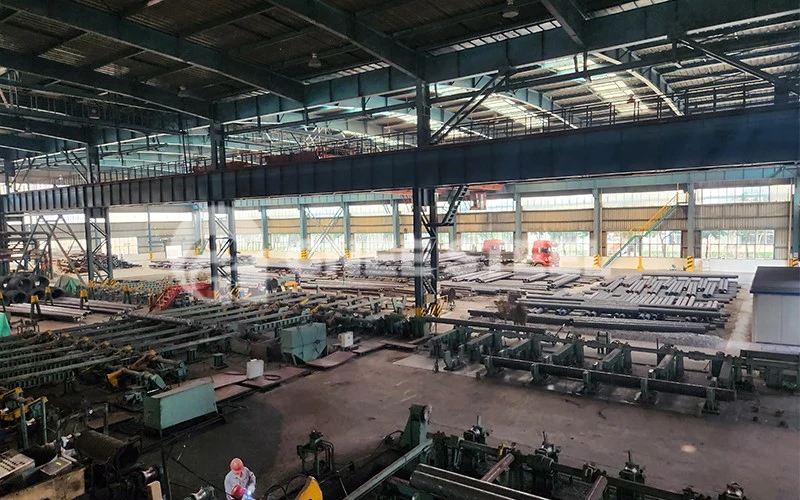
A252 GR3 piling pipe factory