


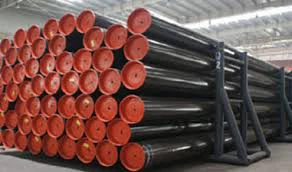


1. What is ASTM A106 Gr.B?
ASTM A106 Gr.B is a specification for seamless carbon steel pipe intended for high-temperature service. The "seamless" manufacturing process (explained below) gives it a homogeneous structure without a welded seam, making it inherently stronger and more reliable for critical applications involving high pressure.
2. Key Applications
This pipe is the workhorse of several industries:
Power Generation: Steam lines, boiler tubes, and feedwater lines in fossil fuel and nuclear power plants.
Oil & Gas Refining: Pipelines for crude oil, process fluids, and refinery gases.
Petrochemical Plants: Transporting process chemicals and hydrocarbons at elevated temperatures.
Pressure Vessel Systems: For interconnecting vessels and heat exchangers.
3. Chemical Composition & Mechanical Properties
The properties of Grade B are defined by its chemical composition and mechanical strength.
Chemical Composition (Requirements, % max):
| Element | Grade B |
|---|---|
| Carbon (C) | 0.30 |
| Manganese (Mn) | 1.06 |
| Phosphorus (P) | 0.035 |
| Sulfur (S) | 0.035 |
| Silicon (Si) | 0.10 |
| Chromium (Cr) | 0.40 |
| Copper (Cu) | 0.40 |
| Molybdenum (Mo) | 0.15 |
| Nickel (Ni) | 0.40 |
| Vanadium (V) | 0.08 |
Note: The relatively low carbon content contributes to good weldability.
Mechanical Properties (Requirements):
| Property | Grade B |
|---|---|
| Tensile Strength, min | 415 MPa (60,000 psi) |
| Yield Strength, min | 240 MPa (35,000 psi) |
| Elongation, min | Varies with wall thickness |
4. Manufacturing Process: Why "Seamless" Matters
Seamless pipes are made by piercing a solid billet of steel to create a hollow shell (a "mother tube"). This is typically done using a rotary piercing mill (like the Mannesmann process). The tube is then elongated and rolled to the final size.
Advantages of Seamless Pipes:
No Weak Seam: Eliminates the risk of weld seam failure under high stress or corrosion.
Uniform Strength: The structure is consistent around the entire circumference.
Better for High Pressure: Withstands higher internal pressures than an equivalent welded pipe.
More Predictable Under Corrosion: Less risk of localized corrosion at a weld line.
5. Grades Comparison: A106 Grade A vs. B vs. C
The ASTM A106 standard includes three grades with increasing strength levels.
| Feature | Grade A | Grade B | Grade C |
|---|---|---|---|
| Tensile Strength (min) | 330 MPa (48,000 psi) | 415 MPa (60,000 psi) | 485 MPa (70,000 psi) |
| Yield Strength (min) | 205 MPa (30,000 psi) | 240 MPa (35,000 psi) | 275 MPa (40,000 psi) |
| Carbon Content (max) | 0.25% | 0.30% | 0.35% |
| Common Use | Low-pressure, low-stress applications | Most common, general high-temp service | Higher pressure/thickness requirements |
| Cost | Lower | Moderate (Best Value) | Higher |
Why is Grade B the most popular? It offers the best balance: sufficient strength for most applications without the need for the higher carbon content of Grade C, which can make welding more complex and expensive.
6. Key Differences: ASTM A106 vs. ASTM A53
This is a very common question. Both are carbon steel pipes, but with different focuses.
| Feature | ASTM A106 | ASTM A53 |
|---|---|---|
| Service | High-Temperature (up to ~750°F / 400°C) | Ambient Temperature |
| Types | Seamless only (Types S & F) | Seamless (Type S) and Welded (Type E & F) |
| Chemistry | Tighter controls on carbon & manganese for high-temp strength | More relaxed chemistry |
| Common Use | Power plants, refineries, process lines | Structural, low-pressure plumbing, air/water lines |
Simple Rule of Thumb: Use A53 for general, low-temperature structural and plumbing purposes. Use A106 when the pipe will carry hot media (steam, hot oil) or operate under high pressure.
7. Available Sizes and Dimensions
ASTM A106 Gr.B pipes are available in a wide range of sizes:
Nominal Pipe Size (NPS): From NPS 1/8" (10.3mm OD) up to NPS 48" (1219mm OD) and larger for some manufacturers.
Schedules (Wall Thickness): Common schedules include SCH 40, SCH 80, SCH 160, and XXS (Double Extra Strong).
Conclusion
ASTM A106 Grade B Seamless Steel Pipe is a premium, high-performance piping material chosen for its reliability, strength, and safety in demanding high-temperature and high-pressure environments. Its seamless nature and carefully controlled chemistry make it the default standard for critical applications in the power, oil, gas, and chemical industries.


