


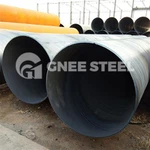


API 5L X56 PSL 1 Pipe
Type:ERW/ LSAW/ DSAW/ Welded
MOQ: 30 Tons
API 5L X56 PSL1 Welded Pipe Description
API 5L X56 PSL1 welded steel pipe is made of high-strength carbon steel, with a yield strength ranging from 390 MPa to 540 MPa, a tensile strength of ≥490 MPa to 760 MPa, and a yield ratio of ≤0.93.
API 5L X56 PSL1 Welding Tubes Specification
| Type | LSAW Pipes (Longitudinal Submerged Arc Welded Pipes), HSAW Pipes (Helical Submerged Arc Welded Pipes), DSAW Pipes (Double Submerged Arc Welded Pipes), SSAW Pipes (Spiral Submerged Arc Welded Pipes) |
| Outer Diameter Size | 12" NB To 150" NB (Nominal Bore Size) |
| Wall Thickness | Schedule 20 To Schedule XXS (Heavier On Request) Up to 250 mm Thickness |
| Length | 5 To 7 Meters, 09 To 13 Meters, Single Random Length, Double Random Length And Customize Size. |
| Pipe Ends | Plain Ends / Beveled Ends / Coupling |
| Surface Coating | Epoxy Coating / Colour Paint Coating / 3LPE Coating. |
| Packaging | Loose / Bundle / Wooden Pallet / Wooden Box / Plastic Cloth Wraps / Plastic End Caps / Beveled Protector |
API 5L X56 PSL1 Welded Steel Pipe


Non-destructive Testing of API 5L X56 PSL1 Longitudinal Welded Pipe
Magnetic Testing
Magnetic testing can only detect surface and near-surface defects of API 5L X56 PSL1 longitudinal welded pipes and can only perform quantitative analysis of defects. The nature and depth of defects can only be estimated based on experience. Magnetic testing detects defects using the leakage of magnetic fields generated by magnetizing ferromagnetic API 5L X56 PSL1 longitudinal welded pipes. Depending on the method of measuring the leakage field, it can be divided into magnetic particle testing, magnetic induction testing, and magnetic recording testing, with magnetic particle testing being the most widely used.
Penetration Testing
Penetration testing uses the physical properties of certain liquids' permeability to detect and display defects. This includes dye penetrant inspection and fluorescent penetrant inspection, which can be used to inspect surface defects of both ferromagnetic and non-ferromagnetic materials.
Radiographic Testing
Radiographic testing is a method that uses the penetrative and attenuating properties of radiation in materials to detect defects. Depending on the type of radiation used, it can be divided into X-ray testing, γ-ray testing, and high-energy ray testing. Each type of radiographic testing can further be divided into ionization method, fluorescent screen observation method, photographic method, and industrial television method, based on how defects are displayed. Radiographic inspection is primarily used to detect internal defects in the welds of API 5L X56 PSL1 longitudinal welded pipes, such as cracks, lack of fusion, porosity, and slag inclusions.
Ultrasonic Testing
Ultrasonic testing detects internal defects by using the reflection of ultrasonic waves at the interfaces of different media. Ultrasonic testing can inspect defects in any material and at any location within the weld, and it can detect defect locations with high sensitivity. However, determining the nature, shape, and size of the defects is challenging. Therefore, ultrasonic testing of API 5L X56 PSL1 longitudinal welded pipes is often used in conjunction with radiographic testing.
Hot Tags: api 5l x56 psl 1 pipe, China api 5l x56 psl 1 pipe manufacturers, suppliers, ERW Pipes, EN 10219, steel pipe, ASTM A334 Gr 1 carbon steel seamless pipe, Resistance welded pipes, A691 Alloy ERW Pipe
Previous
API 5L X60 ERW Carbon Steel PipeYou Might Also Like


Send Inquiry