


BTC (Buttress Thread) and LTC (Long Round Thread) represent the two most prevalent casing connection solutions under the API 5CT standard. BTC, with its unique trapezoidal geometry, delivers exceptionally high tensile strength; it is specifically engineered to support heavy-duty pipe strings in deep wells, effectively preventing disconnection under extreme loads. Conversely, LTC ensures superior sealing integrity and reliability through its extended round threads, making it the most cost-effective and versatile "all-rounder" choice for medium-to-deep wells and conventional drilling operations.
Unsure whether to choose BTC or LTC for your project? Consult our technical experts for a free thread selection guide and load-bearing analysis today.
BTC (Buttress Thread Coupling)
BTC is a high-strength connection designed to handle extreme axial tensile loads.
Thread Profile: Features a trapezoidal (or square-cut) design. The threads appear as a series of interlocking steps or "buttresses."
Technical Specifications: Typically has 5 threads per inch (5 TPI).
Key Advantages:
Extreme Tensile Strength: Due to its trapezoidal structure, BTC can withstand massive vertical tension (such as the weight of a pipe string several kilometers long). This design effectively prevents "thread jump-out" under heavy loads.
Good Compression Resistance: It also performs exceptionally well under high axial compression stress.
Fast Make-up: The coarser threads allow for quicker assembly (makeup) at the rig site.
Applications: Primarily used for deep wells, ultra-deep wells, and long, heavy casing strings. It is the industry standard for high-load environments.
LTC (Long Round Thread Coupling)
LTC is an improved version of the traditional round thread, designed to balance sealing integrity and structural strength.
Thread Profile: Features a rounded "V" thread profile, where both the crests and roots of the threads are curved.
Technical Specifications: Typically has 8 threads per inch (8 TPI). The "Long" refers to the fact that the threaded section is longer than that of a Short Round Thread (STC).
Key Advantages:
Excellent Sealing: The rounded threads, when combined with thread dope, provide a superior metal-to-metal seal, effectively preventing fluid or gas leaks.
Standard Strength: The increased thread engagement (compared to STC) provides enough tensile strength for most standard drilling operations.
Reliability & Economy: It is a mature, cost-effective technology that offers high reliability for everyday use.
Applications: Widely used in medium-depth wells and standard vertical drilling. It is one of the most commonly used thread types in global oilfields due to its balanced performance.
The main difference between BTC (Buttress Thread Casing) and LTC (Long Round Thread Casing) lies in their thread geometry and their load-bearing capacity. While both are governed by the API 5CT standard, they are used for different well conditions.
Here is a detailed comparison:
Thread Profile (Shape)
LTC: Features a rounded "V" thread profile. It is essentially a longer version of the standard Short Thread (STC).
BTC: Features a trapezoidal (square-cut) thread profile. The threads look like a series of interlocking steps or "buttresses."
Threads Per Inch (TPI)
LTC: Has 8 threads per inch. The finer threads provide good engagement but are more susceptible to damage during handling.
BTC: Has 5 threads per inch. These coarser threads are more robust and can be "made up" (screwed together) more quickly at the rig site.
Tensile Strength (Load Capacity)
LTC: Offers good tensile strength, suitable for medium-depth wells. However, under extreme axial tension (the weight of a very long pipe string), rounded threads can theoretically "jump" or pull out of the coupling.
BTC: Offers superior tensile strength. The square-cut profile "locks" the pipe and coupling together much more effectively. It is specifically designed to prevent "thread jump-out" under the immense weight of deep-well casing strings.
Sealing Performance
LTC: Relies on the interference fit of the tapered rounded threads and the application of thread dope to create a seal. It is generally suitable for standard pressure environments.
BTC: Also relies on thread interference and dope, but its geometry provides slightly better leak resistance under high internal and external pressures compared to round threads.
Primary Application
LTC: The "workhorse" for medium-depth wells and standard vertical drilling where costs need to be balanced with reliable performance.
BTC: The industry standard for deep wells, high-pressure wells, and long casing strings where the pipe weight is a critical factor.
Comparison Summary Table
| Feature | LTC (Long Round Thread) | BTC (Buttress Thread) |
| Thread Shape | Rounded "V" | Trapezoidal / Square-cut |
| Threads Per Inch | 8 TPI | 5 TPI |
| Tensile Strength | High (Standard) | Highest (Heavy Duty) |
| Make-up Speed | Moderate | Fast |
| Risk of Jump-out | Low to Moderate | Very Low |
| Best Application | Medium-depth wells | Deep, heavy, high-pressure wells |
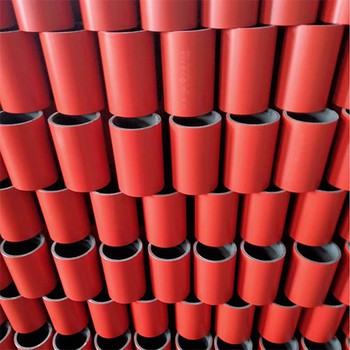
API 5CT Couplings factory
FAQ
What is a BTC thread?
BTC (Buttress Thread)-also known as an asymmetrical trapezoidal thread-is an API-standard casing connection specifically engineered to withstand extremely high tensile forces and heavy loads. It features a unique trapezoidal cross-section design that allows it to interlock tightly-much like a traditional mortise-and-tenon joint-when supporting the immense self-weight of a pipe string extending thousands of meters deep; this effectively prevents thread slippage or jump-out under extreme tensile stress. Due to its exceptional structural strength and reliable load-bearing capacity, BTC has become the industry-standard connection solution for deep wells, high-pressure wells, and heavy-duty casing string operations.
What is LTC thread?
LTC (Long Round Thread) is a standard casing connection featuring a rounded "V" thread profile with 8 threads per inch. By utilizing a longer engagement length compared to Short Round Threads, it achieves superior tensile strength and excellent sealing performance. Due to its ability to balance structural reliability with cost-effectiveness, LTC has become the most popular "all-around" connection solution for medium-to-deep wells and conventional drilling operations.


