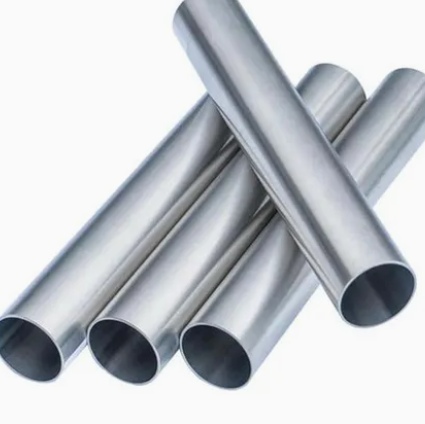

1. **What is a mild steel pipe?**
Mild steel pipe is a pipe made from **low-carbon steel** (typically containing less than 0.25% carbon). It's characterized by its relatively **high strength, good formability, weldability, and machinability**, but **low corrosion resistance** compared to alloys like stainless steel. It's the most common and economical type of carbon steel pipe used for structural and fluid conveyance applications where high strength or corrosion resistance isn't the primary requirement.
2. **Which is better, MS or GI?**
Neither is universally "better"; the choice depends entirely on the **application**:
* **Mild Steel (MS):** Better for **structural applications** (frames, supports, scaffolding) where high strength and weldability are critical, and corrosion isn't a major factor, or where the pipe will be painted/coated separately. It's generally **less expensive** than GI.
* **Galvanized Iron (GI):** Better for **applications exposed to moisture or mild corrosive environments** (water lines, fencing, outdoor structures, some plumbing) because the zinc coating provides **corrosion resistance**. It sacrifices some weldability (zinc fumes are hazardous) and is typically **more expensive** than MS.
**Choose MS for strength/weldability indoors or where coated. Choose GI for corrosion resistance outdoors or in damp environments.**
3. **What is type S steel pipe?**
"Type S" steel pipe refers to a **specific grade of pipe defined by the ASTM A53 standard**. ASTM A53 covers seamless and welded black and hot-dipped galvanized steel pipe. Within this standard:
* **Type S** stands for **Seamless** pipe. It has no welded seam and is made by piercing a solid billet.
* **Type E** stands for **Electric Resistance Welded (ERW)** pipe, which has a welded seam.
* **Type F** stands for **Furnace Butt Welded (continuous weld)** pipe (less common today).
So, "Type S" specifically denotes **seamless pipe conforming to ASTM A53**, commonly used for pressure piping systems, mechanical applications, and utilities.
4. **Where is MS pipe used?**
Mild steel pipe is incredibly versatile and used in a vast range of applications, including:
* **Structural Frameworks:** Building frames, supports, columns, trusses, scaffolding.
* **Fluid Conveyance:** Water lines (often galvanized *after* fabrication), steam lines (low pressure), air lines, oil and gas lines (non-corrosive environments, often with coatings), fire sprinkler systems (often galvanized).
* **Mechanical Applications:** Machinery parts, rollers, sleeves, protective casings, automotive components.
* **Fencing and Railings:** Gates, fences, handrails (often painted or galvanized).
* **Piling:** Foundation support piles (driven into the ground).
* **General Fabrication:** Any application requiring a strong, formable, weldable, and economical steel tube.
5. **What is the difference between steel pipe and MS pipe?**
* **"Steel Pipe"** is a **very broad category** encompassing pipes made from *any* type of steel, including **Mild Steel (Low Carbon Steel), Medium Carbon Steel, High Carbon Steel, Alloy Steel (e.g., Chrome-Moly), and Stainless Steel**. It refers to the general product form (a hollow tube).
* **"MS Pipe" (Mild Steel Pipe)** is a **specific subset** of steel pipe. It refers *only* to pipes made from **low-carbon steel** (mild steel), characterized by its specific properties (good strength/formability/weldability, low cost, low corrosion resistance).
**In simple terms: All MS Pipe *is* Steel Pipe, but not all Steel Pipe is MS Pipe.** MS Pipe is defined by its *material composition* (low carbon steel), while "steel pipe" refers to the *form* and can be made from many different steel alloys.