


API Trapezoidal Thread Couplings, widely referred to as Buttress Thread Couplings (BTC), feature a specialized thread design where the thread profile is trapezoidal or sawtooth-shaped. This design is engineered to handle higher axial tensile or compressive loads compared to round threads.
Thread Profile: 3° load face and 10° stab face angles.
Key Advantages: High connection strength (nearly equal to the pipe body) and superior resistance to "pull-out" under extreme tension.
Primary Application: Ideal for deep-hole drilling, high-pressure environments, and long, heavy casing strings.
Engineered for the Deepest Wells: GNEE's BTC Couplings Provide Joint Strength Nearly Equal to the Pipe Body. Secure Your Well Integrity Today!
API Buttress (Trapezoidal) Thread Casing Coupling Dimensions
Note: BTC specifications typically range from 4-1/2" to 20". Below are the most common industry sizes.
| Casing OD (Size) | Thread Type | Coupling OD - W (in/mm) | Coupling Length - L (in/mm) | Diameter of Counterbore - Q (in/mm) |
| 4-1/2" | BTC | 5.000 (127.00) | 8.875 (225.43) | 4.635 (117.73) |
| 5-1/2" | BTC | 6.050 (153.67) | 9.250 (234.95) | 5.635 (143.13) |
| 7" | BTC | 7.656 (194.46) | 10.000 (254.00) | 7.135 (181.23) |
| 9-5/8" | BTC | 10.625 (269.88) | 10.625 (269.88) | 9.760 (247.90) |
| 13-3/8" | BTC | 14.375 (365.13) | 10.625 (269.88) | 13.510 (343.15) |
| 20" | BTC | 21.000 (533.40) | 10.625 (269.88) | 20.135 (511.43) |
API 5CT BTC Coupling Tolerance Requirements
BTC connections require high geometric precision to ensure stability under heavy loads.
| Item | Tolerance | Remarks |
| Coupling OD (W) | ±1% | Ensures proper fit within the wellbore. |
| Coupling Length (L) | ±1/8 inch (±3.18 mm) | Guarantees sufficient thread engagement. |
| Diameter of Counterbore (Q) | +0.031 in / -0 | Facilitates smooth entry of the casing pipe. |
| Thread Pitch | ±0.0015 in per inch | Standard for BTC is 5 TPI (5 Threads Per Inch). |
| Thread Taper | +0.0625 / -0.0312 | Essential for sealing and mechanical strength. |
Quality Control & Material Specifications
GNEE's commitment to premium manufacturing for high-strength connections.
| Inspection Item | Standard / Requirement | GNEE Quality Control Method |
| Steel Grade | L80, N80, Q125, P110 | High-strength, corrosion-resistant API certified grades. |
| Non-Destructive Testing (NDT) | 100% Magnetic Particle (MPI) | Detects micro-cracks or inclusions after heat treatment. |
| Surface Treatment | Tin-Plating or Phosphating | Tin-plating is often preferred for BTC to enhance lubrication and prevent galling under high loads. |
| Hardness Testing | Per API 5CT Standards | Ensures coupling hardness is compatible with the pipe body to prevent deformation. |
| Leak-Proof Testing | High-pressure Hydrostatic | Simulates deep-well pressure to ensure zero leakage. |
Coupling Pipe Grade Identification By Paint Color
|
Grade |
Colour Coding (Painted Outside) |
| H-40 | Black |
| J-55 or K-55 | Green |
| N-80 | Red |
| M-65 or L-80 | Red with one Brown Band |
| L-80 Type 9CR | Red with two Yellow Bands |
| L-80 Type 13CR | Red with one Yellow Band |
| C-90 Type 1 | Purple |
| C-90 Type 2 | Purple with one Yellow Band |
| T-95 Type 1 | Silver |
| T-95 Type 2 | Silver with one Yellow Band |
| C-95 | Brown |
| P-110 | White |
| Q-125 Type 1 | Orange |
| Q-125 Type 2 | Orange with one Yellow Band |
| Q-125 Type 3 | Orange with one Green Band |
| Q-125 Type 4 | Orange with one Brown Band |
API Casing Coupling test and inspection equipment
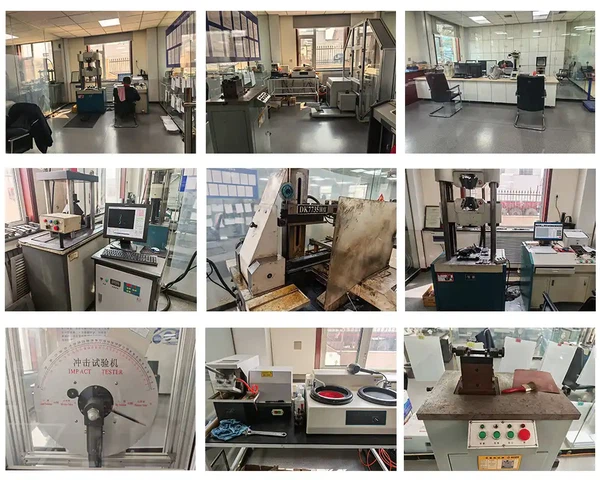
API Casing coupling factory

FAQ
Can BTC be used for gas lift applications?
Yes, but it is not the ideal choice for high-pressure gas lift applications.
Here is the simple breakdown of why:
Seal Type: BTC (Buttress Thread) relies on thread interference and "thread dope" (grease) for its seal. It does not have a metal-to-metal seal.
The Risk: Gas molecules are very small and can leak through the tiny gaps in trapezoidal threads more easily than liquids (oil/water), especially under the pressure cycles of a gas lift.
Better Options: For gas lift, most engineers prefer Premium Connections (which have a gas-tight metal-to-metal seal) or BTC with a Seal Ring (BTC-SR), which adds a Teflon ring to prevent gas leaks.
Why is BTC preferred over LTC for deep wells?
BTC is preferred over LTC for deep wells primarily because of connection strength and load capacity.
Here are the 3 main reasons:
Higher Tensile Strength: In deep wells, the casing string is extremely heavy. BTC's trapezoidal (sawtooth) thread design can handle much more weight-often reaching 100% of the pipe body strength-whereas LTC (round thread) is significantly weaker.
Pull-out Resistance: Because of its square-like thread shape, BTC "locks" better under tension. LTC threads are rounded, which makes them more likely to "slip" or pull apart under the extreme stress of a long, heavy casing string.
Better Compression Handling: BTC performs better in deep, complex wells where the pipe might experience pushing (compression) as well as pulling (tension).


