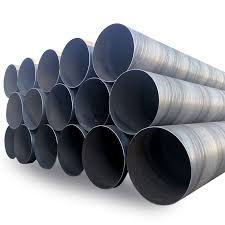
L690, standardized under ISO 3183 and equivalent to the API 5L X100 grade, is a high-grade line pipe steel. It belongs to the category of Ultra-High-Strength Low-Alloy (UHSLA) steels. Achieving a specified minimum yield strength (SMYS) of 690 MPa (100 ksi), it represents the cutting edge of modern pipeline technology, enabling more efficient and economical transportation of oil and natural gas.
1. Primary Uses and Applications
L690 steel pipes are engineered for demanding applications in the energy sector, particularly in long-distance transmission pipelines where high pressure and challenging environments are the norm.
Long-Distance High-Pressure Transmission Pipelines: Its primary use is in the onshore and offshore pipelines designed to transport natural gas or crude oil at very high pressures. This allows for greater throughput without increasing the pipe diameter.
Arctic and Cold Region Pipelines: L690 is often designed with excellent low-temperature toughness, making it suitable for pipelines in arctic, sub-arctic, and other low-temperature environments where resistance to brittle fracture is critical.
Deep-Water Offshore Applications: For offshore pipelines, reducing the weight of the pipe is crucial. The high strength of L690 allows for thinner wall thicknesses compared to lower grades, making pipelines easier to install in deep-water environments and reducing the load on supporting structures.
Bottleneck Removal and Capacity Enhancement: It is used in projects aimed at increasing the capacity of existing pipeline corridors ("looping") without needing to lay additional lines of larger diameter.
2. Key Advantages and Benefits
The adoption of L690 steel pipe offers significant technical, economic, and environmental advantages over lower-grade steels like X70 or X80.
Higher Pressure and Throughput: The high yield strength allows pipelines to operate at significantly higher internal pressures, directly increasing the volume of gas or oil transported.
Material and Cost Savings: For the same pressure rating, the required wall thickness of L690 is less than that of lower-grade steels. This translates to substantial savings in steel tonnage, reducing material, manufacturing, welding, and transportation costs.
Weight Reduction: The reduced wall thickness leads to a lighter pipeline, which is a major benefit for offshore projects where buoyancy and installation forces are critical, and for onshore projects in difficult terrain.
Improved Toughness and Safety: Modern L690 is produced using advanced Thermo-Mechanical Controlled Processing (TMCP) and often features an acicular ferrite or bainitic microstructure. This provides exceptional fracture toughness, ensuring safety and integrity under dynamic loading and in low-temperature conditions.
Enhanced Weldability (for UHSLA Steel): While welding requires strict procedures, the chemical composition of L690 is carefully balanced with low carbon content and controlled Carbon Equivalent (CE). This makes it weldable without excessive pre-heat, minimizing the risk of cold cracking in the Heat-Affected Zone (HAZ).
3. Future Development Prospects and Trends
The future for L690 steel pipe is promising, driven by the global energy industry's evolving needs. However, its widespread adoption also faces certain challenges.
Positive Trends:
Growing Demand for Natural Gas: As the world transitions to cleaner energy, the demand for natural gas is rising. L690 enables the economic and efficient transportation of gas from remote fields.
Push for Economic Efficiency: The constant pressure to reduce capital expenditure (CAPEX) in mega-projects will continue to drive the use of higher-grade steels like L690 to achieve "more with less."
Advancements in Manufacturing: Ongoing R&D in steelmaking, TMCP, and accelerated cooling techniques will further improve the consistency, toughness, and weldability of L690, making it more reliable and easier to use.
Development of Even Higher Grades: Research into grades beyond X100 (e.g., X120) continues, with L690 serving as a critical technological stepping stone. The knowledge gained from L690 production directly feeds into these next-generation materials.
Challenges and Focus Areas:
Strain-Based Design: Future pipelines in seismic zones or permafrost regions require strain capacity beyond yield strength. Developing L690 pipes with high uniform elongation and strain-hardening exponents is a key R&D focus.
Hydrogen-Induced Cracking (HIC) Resistance: With the emerging hydrogen economy, developing L690 variants resistant to HIC for transporting hydrogen-natural gas blends or pure hydrogen is a crucial future direction.
Standardization of Welding Procedures: Wider adoption requires the development and global standardization of robust, field-proven welding and non-destructive testing (NDT) procedures to ensure joint integrity.
In conclusion, L690 (X100) steel pipe is a key enabling technology for the next generation of high-performance, cost-effective, and safe energy pipelines. Its use is set to grow as the industry tackles more challenging projects, driven by advancements in metallurgy and a clear economic and environmental imperative.