



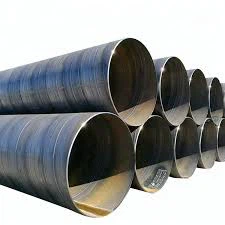
GB/T 3091 Q215B is a standard and well-established material specification for manufacturing Spiral Submerged Arc Welded (SSAW) steel pipes [citation:1, citation:4, citation:6]. This combination is a common product offered by numerous Chinese manufacturers for low-pressure fluid transmission and general structural applications, offering a step up in strength from Q195 while maintaining excellent formability [citation:5, citation:7].
The designation "GB/T 3091 Q215B Spiral Submerged Arc Pipe" combines a carbon structural steel grade (Q215B) with the standard quality level, produced using the economical spiral welding process for large-diameter, cost-effective applications [citation:1, citation:4]. The "B" suffix indicates guaranteed impact toughness at room temperature, distinguishing it from Q215A [citation:5, citation:7].
📋 Key Specifications for GB/T 3091 Q215B SSAW Pipe
The table below summarizes the primary specifications for this product, based on comprehensive industry data [citation:1, citation:2, citation:3, citation:4, citation:5, citation:6, citation:7, citation:8].
| Attribute | Description |
|---|---|
| Standard | GB/T 3091: "Welded steel pipes for low pressure liquid delivery" (current version: GB/T 3091-2015; new version GB/T 3091-2025 effective October 2025) [citation:1, citation:4, citation:8]. |
| Scope | Applicable to water, air, heating steam, gas, and other low-pressure fluid transmission [citation:2, citation:3, citation:4, citation:6]. |
| Steel Grade | Q215B: A carbon structural steel grade. The "Q" stands for "屈服强度" (yield strength), "215" indicates the minimum yield strength in MPa, and "B" denotes the quality grade with specified impact requirements at room temperature (+20°C) [citation:5, citation:7]. |
| Base Material Standard | GB/T 700: Carbon Structural Steels [citation:1, citation:4, citation:5, citation:7]. |
| Manufacturing Process | Spiral Submerged Arc Welding (SSAW/HSAW) : Formed from hot-rolled steel coil at room temperature, with the weld seam running continuously in a spiral. Welded using double-sided automatic submerged arc welding (inside and outside) [citation:1, citation:2, citation:4, citation:6]. |
| Chemical Composition (max %) [citation:5, citation:7, citation:9] | Carbon (C): ≤ 0.15% Manganese (Mn): 0.25-0.60% Silicon (Si): ≤ 0.30% Phosphorus (P): ≤ 0.045% Sulfur (S): ≤ 0.045% |
| Mechanical Properties (min) [citation:1, citation:5, citation:7, citation:8, citation:9] | Yield Strength (t ≤ 16mm): 215 MPa Yield Strength (t > 16mm): 205 MPa Tensile Strength: 335-450 MPa Elongation (D > 168.3mm): ≥ 20% Charpy Impact: 27 J minimum at +20°C (key difference from Q215A) [citation:5, citation:7] |
| Typical Size Range [citation:1, citation:2, citation:3, citation:4, citation:5, citation:6, citation:7, citation:8] | Outside Diameter: 219 mm to 4064 mm (approx. 8" to 160") for SSAW; smaller diameters available as ERW [citation:5, citation:6] Wall Thickness: 2.0 mm to 26 mm for SSAW; up to 12.5 mm for ERW Length: 3 m to 12 m standard; up to 25 m available [citation:3, citation:6] |
| Key Testing Requirements [citation:1, citation:2, citation:3, citation:5, citation:8] | Chemical analysis; tensile test; flattening test; bend test; hydrostatic test (each pipe); non-destructive testing (ultrasonic or X-ray of weld seam - standard practice). Charpy impact testing is required for Grade B at +20°C [citation:5, citation:7]. |
| Common Applications [citation:5, citation:7] | Low-pressure water transmission; irrigation systems; drainage lines; ventilation ducts; non-critical structural supports; fencing and handrails; scaffolding; domestic gas distribution; HVAC systems; agricultural irrigation. |
| Certification | Mill Test Certificate typically to EN 10204 Type 3.1 or equivalent, with test results and traceability records [citation:2, citation:5]. |
📊 GB/T 3091 Grade Comparison
Q215B is positioned between Q195 and Q235 in the GB/T 3091 specification. The table below shows its position relative to other common grades [citation:1, citation:2, citation:5, citation:7, citation:8, citation:9]:
| Grade | Yield Strength (MPa) min (t ≤ 16mm) | Tensile Strength (MPa) min | Elongation % (D > 168.3mm) | Relative Strength vs. Q195 | Key Feature | Typical Application |
|---|---|---|---|---|---|---|
| Q195 | 195 | 315 | 20 | Baseline | Most economical | Non-critical, cost-driven applications |
| Q215B | 215 | 335 | 20 | +10% | Good ductility, guaranteed impact | Light structures, cold bending applications |
| Q235B | 235 | 370 | 20 | +21% | Balanced properties | General construction - MOST COMMON |
| Q275B | 275 | 410 | 18 | +41% | Higher strength | Moderate load-bearing structures |
| Q355B | 355 | 470 | 18 | +82% | High strength | Heavy-duty structural applications |
📏 Dimensional Specifications
GB/T 3091 specifies the following typical tolerances for SSAW pipes [citation:2, citation:3, citation:4]:
| Parameter | Tolerance |
|---|---|
| Outside Diameter (OD ≤ 508mm) | ±0.75% of specified diameter |
| Outside Diameter (OD > 508mm) | ±1.0% of specified diameter |
| Wall Thickness | ±12.5% of nominal |
| Straightness (OD > 168.3mm) | ≤ 0.2% of total length [citation:2, citation:3] |
| Length (fixed lengths) | +100mm / -0mm |
| End Finish | Plain ends standard; beveled ends for wall thickness > 4mm (30° angle, 1.6mm root face) [citation:2, citation:3] |
Standard Diameter Range for SSAW: 219mm to 4064mm (8" to 160") [citation:1, citation:2, citation:4, citation:5, citation:6]
🔍 Key Points to Understand
What "GB/T 3091 Q215B" Means: This is the Chinese national standard for low-pressure fluid transmission pipes using Q215B carbon steel. The "B" suffix is significant-it guarantees Charpy V-notch impact energy of 27 Joules at room temperature (+20°C) , making it suitable for applications where some toughness is required, unlike Q215A which has no mandatory impact testing [citation:5, citation:7].
Q215B vs. Q195: Q215B offers approximately 10% higher yield strength than Q195 (215 MPa vs. 195 MPa) with similar excellent ductility and weldability. It is a cost-effective upgrade when slightly higher strength is needed [citation:5, citation:7].
Q215B vs. Q235B: Q215B has lower strength than Q235B (215 MPa vs. 235 MPa) but also lower carbon content (≤0.15% vs. ≤0.20-0.22%), which gives it superior cold bending properties. It is often chosen for applications requiring extensive cold forming [citation:5, citation:7].
International Equivalents: Q215B is roughly equivalent to ASTM A53 Grade A (205 MPa yield) in terms of strength, though chemical compositions differ. It is also similar to St35.8 or P235TR1 in European specifications [citation:5, citation:10].
SSAW Advantages for Q215B: The spiral welding process offers specific benefits for large-diameter pipes [citation:4, citation:6]:
Large Diameter Capability: Can economically produce pipes up to 160" diameter
Cost Efficiency: Lower cost than longitudinal welding for large diameters
Long Lengths: Up to 25m lengths reduce field joints
🔧 Manufacturing Process for GB/T 3091 Q215B SSAW Pipe
The manufacturing process follows standard SSAW production methods with quality controls suitable for structural applications [citation:1, citation:4, citation:6]:
| Step | Description |
|---|---|
| 1. Raw Material Preparation | Hot-rolled steel coils meeting Q215B chemistry requirements are leveled, inspected, and edge-milled [citation:1, citation:4]. |
| 2. Spiral Forming | The steel strip is continuously formed into a cylindrical shape at a specific helix angle at room temperature using five-roll forming [citation:1, citation:4]. |
| 3. Submerged Arc Welding | Double-sided automatic submerged arc welding (inside and outside) creates the spiral seam with full penetration [citation:1, citation:4, citation:6]. |
| 4. Non-Destructive Testing | 100% ultrasonic or X-ray inspection of the weld seam is standard practice [citation:1, citation:6]. |
| 5. Hydrostatic Testing | Each pipe individually tested to verify pressure integrity [citation:3, citation:5]. |
| 6. Mechanical Testing | Tensile tests, flattening tests, bend tests, and mandatory Charpy impact testing for Grade B [citation:5, citation:8]. |
| 7. End Finishing | Ends prepared (plain or beveled) for field welding; beveled ends for wall thickness > 4mm [citation:2, citation:3]. |
| 8. Coating | Optional external coatings (varnish, bitumen, epoxy) and galvanizing available (OD ≤ 508mm) [citation:1, citation:4]. |
🏭 Applications
GB/T 3091 Q215B SSAW pipes are used in cost-sensitive applications where good formability and guaranteed toughness are beneficial [citation:5, citation:7]:
| Application | Description | Why Q215B is Chosen |
|---|---|---|
| Low-Pressure Water Transmission | Rural water supply, irrigation systems, drainage lines | Good ductility for installation; economical |
| HVAC Systems | Ductwork, low-pressure heating systems | Excellent weldability for fabrication |
| Fencing and Handrails | Agricultural fencing, barriers, guard rails | Good cold bending properties for forming |
| Scaffolding | Temporary construction supports | Adequate strength, economical |
| Light Structural Frames | Non-critical support structures | Guaranteed toughness at room temperature |
| Agricultural Equipment | Irrigation pipes, livestock equipment | Good formability, corrosion resistance with galvanizing |
| Decorative Applications | Art installations, furniture frames (after processing) | Excellent surface finish, easy to form |
📝 Important Considerations
Standard Version: The current version is GB/T 3091-2015. A new version GB/T 3091-2025 will be effective from October 1, 2025 [citation:4, citation:8]. When ordering, specify the required version year.
Q215A vs. Q215B: The key difference is impact testing:
Q215A: No mandatory Charpy impact testing
Q215B: Mandatory Charpy impact testing at +20°C, 27J minimum [citation:5, citation:7]
Choose Q215B when some toughness assurance is needed.
Coating Options: Pipes can be supplied with various coatings [citation:1, citation:4, citation:5]:
Galvanized: For corrosion protection (OD ≤ 508mm only) [citation:1, citation:4]
Black (bare): Standard mill finish
Varnish/Anti-rust oil: Temporary protection
Bitumen coating: For buried service
International Approximations: Q215B is roughly equivalent to [citation:5, citation:10]:
ASTM A53 Grade A (205 MPa yield)
EN 10217-1 P235TR1 (235 MPa yield - slightly higher)
ISO 559 (similar low-pressure fluid pipe standard)
Complete Specification: When ordering, specify [citation:1, citation:2, citation:4, citation:5]:
GB/T 3091, Grade Q215B, SSAW (spiral welded), Size (OD x WT), Length, End Finish
Standard version: [e.g., GB/T 3091-2015]
Coating requirements: [e.g., bare, galvanized, varnish]
Any supplementary requirements (impact testing if using Q215A)
📝 Summary
GB/T 3091 Q215B Spiral Submerged Arc Welded pipes are a cost-effective, intermediate-strength choice for large-diameter, low-pressure fluid transmission and light structural applications under the Chinese national standard [citation:1, citation:4, citation:5, citation:7]. With minimum yield strength of 215 MPa, these pipes offer approximately 10% higher strength than Q195 while maintaining excellent ductility and weldability [citation:5, citation:7].
The "B" quality grade guarantees Charpy impact toughness of 27 Joules at room temperature (+20°C), making Q215B suitable for applications where some impact resistance is needed, unlike Q215A which has no mandatory impact testing [citation:5, citation:7].
Available in diameters from 219mm to over 4000mm with wall thicknesses to 26mm and lengths up to 25m, these pipes are produced using the cost-effective SSAW manufacturing process while meeting the requirements of the GB/T 3091 specification [citation:4, citation:5, citation:6].
Q215B is often chosen for applications requiring good cold bending properties (such as fencing, handrails, and light structural frames) where its lower carbon content (≤0.15%) provides better formability than Q235B [citation:5, citation:7]. For applications requiring even higher strength, consider upgrading to Q235B (the most common grade) or Q275B [citation:5, citation:7].
When ordering, ensure you clearly indicate the complete standard with version year, grade Q215B, manufacturing process (SSAW), required dimensions, and any coating requirements based on your specific application [citation:1, citation:2, citation:4, citation:5].


