



DIMENSIONS AND SIZES OF EN 10255 STEEL PIPES
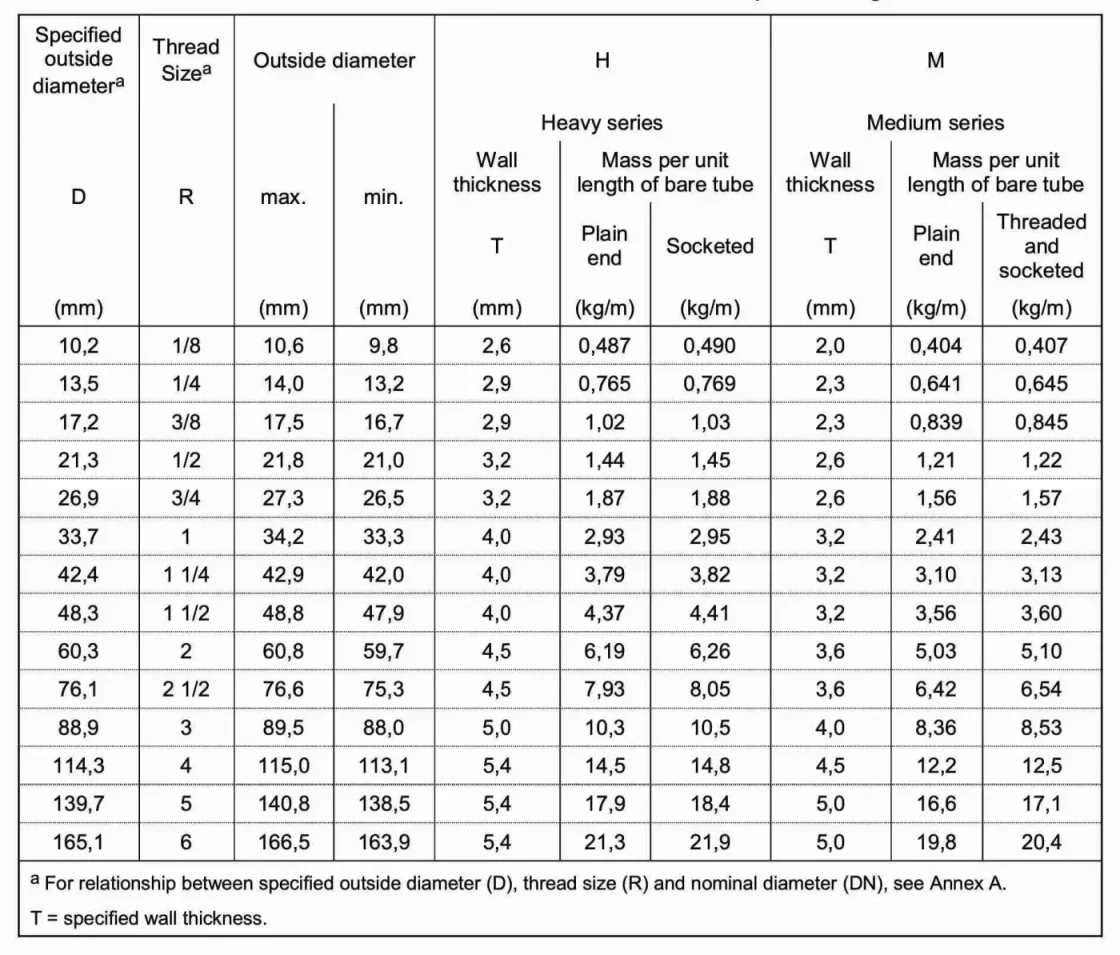
The following table contains the dimensions and weight of steel tubes in accordance with the European standard EN 10255 "Non-Alloy Steel Tubes Suitable for Welding and Threading" and British Standard BS 1387:1985 "Specification for screwed and socketed steel tubes and tubulars, and for plain end steel tubes suitable for welding or screwing to BS 21 pipe threads":
|
Specified outside diametera
(mm) |
Thread Sizea
R |
Outside
max.
(mm) |
diameter
min.
(mm) |
H
Wall thickness
T
(mm) |
H
eavy serie
Mass length o
Plain end
(kg/m) |
s
per unit f bare tube
Socketed
(kg/m) |
Me
Wall thickness
T
(mm) |
M
dium seri
Mass length o
Plain end
(kg/m) |
es
per unit f bare tube
Threaded and socketed
(kg/m) |
| 102 | 1/8 | 10,6 | 98 | 26 | 487 | 490 | 20 | 404 | 407 |
| 135 | 1/4 | 14,0 | 132 | 29 | 765 | 769 | 23 | 641 | 645 |
| 172 | 3/8 | 17,5 | 167 | 29 | 102 | 103 | 23 | 839 | 845 |
| 213 | 1/2 | 218 | 210 | 32 | 144 | 145 | 26 | 121 | 122 |
| 269 | 3/4 | 27,3 | 265 | 32 | 187 | 188 | 26 | 156 | 157 |
| 337 | 1 | 342 | 333 | 40 | 293 | 295 | 32 | 241 | 243 |
| 424 | 11/4 | 42,9 | 420 | 40 | 379 | 382 | 32 | 310 | 313 |
| 483 | 11/2 | 488 | 479 | 40 | 437 | 441 | 32 | 356 | 360 |
| 603 | 2 | 60,8 | 597 | 45 | 619 | 626 | 36 | 503 | 510 |
| 761 | 21/2 | 766 | 753 | 45 | 793 | 805 | 36 | 642 | 654 |
| 889 | 3 | 89,5 | 880 | 50 | 103 | 105 | 40 | 836 | 853 |
| 1,143 | 4 | 1,150 | 1,131 | 54 | 145 | 148 | 45 | 122 | 125 |
| 1,397 | 5 | 1,408 | 1,385 | 54 | 179 | 184 | 50 | 166 | 171 |
| 1,651 | 6 | 1,665 | 1,639 | 54 | 213 | 219 | 50 | 198 | 204 |
| a For relationship between specified outside diameter (D), thread size (R) and nominal diameter (DN),see Annex A. T = specified wall thickness. |
|||||||||
|
Nominal Bore |
Outside Diameter |
Thickness |
Weight |
||||||
|
Light |
Medium/ Heavy
|
Light |
Medium |
Heavy |
Light |
Medium |
Heavy |
||
|
in |
mm |
mm |
mm |
mm |
mm |
mm |
kg/m |
kg/m |
kg/m
|
|
1/4 |
8 |
13.6 |
13.9 |
1.80 |
2.3 |
2.9 |
0.515 |
0.641 |
0.765 |
|
3/8 |
10 |
17.1 |
17.4 |
1.80 |
2.3 |
2.9 |
0.670 |
0.839 |
1.020 |
|
1/2 |
15 |
21.4 |
21.7 |
2.00 |
2.6 |
3.2 |
0.947 |
1.210 |
1.440 |
|
3/4 |
20 |
26.9 |
27.2 |
2.30 |
2.6 |
3.2 |
1.380 |
1.560 |
1.870 |
|
1 |
25 |
33.8 |
34.2 |
2.60 |
3.2 |
4.0 |
1.980 |
2.410 |
2.940 |
|
1 1/4 |
32 |
42.5 |
42.9 |
2.60 |
3.2 |
4.0 |
2.540 |
3.100 |
3.800 |
|
1 1/2 |
40 |
48.4 |
48.8 |
2.90 |
3.2 |
4.0 |
3.230 |
3.570 |
4.380 |
|
2 |
50 |
60.2 |
60.8 |
2.90 |
3.6 |
4.5 |
4.080 |
5.030 |
6.190 |
|
2 1/2 |
65 |
76.0 |
76.6 |
3.20 |
3.6 |
4.5 |
5.710 |
6.430 |
7.930 |
|
3 |
80 |
88.7 |
89.5 |
3.20 |
4.0 |
5.0 |
6.720 |
8.370 |
10.300 |
|
4 |
100 |
113.9 |
114.9 |
3.60 |
4.5 |
5.4 |
9.750 |
12.200 |
14.500 |
|
5 |
125 |
– |
140.6 |
– |
5.0 |
5.4 |
– |
16.600 |
17.900 |
|
6 |
150 |
– |
165.1 |
– |
5.0 |
5.4 |
– |
19.700 |
21.300 |
CHEMICAL COMPOSITION OF EN 10255 PIPES
| Grade | Chemical composition (%) | |||
| S195T | C | Mn | P | S |
| ≤ 0.20 | ≤ 1.40 | ≤ 0.035 | ≤ 0.030 | |
MECHANICAL PROPERTIES OF EN 10255 PIPES
| Grade | Mechanical Properties | ||
| S195T | Yield Strength (Mpa) | Tensile Strength (Mpa) | Elongation (%) |
| 195 | 320-520 | 20 | |
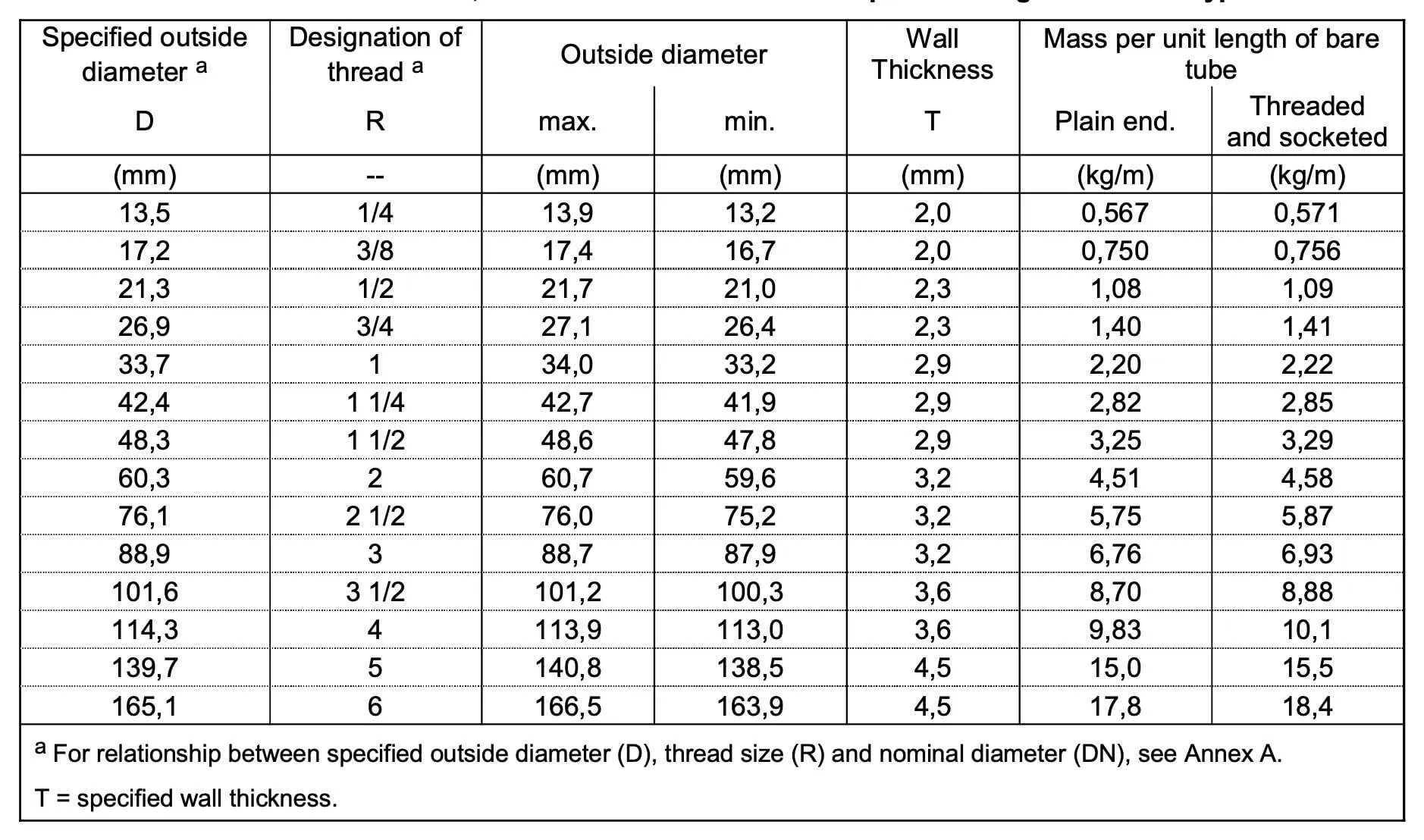
TOLERANCES OF EN 10255 PIPING
- Type L - Dimension Tolerance and Unit Mass
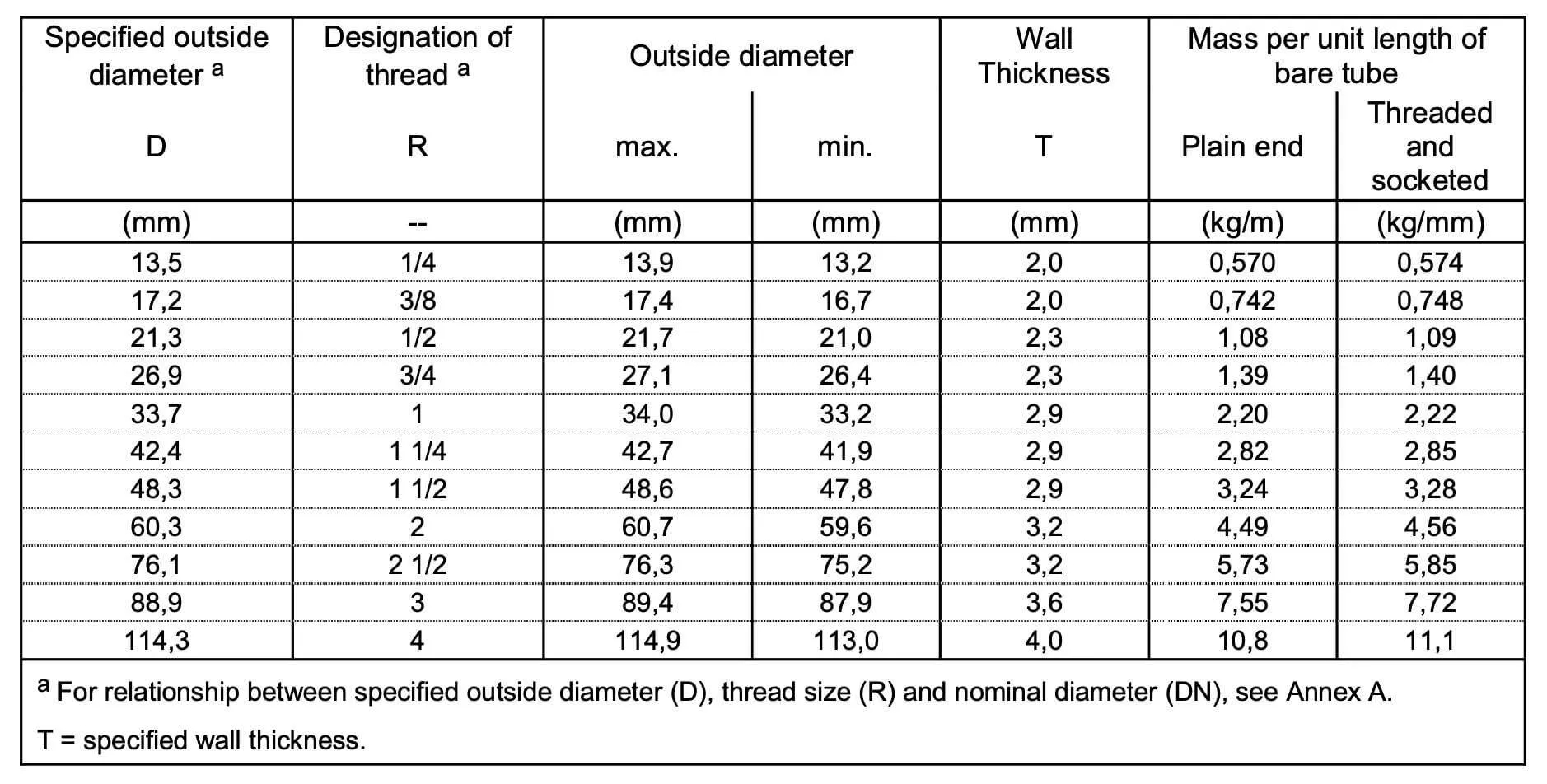
- Type L1 - Dimension Tolerance and Unit Mass
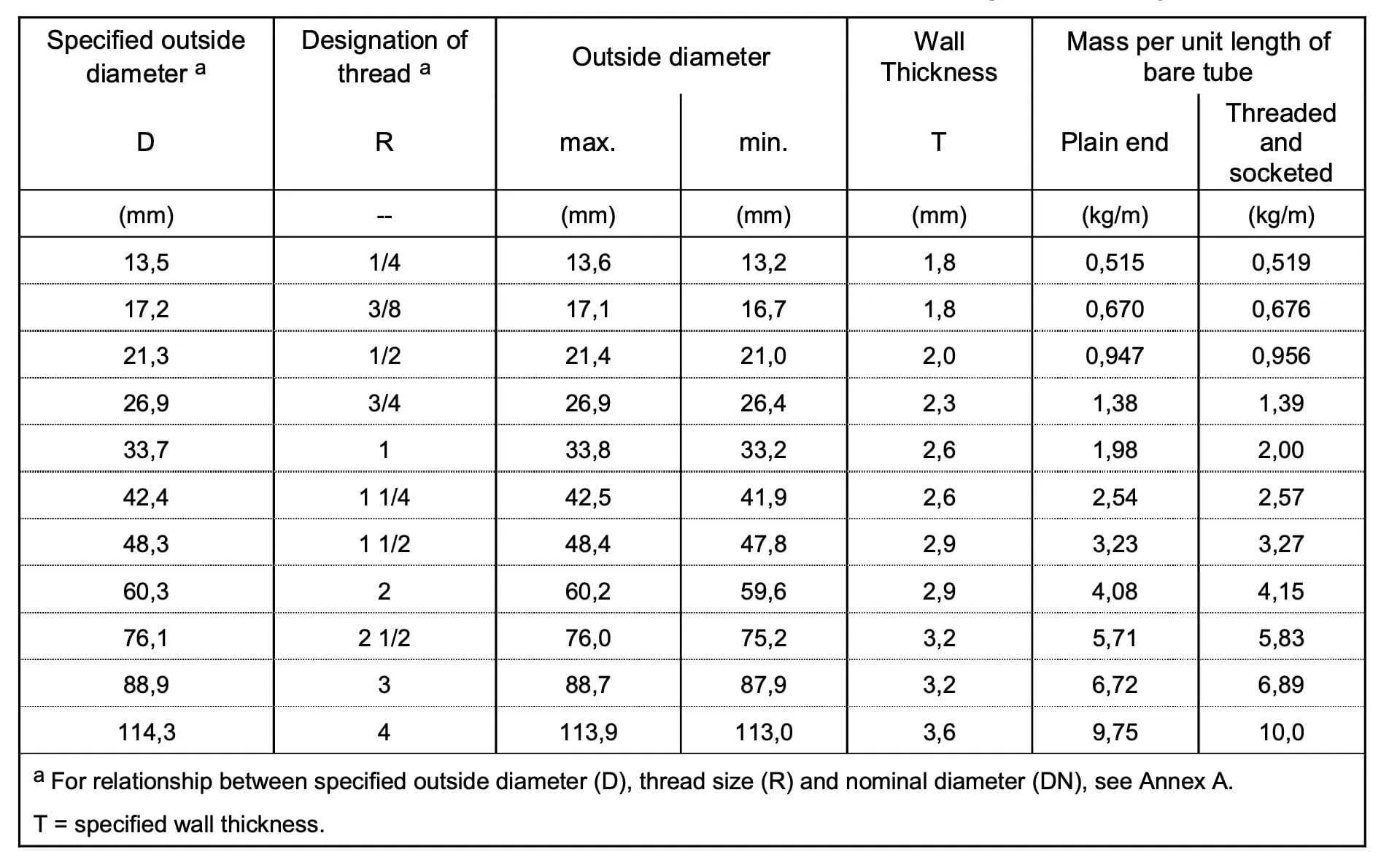
- Type L2 - Dimension Tolerance and Unit Mass
- Wall Thickness
• ±10%. for M and H series & Type L;
• -8% with the plus tolerance limited by the mass tolerance, for Types L1 and L2.
- Weight
• ±7.5% on bundles of 10 tons or more, for M and H series and Type L;
• +10%, -8% on individual tubes for Types L1 and L2.
- Straightness
• Straightness shall not exceed 0.002 L.
TEST AND INSPECTION OF EN 10255 PIPING
- Tensile Test
The tensile test shall be performed on a bare tube in accordance with EN 10002-1.
- Bend Test
In order to ensure the quality of our welded tubes, we perform a bend test in accordance with EN 10232. This test is applied to bare tubes with specified outside diameters of 17.2mm up to and including 60.3mm, and the tube is bent to an angle of 90°. The groove in the forming tool has a width that fits the tube diameter accurately and a depth not less than half of the diameter. The radius at the bottom of the groove of the former is as given in the table below. Welded tubes shall be bent with the weld at the outside of the bend. The tubes shall show no cracks visible without magnifying aids. By performing this test, we can ensure that our welded tubes meet the highest standards of quality.
| Diameter (mm) | 17.2 | 21.3 | 26.9 | 33.7 | 42.4 | 48.3 | 60.3 |
| Bending Radius | 50 | 65 | 85 | 100 | 150 | 170 | 220 |
- Flattening Test
In order to ensure the structural integrity of welded tubes, a flattening test is carried out in accordance with EN 10233. The test is applied to bare tubes with an outside diameter greater than 60.3mm and involves flattening the tube in a press until the distance between platens, measured under load, reaches 75% of the original outside diameter. The weld should be placed alternately at 0 or 90° to the direction of flattening. During the flattening process, the tube should show no cracks or flaws visible without magnifying aids. Once the distance between platens reaches 60% of the original outside diameter, slight premature failure at the edges shall not be considered as a cause for rejection. This test ensures that welded tubes can withstand the required amount of pressure without failing.
- Leak Tightness Test
Any system that involves the transport of fluids must be designed to ensure that there are no leaks. This is especially important in industries like healthcare, where even a small leak can have serious consequences. To ensure the integrity of their products, manufacturers must subject each tube to a leak-tightness test. The most common type of test is a hydrostatic test, which involves filling the tube with water and pressurizing it to 50 bar for at least 5 seconds. However, manufacturers also have the option of using an electromagnetic test in accordance with EN 10246-1. Whichever type of test is used, the goal is to ensure that the finished product is completely safe and fit for use.
- Dimensional Inspection
The size and dimension inspection shall be performed.
- Visual Examination
The visual examination shall be performed as per the standard.
MARKING ON EN 10255 PIPES
The markings should be placed at least once within one meter of one end of the tube, and the tubes shall be marked with the following information by suitable and durable methods:
• The name or trademark of the manufacturer;
• The serious symbol (H or M) and the type (L, L1, or L2);
• The symbol of the manufacturing process (S or W)
Colors can be a helpful way to organize and identify different objects, and this is especially true when it comes to tubes. Tubes are often used in a variety of settings, from construction sites to laboratories, and they come in a wide range of sizes and materials. While each type of tube has its own unique properties, they all need to be marked so that they can be easily identified. The manufacturer may opt to use color coding instead of series or type markings. This will make it easy to quickly identify the different types of tubes, saving time and preventing confusion.
| Heavy | Medium | Types |
| Red | Blue | See Tolerance Table |
The following information shall appear on the label of each bundle:
• The name or trademark of the manufacturer;
• The standard code EN 10255;
• The symbol of the manufacturing process (S or W)
• The D (outside diameter) or R (thread size);
• The series or type or specified wall thickness.
EN 10255 AND BS 1387 COMPARISON TABLE
Abolished and replaced by the European standard EN 10255: 2004 (adopted by the UK national standard body as BS EN 10255:2004 "non-alloy steel tubes suitable for welding or threading"), BS 1387:1985 has been retired. The kinds in BS 1387 and EN 10255 that correspond to each other are listed in the table below.
| EN 10255 L | – |
| EN 10255 L1 | – |
| EN 10255 L2 | BS 1387 Light |
| EN 10255 Medium | BS 1387 Medium |
| EN 10255 Heavy | BS 1387 Heavy |
APPEARANCE OF EN 10255 PIPES
The quality of a tube is often determined by its surface finish. For this reason, manufacturers must take care to ensure that their products are free from defects that can be detected by visual examination. The internal and external surfaces of the tube must be smooth, with no imperfections or marks that would require dressing. Any surface imperfections that encroach on the specified minimum wall thickness are considered defects. It is permissible to dress surface imperfections by grinding or machining provided that the wall thickness in the dressed area is not less than the specified minimum. All dressed areas must blend smoothly into the contour of the tube. By following these guidelines, manufacturers can produce tubes with superior surface finishes that meet the highest standards of quality.


