



ASTM A500 CARBON STEEL MATERIAL COMPONENT PROPERTIES
ASTM A500 carbon steel structural tube is only made from materials that meet the carbon steel requirements. A500 is mostly composed of iron, with additional carbon, manganese, phosphorus, sulfur, and copper. For accurate A500 carbon steel chemical characteristics, see the chart below.
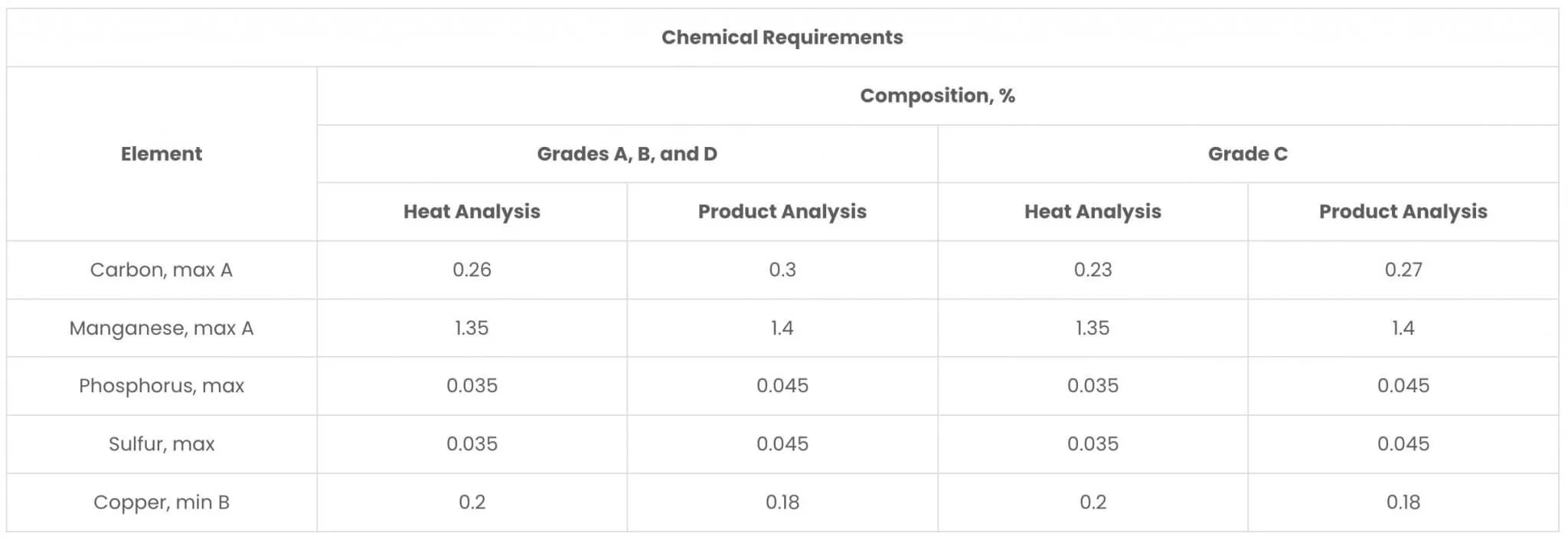
ASTM A500 CARBON STEEL MECHANICAL PROPERTIES
The amount of stretching tension that a material can endure before breaking or failing is referred to as its tensile strength. The ultimate tensile strength of A500 carbon steel is computed by dividing its area by the stress applied to it, which is represented in pounds or tons per square inch of material. Tensile strength is a critical indicator of ASTM A500's capacity to perform in a given application. The tensile strength of A500 carbon steel is shown in the chart below.
MECHANICAL PROPERTIES OF ASTM A500 ROUND STRUCTURAL TUBING
| Steel Grade | Tensile Strength | Yield Strength | Elongation in 50.8mm | ||
| psi | Mpa | psi | Mpa | Min | |
| Gr. A | 45,000 | 310 | 33,000 | 228 | 25% |
| Gr. B | 58,000 | 400 | 42,000 | 290 | 23% |
| Gr. C | 62,000 | 427 | 46,000 | 317 | 21% |
| Gr. D | 58,000 | 400 | 36,000 | 250 | 23% |
MECHANICAL PROPERTIES OF ASTM A500 SHAPED STRUCTURAL TUBING
| Steel Grade | Tensile Strength | Yield Strength | Elongation in 50.8mm | ||
| psi | Mpa | psi | Mpa | Min | |
| Gr. A | 45,000 | 310 | 39,000 | 269 | 25% |
| Gr. B | 58,000 | 400 | 46,000 | 317 | 23% |
| Gr. C | 62,000 | 427 | 50,000 | 345 | 21% |
| Gr. D | 58,000 | 400 | 36,000 | 250 | 23% |
ASTM A500 CARBON STEEL PERMISSIBLE DIMENSIONAL VARIATIONS FOR OUTSIDE DIMENSIONS
Outside diameter measurements for the ASTM A500 carbon steel tube must be taken at least 2″ (50.8mm) from each end.
The outer diameter of round structural tubing having a nominal OD of 1.900″ (48.26mm) or less may vary no more than 0.5 percent of the specified size, rounded to the closest 0.005″ (0.13mm). Outside diameter may not vary more than 0.75 percent, rounded to the closest 0.005″, for nominal ODs of 2″ (50.8mm) and greater.
Square and rectangular structural tubes must be measured across the flats with an allowance for convexity or concavity. The dimensions specified must not exceed the plus/minus tolerances stated in the table below.
OUTSIDE DIMENSIONAL TOLERANCES FOR ASTM A500 SQUARE & RECTANGULAR STEEL TUBING
There are multiple considerations that must be accounted for when determining the outside dimensional tolerances for square and rectangular steel tubing. The chart below and the following attributes describe the exact outside dimensional tolerances for A500 carbon steel.
| Outside Large Flat Dimension | 2½ in or under | Over 2½ to 3½ in | Over 3½ to 5½ in | Over 5½ in |
| 63.5mm or under | Over 63.5mm – 88.9mm | Over 88.9mm – 139.7mm | Over 139.7mm | |
| Large Flat Dimension Tolerance | ± 0.020 in | ± 0.025 in | ± 0.030 in | 0.01 times large flat dimension |
| ± 0.51mm | ± 0.64mm | ± 0.76mm |
WALL THICKNESS REQUIREMENT
Minimum wall thickness at any point of measurement shall not be less than 90% of specified nominal wall thickness. Maximum wall thickness, excluding weld seams, shall not be more than 110% of specified nominal wall thickness. Wall thickness of square structural tubing and rectangular structural tubing must be measured at the center of the flat.
STRAIGHTNESS REQUIREMENT
For a structural tube, the allowable variation in straightness is 1/8″ times the entire length in feet (or 10.4mm times the number of meters) divided by five.
SIDE SQUARENESS REQUIREMENT
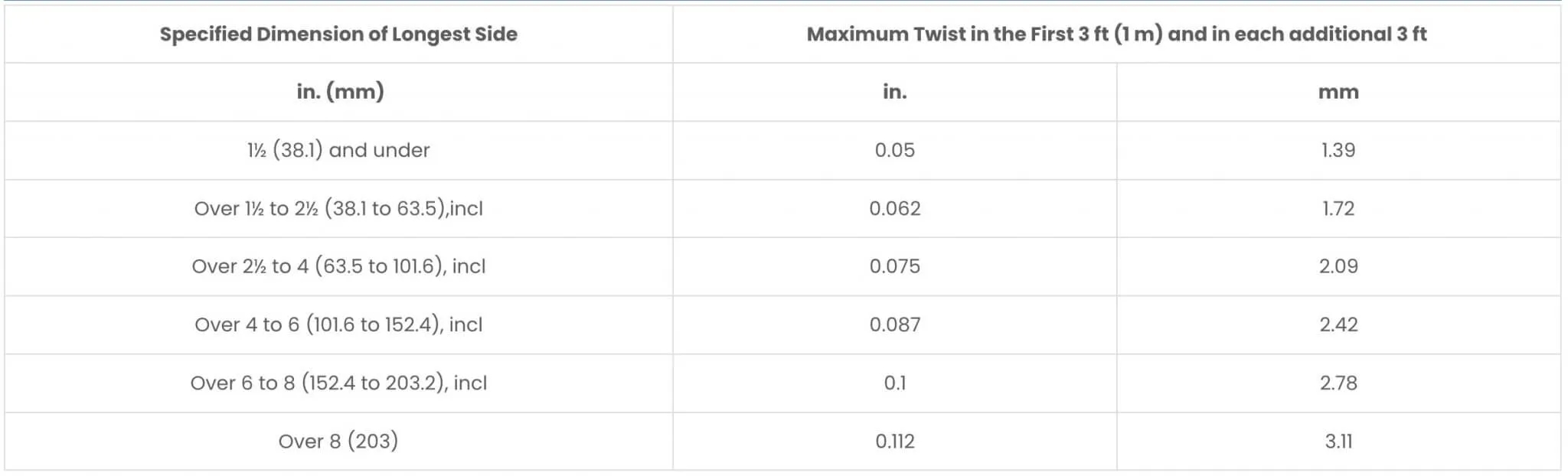
For square structural tubing and rectangular structural tubing, adjacent sides may deviate from 90° by no more than ±2°.
APPLICATIONS OF ASTM A500 STEEL STRUCTURAL PIPE
Depending on its size, A500 structural pipe is used in construction, heavy equipment, agricultural, machinery, fabrication, and general structural purposes. In construction, they are often used as support beams or columns. In heavy equipment manufacturing, they are used in the construction of machineries such as tractors and excavators. In agriculture, they are often used in the construction of irrigation systems. In fabrication, they are commonly used to create sections for steel beams and pillars. As a result, ASTM A500 structural pipes have a wide range of applications in many industries. ASTM A500 tubing comes in four grades: Grade A, Grade B, Grade C, and Grade D. Each grade has specific chemical requirements as well as different mechanical property requirements that must be met in order to be considered ASTM A500-compliant.
ASTM A500 CARBON STEEL STRUCTURAL TUBING BENEFITS
ASTM A500 Carbon Steel Structural Tubing has various advantages that make it a popular building material for structural load-bearing applications. Some of the most noticeable advantages that A500 Carbon Steel Structural Tubing offers are:
• Excellent weldability
• Good machinability
• Can be cold worked
• Aesthetically pleasing


