


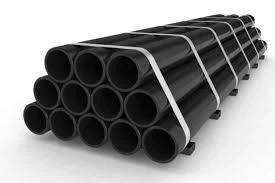
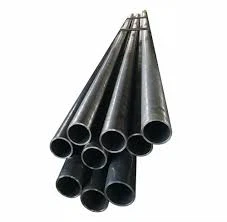
ASTM A106 - Seamless Carbon Steel Pipe for High-Temperature Service
ASTM A106 is the premier standard for seamless carbon steel pipe used in high-temperature and high-pressure service. It is the industry benchmark for critical applications in power plants, refineries, and process industries.
Key Features
| Feature | Description |
|---|---|
| Material | Carbon Steel (fine grain practice) |
| Manufacturing | Seamless (SMLS) Only |
| Grades | A, B, C (Grade B most common) |
| Primary Use | High-temperature/pressure fluid conveyance |
| Temperature Range | Up to 540°C (1000°F) |
Grades Comparison
| Grade | Yield Strength (min) | Tensile Strength (min) | Key Difference |
|---|---|---|---|
| Grade A | 30,000 psi (205 MPa) | 48,000 psi (330 MPa) | Lowest strength |
| Grade B | 35,000 psi (240 MPa) | 60,000 psi (415 MPa) | Most common, standard |
| Grade C | 40,000 psi (275 MPa) | 70,000 psi (485 MPa) | Highest strength |
Note: All grades require fine grain practice and killed steel (silicon ≥ 0.10%).
Chemical Composition
Grade B Requirements:
| Element | Composition (%) |
|---|---|
| Carbon (C), max | 0.30 |
| Manganese (Mn) | 0.29-1.06 |
| Phosphorus (P), max | 0.035 |
| Sulfur (S), max | 0.035 |
| Silicon (Si) | ≥ 0.10 |
| Special: | Made by fine grain practice |
Heat Treatment
Options:
Hot-finished (no subsequent heat treatment)
Normalized
Normalized and Tempered
Annealed
Note: Cold-drawn pipe must be heat treated after final cold draw.
Testing Requirements
| Test | Requirement |
|---|---|
| Hydrostatic Test | Mandatory for all pipe |
| Tensile Test | One per heat/lot |
| Flattening Test | For sizes ≤ NPS 2 |
| Hardness Test | Optional |
| Bend Test | For sizes ≤ NPS 2 (optional) |
| Nondestructive Test | Optional (often specified) |
Hydrostatic Test Pressure:
text
P = 2St/D or 1000 psi minimum, whichever is greater Where: S = 60% of yield strength t = wall thickness D = outside diameter
Applications
Primary Industries:
| Industry | Typical Applications |
|---|---|
| Power Generation | Main steam lines, feedwater lines, boiler piping |
| Oil & Gas Refineries | Process piping, utility lines, hydrocarbon service |
| Petrochemical | High-pressure process lines, steam distribution |
| Industrial Plants | High-temperature heating systems, compressed air |
Service Conditions:
Temperature: Up to 540°C (1000°F)
Pressure: High-pressure systems (>150 psi typical)
Media: Steam, water, oil, gas, air
Critical Comparison with A53
| Parameter | ASTM A106 | ASTM A53 |
|---|---|---|
| Manufacturing | Seamless only | Seamless & welded |
| Temperature | High-temperature (to 540°C) | Limited (~430°C max) |
| Chemistry Control | Strict (Si min, fine grain) | Less strict |
| Cost | Higher | Lower |
| Pressure Rating | Higher | Lower |
| Primary Use | Critical high-temp/pressure | General purpose |
Temperature Limitations
Design Limits:
| Condition | Maximum Temperature |
|---|---|
| General Service | Up to 425°C (800°F) |
| Extended Service | 425-540°C (800-1000°F) with de-rating |
| Not Recommended | Above 540°C (1000°F) |
Why the limit? Graphitization and oxidation become significant above 540°C.
Size Range
| Parameter | Typical Range |
|---|---|
| NPS | 1/8" to 48"+ |
| Schedule | 10 through XXS |
| Length | SRL (~6m), DRL (~12m), custom |
| Common Sizes | NPS 2" to 24" |
Ordering Information
Essential Specifications:
Standard: ASTM A106/A106M
Grade: A, B, or C
Size: NPS and Schedule (e.g., NPS 8, Sch 40)
Length: SRL, DRL, or cut lengths
Ends: Plain, beveled, or threaded & coupled
Supplementary Requirements: S1, S2, etc.
Common Supplementary Requirements:
S1: Normalizing
S2: Tensile Tests
S4: Hydrostatic Test
S5: Charpy Impact Test
S6: Nondestructive Test
Welding & Fabrication
Key Considerations:
Preheat: Often required for thicker walls (>19 mm)
Post-Weld Heat Treatment: For certain thicknesses
Filler Metal: Typically E7018 for SMAW
Procedures: Must be qualified per ASME Section IX
Weldability:
Excellent (low carbon equivalent ~0.35-0.40)
Silicon content ensures good fluidity
Fine grain structure resists HAZ cracking
Quality Assurance
Mandatory Documentation:
Mill Test Certificate with heat number traceability
Chemical analysis for each heat
Mechanical test results
Hydrostatic test pressure record
Certification Options:
ASME SA106: For Section I and VIII construction
PED/CE Marking: For European markets
NORSOK: For offshore applications
International Equivalents
| Region | Equivalent Standard | Notes |
|---|---|---|
| ISO | ISO 3183 L245 | Similar properties |
| Europe | EN 10216-2 P235GH | Comparable temperature range |
| Japan | JIS G3456 STPT370 | Similar seamless pipe |
| China | GB/T 8163 | Partial equivalent (lower temp) |
Design Calculations
Pressure Rating (ASME B31.1):
text
t = (P × D) / (2 × S × E + P × Y) Where S = allowable stress from ASME Section II, Part D
Corrosion Allowance:
Typical: 3.0 mm (1/8")
Aggressive environments: May require more
Design life: Typically 20-30 years
Limitations & Warnings
⚠️ Critical Restrictions:
NOT for low-temperature service (use A333 Gr.6 for <-45°C)
NOT for corrosive services without proper corrosion allowance
Graphitization risk above 425°C with long-term exposure
Oxidation/scaling becomes significant above 540°C
NOT for cyclic service without fatigue analysis
Industry Standards Reference
| Application | Governing Code |
|---|---|
| Power Plants | ASME B31.1 - Power Piping |
| Refineries | ASME B31.3 - Process Piping |
| Boiler External Piping | ASME Section I |
| Pressure Vessels | ASME Section VIII |
Economic Considerations
Cost Factors:
Premium over A53: 20-40% typically
Grade B vs Grade A: 5-10% higher
Grade C vs Grade B: 10-15% higher
Value justification: Reliability at high temperatures
Life Cycle Benefits:
Proven reliability in critical service
Reduced maintenance and downtime
Code compliance for high-temperature applications
Global acceptance and interchangeability
Recent Developments
A106 Updates:
Latest version: A106/A106M-19a
Enhanced traceability requirements
Improved testing provisions
Digital documentation options
Industry Trends:
Increased use in renewable energy projects
Higher temperature applications with improved steels
Enhanced corrosion resistance versions developing
In summary: ASTM A106 is the gold standard for seamless carbon steel pipe in high-temperature service, offering proven reliability, code compliance, and global acceptance for critical industrial applications. Its fine grain practice, killed steel, and mandatory testing ensure performance where safety and reliability are paramount.


