



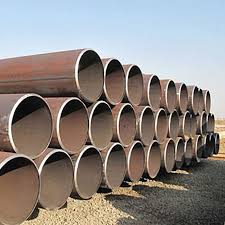
ASTM A672 Electric-Fusion-Welded Steel Pipe for High-Pressure Service at Moderate Temperatures
Overview
ASTM A672 covers electric-fusion-welded (EFW) steel pipe fabricated from pressure vessel quality plate, with filler metal added, for high-pressure service at moderate temperatures. It is commonly used for large-diameter piping in power generation, petrochemical, and industrial plants where seamless pipe would be cost-prohibitive or unavailable.
Key Distinction: While "Electric Resistance Welded (ERW)" is a subset of fusion welding, ASTM A672 typically refers to processes like Submerged Arc Welding (SAW) where filler metal is used. True ERW (no filler metal) may be used only for specific grades and thicknesses per the standard.
Grades & Temperature Classes
| Grade | Chemical Type | Typical ASME P-Number | Maximum Temperature Class |
|---|---|---|---|
| A45, A50, A55, A60 | Carbon Steel | P-1 | Up to 750°F (400°C) |
| B45, B50, B55, B60 | Carbon-Manganese Steel | P-1 | Up to 750°F (400°C) |
| C45, C50, C55, C60 | Carbon-Silicon Steel | P-1 | Up to 750°F (400°C) |
| H45, H50, H55, H60 | C-0.5Mo Steel | P-3 | Up to 850°F (454°C) |
| J45, J50, J55, J60 | 1.25Cr-0.5Mo Steel | P-4 | Up to 1100°F (593°C) |
| K45, K50, K55, K60 | 2.25Cr-1Mo Steel | P-5 | Up to 1200°F (649°C) |
Naming Convention: Letter indicates chemistry, number indicates minimum yield strength in ksi (e.g., A55 = Carbon Steel with 55,000 psi min yield strength).
Mechanical Properties (Example for A/B/C Grades)
| Property | Requirement (for A55/B55/C55) |
|---|---|
| Minimum Tensile Strength | 75,000 psi (515 MPa) |
| Minimum Yield Strength | 55,000 psi (380 MPa) |
| Elongation in 2" (min) | Longitudinal: 22% / Transverse: 16% |
Properties vary by grade number (strength level). Higher number = higher strength.
Chemical Composition (Maximum %, Example: Grade A55)
| Element | Grade A55 |
|---|---|
| Carbon (C) | 0.17 |
| Manganese (Mn) | 0.70 |
| Phosphorus (P) | 0.035 |
| Sulfur (S) | 0.035 |
| Silicon (Si) | 0.10-0.35 |
Alloy grades (H, J, K) have specific Cr, Mo, V, etc. requirements.
Manufacturing & Heat Treatment
Typical EFW Process:
Plate Preparation: Pressure vessel quality plate, ultrasonically tested.
Edge Preparation: Beveled edges for welding.
Forming: Cold or roller-formed into cylinder.
Welding: Longitudinal seam welded via Submerged Arc Welding (SAW) – the primary process for A672.
Heat Treatment: Mandatory – Full pipe normalizing or normalizing & tempering (depends on grade/thickness).
Expanding: Optional cold expansion to improve dimensional uniformity and stress relief.
Testing & Inspection: Hydrostatic, NDE, mechanical testing.
Post-Weld Heat Treatment (PWHT) Requirements:
Carbon Steel (Grades A, B, C, F): Normalize if wall thickness > ¾ inch (19 mm).
Alloy Steels (Grades H, J, K, etc.): Always normalize and temper.
Purpose: Achieve homogeneous microstructure, relieve stresses, meet mechanical properties.
Standard Sizes & Tolerances
| Parameter | Typical Range | Tolerances (per ASTM A672) |
|---|---|---|
| Outside Diameter | 16" to 144"+ (Large Diameter Specialty) | ±0.5% of specified OD |
| Wall Thickness | 0.250" to 4.0"+ | +12.5%, -10% of nominal wall |
| Length | Up to 40 ft (typical for large OD) | +1/4", -0" for cut lengths |
Key Point: A672 is the go-to standard for large-diameter, heavy-wall welded pipe where seamless is not feasible.
Mandatory Testing & Quality Assurance
| Test | Requirement | Frequency / Purpose |
|---|---|---|
| Hydrostatic Test | Pressure = 2S × t/D (min 1000 psi). S = 80% of specified min yield |
100% of pipe. Primary leak test. |
| Radiographic Examination | Full-length RT of weld seam. | 100% of weld length. Essential for defect detection. |
| Ultrasonic Examination | Alternative or supplement to RT for plate/lamination check. | As specified. |
| Tensile Test | One transverse weld test per 200 ft (60 m) of weld. | Verify weld and HAZ properties. |
| Bend Tests | Transverse face & root bend tests across weld. | Two per lot. Check weld ductility. |
| Hardness Survey | Across weld, HAZ, and base metal. | Often required for alloy grades. |
| Plate UT | Ultrasonic examination of base plate prior to forming. | Per specification, for quality plate. |
Primary Applications
Power Generation:
Main Steam Lines (moderate temperature sections)
Feedwater Lines
Condenser & Circulating Water Piping (large diameter)
Flue Gas Ducting
Petrochemical & Refining:
Process Piping for hydrocarbons
Heater Transfer Lines
Large-Diameter Header Systems
Industrial & Other:
High-Pressure Water Transmission
Pulp & Paper Mill Process Lines
Mining & Slurry Lines (abrasion-resistant grades)
Design & Fabrication Considerations
Advantages over Seamless:
Cost-effective for large diameters (>20").
Availability of custom diameters and thicknesses.
Consistent wall thickness around circumference.
Critical Fabrication Notes:
Welding: Girth welds must follow qualified procedures matching the pipe's PWHT.
Grade Suffix: "Q" indicates quenched & tempered (higher strength).
Low-Temperature Service: Supplementary Charpy impact testing can be specified.
Longitudinal Weld: The SAW weld is typically the quality focus; design may limit its location under high bending stress.
Comparison with Key Standards
| Feature | ASTM A672 (EFW) | ASTM A691 (EFW Alloy) | API 5L (Line Pipe) |
|---|---|---|---|
| Primary Process | Submerged Arc Welding (SAW) | ERW or SAW | ERW, SAW, Seamless |
| Typical Use | Moderate Temp, High Pressure, Large OD | High-Temp Alloy Service | Oil/Gas Transmission |
| Material Focus | Pressure Vessel Quality Plate | Chromium-Molybdenum Alloys | High-Strength, Low-Alloy |
| NDE Emphasis | Full-length Radiography | RT or UT | Ultrasonic Weld Inspection |
| Common Size | Very Large OD (24" - 120"+) | Medium to Large OD | Small to Very Large OD |
Ordering Information (Key Data to Specify)
Full Designation: ASTM A672 Grade XX (e.g., A672 Grade B60)
Class: Hydrostatic Test Pressure Class (e.g., Class 32 = 3200 psi test)
Type: Type of Heat Treatment (e.g., "Normalized" or "Normalized & Tempered")
Size: OD (in.) x Wall Thickness (in.) x Length (ft)
Supplementary Requirements: Often specified from:
S1. Radiographic Examination
S2. Ultrasonic Examination
S3. Charpy Impact Tests
S4. Hardness Tests
S5. Hydrostatic Test in presence of Inspector
End Preparation: Beveled per ASME B16.25 or specification.
Summary
ASTM A672 EFW pipe is the premier standard for large-diameter, high-pressure welded piping systems operating at moderate temperatures. Its rigorous requirements for plate quality, full-length radiography, and mandatory heat treatment ensure reliability comparable to seamless pipe for many applications, but at a lower cost for large sizes.
It is a specialist product where the integrity of the longitudinal weld is paramount. Success depends on specifying the correct grade, class, and supplementary requirements for the service conditions, and ensuring proper welding and heat treatment during fabrication.
Note: For all applications, design must follow the appropriate ASME B31 code (e.g., B31.1 Power Piping, B31.3 Process Piping). The manufacturer must provide a detailed Mill Test Report including chemistry, mechanical tests, heat treatment records, and NDE reports.


