



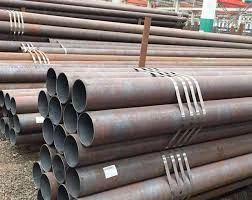

1. What Does "20MnG" Mean?
The name "20MnG" is a Chinese GB (Guobiao) standard designation that breaks down as follows:
20: Represents the approximate carbon content, which is about 0.20%. This is a medium-carbon steel.
Mn: Indicates that Manganese (Mn) is the primary alloying element.
G: Stands for "Guan" (管), the Chinese word for "Pipe."
Therefore, 20MnG is a seamless steel pipe made from a medium-carbon manganese steel.
2. Key Characteristics and Properties
20MnG is a popular grade for pressure vessels and boilers due to its balanced combination of properties:
Good Strength and Toughness: The combination of ~0.20% carbon and manganese (typically 0.70-1.00%) provides a good balance of tensile strength and impact toughness, which is crucial for containing pressure.
Excellent Plasticity and Ductility: It can be easily bent, flanged, and formed during manufacturing and installation without cracking.
Good Weldability: As a low-alloy steel, it is generally easier to weld than higher carbon or alloy steels, though proper pre-heating and post-weld heat treatment procedures should still be followed for thicker sections to avoid cracking.
High-Temperature Performance: It maintains its strength and resists creep (slow deformation under constant stress) at moderately elevated temperatures, making it suitable for boiler and pressure service.
Seamless Construction: Being seamless, it has no longitudinal weld seam, which is a potential weak point. This results in more uniform strength characteristics, better pressure integrity, and higher resistance to corrosion and fatigue.
3. Chemical Composition (Typical based on GB 5310)
The standard governing high-pressure boiler tubes in China is GB 5310. The typical chemical composition for 20MnG under this standard is:
| Element | Content (%) |
|---|---|
| Carbon (C) | 0.17 ~ 0.23 |
| Silicon (Si) | 0.17 ~ 0.37 |
| Manganese (Mn) | 0.70 ~ 1.00 |
| Phosphorus (P) | ≤ 0.025 |
| Sulfur (S) | ≤ 0.015 |
| Chromium (Cr) | ≤ 0.25 |
| Nickel (Ni) | ≤ 0.25 |
| Copper (Cu) | ≤ 0.20 |
| Molybdenum (Mo) | ≤ 0.15 |
| Vanadium (V) | ≤ 0.25 |
Note: Low levels of P and S are controlled to ensure good weldability and toughness.
4. Mechanical Properties (Based on GB 5310)
After normalizing heat treatment, the mechanical properties typically meet:
| Property | Value |
|---|---|
| Yield Strength (Rp0.2) | ≥ 240 MPa |
| Tensile Strength (Rm) | 410 ~ 550 MPa |
| Elongation (A) | ≥ 24% |
| Impact Energy | Meets standard requirements |
5. Main Applications
20MnG seamless pipes are primarily used in the power generation and petrochemical industries for high-temperature and high-pressure applications:
Boiler Tubes: For high-pressure steam boilers in power plants (both water wall tubes and superheater tubes).
Pressure Vessel Pipes: Used in various vessels and heat exchangers in the chemical and petrochemical industries.
Seamless Steel Gas Cylinders: For storing permanent gases like oxygen, nitrogen, and argon.
Fluid Transmission: For conveying high-pressure fluids.
6. Relevant Standards
GB 5310 - Seamless Steel Tubes for High Pressure Boiler: This is the primary Chinese standard for 20MnG pipes used in boiler applications. It specifies stringent requirements for quality, testing, and performance.
Equivalent Grades: While not exact equivalents, the properties of 20MnG are similar to some international grades, though the chemical composition might differ slightly.
ASTM A106 Gr. B (USA)
EN 10216-2 P235GH (Europe)
JIS G3454 STPT410 (Japan)
Summary
20MnG Seamless Steel Pipe is a reliable and widely used medium-carbon, manganese-alloyed steel pipe. Its key advantages are its good strength, excellent toughness, and high pressure-bearing capacity at elevated temperatures, all enhanced by its seamless manufacturing process. It is a fundamental material for critical applications in power generation and pressure equipment, primarily governed by the Chinese standard GB 5310.
When procuring 20MnG pipes, it is essential to review the mill test certificates to ensure they comply with the required standard (like GB 5310) and the specific chemical and mechanical properties for your application.


