


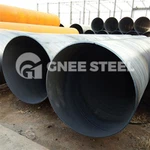


St37 Hollow Tube
Usage: Civil engineering, architecture, steel towers, shipyard, scaffoldings, struts, piles for suppression of landslide and other structures
Package: In bundles with steel strip or in loose, non-woven fabrics packings or as per customers' request
St37 Hollow Tube Description
St37 hollow rectangular pipes are carbon structural steel pipes with German grades, including several smaller grades such as St37-2, St37-3U, St37-3n, RSt-2, USt37-2, etc. They are commonly used in construction and underground engineering.
ST37 Rectangular And Square Tube Specification
|
Product Name |
Rectangular And Square Tube | |||
|
Wall Thickness |
1-5MM |
|||
|
Surface |
Pre-galvanized, Hot dipped galvanized, Electro galvanized, Black, Painted, Threaded, Engraved, Socket. |
|||
|
Grade |
ST37: St37-2, St37-3U, St37-3n, RSt-2, USt37-2 |
|||
|
Tolerance |
±1% |
|||
|
Oiled or Non-Oiled |
Non-Oiled |
|||
|
Delivery Time |
3-15 days (according to the actual tonnage) | |||
|
Usage |
Civil engineering, architecture, steel towers, shipyard, scaffoldings, struts, piles for suppression of landslide and other |
|||
|
Package |
In bundles with steel strip or in loose, non-woven fabrics packings or as per customers' request |
|||
|
MOQ |
3 ton |
|||
|
Payment Term |
T/T, L/C, DP |
|||
|
Trade Term |
FOB, CFR, CIF, DDP, EXW |
|||
ST37 HS Tube


Identification Methods for ST37 Rectangular Steel Pipes
1. Counterfeit rectangular pipes often exhibit folding.
Folding refers to various fold lines on the surface of rectangular pipes, which often run longitudinally through the entire product. The cause of folding is due to counterfeit manufacturers pursuing high efficiency, resulting in excessive reduction during pressing, which creates ears. Subsequent rolling processes then lead to folding. Products with folds tend to crack after bending, significantly reducing the steel's strength.
2. Counterfeit rectangular pipes often have a pitted surface.
Pitting occurs due to severe groove wear during rolling, resulting in irregular surface defects on the steel. Counterfeit rectangular pipe manufacturers frequently exceed the standard limits in pursuit of profit.
3. Counterfeit rectangular pipes are prone to scar formation on the surface.
This occurs due to two reasons: (1) uneven material quality and high impurity content in counterfeit rectangular pipes, and (2) poor equipment and inadequate facilities in counterfeit factories, leading to steel sticking and impurities.
4. Counterfeit materials are susceptible to surface cracking.
This is because their billets are often made of clay, which contains numerous pores. During the cooling process, clay billets develop cracks due to thermal stress. These cracks persist even after rolling.
5. Counterfeit rectangular pipes are easily scratched.
This is due to the crude equipment used by counterfeit manufacturers, which often produces burrs that scratch the surface of the steel. Deep scratches significantly reduce the strength of the steel.
6. Counterfeit rectangular pipes lack metallic luster, appearing pale red or dull.
There are two primary reasons for this: (1) the billets used are clay-based, and (2) the rolling temperature is not standardized in counterfeit production, relying instead on visual inspection. This prevents achieving the specified austenite region during rolling, leading to substandard steel performance.
7. The ribs of counterfeit rectangular pipes are thin and shallow, often resulting in incomplete filling.
8. The cross-section of counterfeit rectangular pipes is elliptical.
This is due to manufacturers attempting to save materials, resulting in excessive reduction before the final rolling stages. Such practices significantly reduce the strength of threaded steel and do not conform to standard dimensions for threaded steel.
Hot Tags: st37 hollow tube, China st37 hollow tube manufacturers, suppliers, JIS G3101, ASTM A53 Straight Seam Welded Pipe, GB T700 2006, A335 Alloy Steel Pipes, high alloy steel, Straight Seam Welded Steel Pipe
You Might Also Like


Send Inquiry