


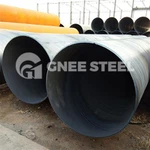


ASTM A135 Gr.B ERW Pipe
A135 GrB ERW Steel Pipe Description
ASTM A135 Gr.B is an electric-resistance-welded (ERW) carbon steel pipe manufactured from flat-rolled steel for conveying gas, vapor, water, and other liquids. Grade B has a minimum yield strength of 240 MPa (35 ksi) and a minimum tensile strength of 415 MPa (60 ksi). Produced across NPS 1/2 to 30 (about 21 to 762 mm OD), it is the higher-strength member of the A135 family and is extensively used in fire sprinkler systems, plumbing, and general fluid conveyance.
ASTM A135 / A135M is the standard specification for electric-resistance-welded steel pipe intended for fluid conveyance. Unlike the broader A53 spec, A135 pipe is produced only by electric-resistance (or electric-induction) welding from flat-rolled steel, with no filler metal added, and it is fabricated in individual or continuous lengths. The standard defines two grades: Grade A, the baseline material with a 205 MPa minimum yield, and Grade B, the higher-strength grade that this guide covers.
Grade B is the grade most commonly specified when the pipe must handle elevated pressures or when the system design calls for a stronger ERW pipe than Grade A can provide. It appears in fire protection systems, plumbing risers, and industrial fluid lines where reliability under internal pressure matters more than the marginal cost difference between the grades.
Chemical Composition of ASTM A135 GrB Welded Pipe
Grade B is a plain-carbon steel with controlled manganese. The steel is produced by the basic-oxygen or electric-furnace process, then formed and welded. Maximum element limits are listed below.
| Element | Composition, % max |
|---|---|
| Carbon (C) | 0.30 |
| Manganese (Mn) | 1.20 |
| Phosphorus (P) | 0.035 |
| Sulfur (S) | 0.035 |
Element limits per ASTM A135/A135M Grade B. Analysis is performed on each heat and reported on the mill test certificate.
The carbon-manganese combination delivers the yield and tensile strength required for Grade B while keeping the material weldable and formable enough for standard field welding and joining. The 0.30% carbon ceiling and 1.20% manganese ceiling keep the steel within the weldable range for most structural and piping applications.
Mechanical Property of ASTM A135 GrB Steel Pipe
| ASTM A135 | Grade A | Grade B |
|---|---|---|
| Tensile Strength, min, ksi [MPa] |
48 [330] |
60 [415] |
| Yield Strength, min, ksi [MPa] |
30 [205] |
35 [240] |
| Elongation, min, % |
35 | 30 |
Dimensions And Sizes Of Astm A135 GrB Sprinkler Pipes
| N.D. | O.D. | SCH 10 | SCH 30/40 | ||||||||
| WALL THICKNESS | NOMINAL WEIGHT | WALL THICKNESS | NOMINAL WEIGHT | ||||||||
| (mm) | (inch) | (mm) | (inch) | (mm) | (inch) | (kg/mtrs) | (lbs/ft) | (mm) | (inch) | (kg/mtrs) | (lbs/ft) |
| 15 | 1/2 | 21.30 | 0.84 | -- | -- | -- | -- | 2.77 | 0.109 | 1.27 | 0.85 |
| 20 | 3/4 | 26.70 | 1.05 | 2.11 | 0.083 | 1.28 | 0.96 | 2.87 | 0.113 | 1.69 | 1.13 |
| 25 | 1 | 33.40 | 1.32 | 2.77 | 0.109 | 2.09 | 1.41 | 3.38 | 0.133 | 2.5 | 1.68 |
| 32 | 1-1/4 | 42.20 | 1.66 | 2.77 | 0.109 | 2.69 | 1.81 | 3.56 | 0.14 | 3.39 | 2.27 |
| 40 | 1-1/2 | 48.30 | 1.90 | 2.77 | 0.109 | 3.11 | 2.09 | 3.68 | 0.145 | 4.05 | 2.72 |
| 50 | 2 | 60.30 | 2.38 | 2.77 | 0.109 | 3.93 | 2.64 | 3.91 | 0.154 | 5.45 | 3.66 |
| 65 | 2-1/2 | 73.00 | 2.88 | 3.05 | 0.12 | 5.26 | 3.53 | 5.16 | 0.203 | 8.64 | 5.8 |
| 80 | 3 | 88.90 | 3.50 | 3.05 | 0.12 | 6.46 | 4.34 | 5.49 | 0.216 | 11.29 | 7.58 |
| 90 | 3-1/2 | 101.60 | 4.00 | 3.05 | 0.12 | 7.41 | 4.98 | 5.74 | 0.226 | 13.58 | 9.12 |
| 100 | 4 | 114.30 | 4.50 | 3.05 | 0.12 | 8.37 | 5.62 | 6.02 | 0.237 | 16.09 | 10.8 |
| 125 | 5 | 141.30 | 5.56 | 3.4 | 0.134 | 11.58 | 7.78 | 6.55 | 0.258 | 21.79 | 14.63 |
| 150 | 6 | 168.30 | 6.63 | 3.4 | 0.134 | 13.85 | 9.30 | 7.11 | 0.28 | 28.29 | 18.99 |
| 200 | 8 | 219.10 | 8.63 | 4.78 | 0.188 | 25.26 | 16.96 | 7.04 | 0.277 | 36.82 | 24.72 |
| 250 | 10 | 273.10 | 10.75 | 4.78 | 0.188 | 31.62 | 21.23 | 7.08 | 0.307 | 51.05 | 34.27 |
A135 Grade B vs. A53 Grade B
A135 Gr.B and A53 Type E Grade B are close cousins, and buyers frequently ask how they differ. The honest answer is that they overlap heavily but are not identical. The main differences:
Fabricating method: A135 covers only electric-resistance or electric-induction welded pipe made from flat-rolled steel. A53 is broader - it includes Types E (ERW), F (furnace-welded), and S (seamless), plus hot-dip galvanized finishes.
Application emphasis: A135 was developed for and is most often specified for fire sprinkler systems and general fluid conveyance. A53 Type E Grade B is a more general-purpose welded pipe used in steam, water, gas, and air lines.
Weld treatment: Both demand quality ERW seams; A135 Gr.B explicitly requires the seam to be heat treated so no untempered martensite remains, which aligns it with fire-protection acceptance.
Grade strength: A53 Grade B and A135 Grade B share the same approximate yield (240 MPa / 35 ksi) and tensile (415 MPa / 60 ksi) minimums, and similar chemistry.
For most fire protection and fluid-conveyance projects, either A135 Gr.B or A53 Type E Gr.B can be used, depending on what the project specification engineers require. A135 Gr.B is the grade that directly targets sprinkler and fire-fighting service.
Applications
A135 Gr.B pipe is selected wherever a stronger ERW pipe is needed to contain gas, vapor, water, or other liquids. Its primary applications include:
Fire sprinkler systems - risers, mains, and branch lines in commercial and industrial buildings, sized per NFPA 13.
Plumbing - cold and hot water supply lines where Schedule 40 or 80 strength is required.
Gas and oil conveyance - low-to-moderate-pressure fluid transmission lines.
Vapor and air lines - general industrial piping for compressed air and process vapor.
General-purpose fluid conveyance - any liquid line where Grade A strength is insufficient.
Manufacturing and the Heat-Treated Weld Seam
A135 Gr.B pipe is manufactured from flat-rolled steel that is cold-formed into a cylindrical shape, then joined by electric-resistance or electric-induction welding without the addition of extraneous filler metal. Where A135 Grade B differs from many other ERW pipe specifications is in a mandatory weld-seam condition after welding.
The standard requires that the weld seam of Grade B pipe be heat treated after welding, or otherwise processed, so that no untempered martensite remains in the weld zone. The weld, in the as-welded condition, can contain hard, brittle untempered martensite that creates a risk of premature failure. The post-weld heat treatment - commonly a stress-relieving or normalizing pass that can reach 540°C (1000°F) and above depending on the mill - tempers this microstructure, restoring toughness and ductility to the seam and making the pipe reliable under internal pressure.
Why it matters: The untempered-martensite requirement is the technical reason A135 Grade B is trusted in pressurised fire protection and process lines. When you receive A135 Gr.B pipe, the mill certificate must show that the weld seam was heat treated (or otherwise processed) so no untempered martensite remains. This is a grade-defining requirement, not an optional extra.
Every length of pipe is also subject to flattening and hydrostatic testing. The flattening test checks that the weld and base metal do not crack or open when the pipe is flattened to a specified dimension - a direct assessment of weld quality and ductility. The hydrostatic test confirms the pipe holds its rated test pressure without leakage. Together these tests, plus the heat-treatment requirement, are why A135 Gr.B pipe meets the acceptance criteria of fire protection systems.
A135 GRB Welded Pipe for Sale

Packaging and shipping


Tell us your NPS, schedule, length, and fire-protection or code requirement and we'll reply with pricing, lead time, and certification within one business day.
Ready to Spec Your A135 Gr.B Order?
FAQ
What is ASTM A135 Gr.B ERW pipe?
ASTM A135 Gr.B is an electric-resistance-welded (ERW) carbon steel pipe manufactured from flat-rolled steel for conveying gas, vapor, water, and other liquids. Grade B has a minimum yield strength of 240 MPa (35 ksi) and minimum tensile strength of 415 MPa (60 ksi). It is widely used in fire sprinkler systems, plumbing, and general fluid conveyance.
What is the difference between ASTM A135 and A53 Grade B pipe?
A135 covers only electric-resistance-welded (ERW) pipe made from flat-rolled steel, while A53 covers welded (Types E and F) and seamless (Type S) pipe, plus hot-dip galvanized finishes. A135 is commonly specified for fire sprinkler service; A53 Type E Grade B is a broader general-purpose ERW pipe. Both provide similar Grade B strength but differ in permitted fabrication methods.
What size range is available for ASTM A135 Gr.B ERW pipe?
ASTM A135 Gr.B pipe is available from NPS 1/2 to NPS 30 (approximately 21 to 762 mm OD). Common fire-sprinkler sizes (Schedule 40) range from NPS 1/2 to NPS 8, with wall thicknesses in Schedule 10, 40, 80, and XXS depending on the application. Larger diameters up to NPS 30 are produced for larger fluid lines.
What are the chemical and mechanical properties of A135 Gr.B pipe?
Grade B chemistry: carbon maximum 0.30%, manganese 1.20%, phosphorus 0.035%, sulfur 0.035%. Mechanical properties: minimum tensile strength 415 MPa (60 ksi), minimum yield strength 240 MPa (35 ksi), minimum elongation 30% on a 2-in (50 mm) gauge. The Grade B weld seam is heat treated after welding so no untempered martensite remains.
Where is ASTM A135 Grade B pipe used?
ASTM A135 Grade B pipe is used in fire sprinkler systems, plumbing, gas and oil conveyance, and general fluid lines where a higher-strength ERW pipe is required. It is an accepted pipe type in fire protection systems and is selected when Grade A's 205 MPa yield strength is insufficient for the design pressure.
Why must the A135 Grade B weld seam be heat treated?
The as-welded ERW seam can contain hard, brittle untempered martensite that risks premature failure under internal pressure. ASTM A135 requires Grade B pipe to be heat treated after welding, or otherwise processed, so no untempered martensite remains in the weld zone. This tempers the microstructure, restoring toughness and ductility, which is why Grade B is accepted in pressurised fire-protection and process lines.
Hot Tags: astm a135 gr.b erw pipe, China astm a135 gr.b erw pipe manufacturers, suppliers, Welded Structural Hollow Sections, Carbon Steel Pipe, Electric Resistance Welded Pipe, JIS G3466 Carbon steel square tubes, ASTM A135 GrA GrB ERW Steel Tube, 275JR 355JR ERW Steel Tube
Previous
ASTM A500 TubingYou Might Also Like


Send Inquiry