


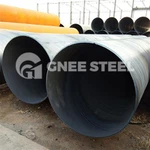


ASTM A106 Grade B carbon steel pipes for groundwater and irrigation water transmission project
Where A106 Grade B Fits in a Water Transmission Project
ASTM A106/A106M is titled Seamless Carbon Steel Pipe for High-Temperature Service and is the default material in refinery process, steam and boiler external piping designed to ASME B31.1 or B31.3. By contrast, AWWA C200 covers steel water pipe of 6 in. (150 mm) nominal diameter and larger for the transmission and distribution of potable, raw and reclaimed water and wastewater; its scope explicitly includes seamless pipe alongside straight-seam and spiral-seam electrically welded pipe. The two documents answer different questions: A106 defines the steel and the pipe, while C200 defines fabrication, testing and acceptance of the water pipe.
In practice, seamless A106 Grade B on a groundwater or irrigation scheme is concentrated in pump discharge headers, valve and bypass station spools, treatment plant yard piping, small-bore branches and specials. Long-distance trunk mains of larger diameter are usually quoted in spiral-seam or longitudinal-seam welded construction, where availability and cost are decisive. A single project can legitimately contain both, provided the material call-out, the governing water-pipe standard and the coating system are stated for each diameter band.
Specification boundary. A material standard is not a pipeline design standard. If a tender names only "ASTM A106 Gr B" with no AWWA C200 reference, no design and surge pressure, no lining or coating standard and no field-joint procedure, the mill can produce conforming pipe that still fails project acceptance. Resolve the governing document, the water classification and the corrosion system before the order is released, and record any deviation in the purchase order rather than in a later email.
Material and Dimensions to Confirm
For the A106 Grade B line items, the checks are short because the standard fixes most of them: a minimum tensile strength of 415 MPa and yield strength of 240 MPa, a minimum of 0.10% silicon with phosphorus and sulfur each capped at 0.035%, and dimensions to ASME B36.10M over the standard NPS 1/8 to NPS 48 range. Specify the NPS together with the schedule or nominal wall, and remember that the minimum permitted wall after the minus tolerance is the value used in the pressure calculation, not the nominal figure. NPS 2 and larger is normally furnished hot finished with plain beveled ends to a 30–35 degree bevel, which suits field butt welding; cold-drawn pipe is available in smaller sizes where tighter tolerances are needed. Complete chemistry, heat treatment and test tables for the material are given on the ASTM A106 seamless pipe product page.
Hydraulic Design, Wall Thickness and Surge
Water mains are sized on more than internal pressure. In AWWA M11 practice the working design stress is taken as a fraction of the specified minimum yield strength, and wall thickness is then increased to cover cases that do not appear on a simple process pipe calculation:
Surge and transient pressure - a pump trip or rapid valve closure can raise line pressure within seconds; surge vessels, slow-closing valves and controlled pump sequencing are part of the design.
Vacuum and external load - a large thin-wall main must survive emptying, soil cover, ground settlement and traffic loading, which is why water practice keeps a minimum practical cylinder wall regardless of the pressure case.
Handling and transport - stiffness during lifting, stacking and bedding adds thickness on long buried lines.
Hydraulic roughness and water quality - groundwater hardness, dissolved oxygen, chlorides and suspended solids influence the choice of lining, and the lining reduces the effective bore used in head-loss calculations.
Review the design pressure, surge allowance, minimum wall, lining thickness and the resulting internal diameter together. Specifying wall from the operating pressure alone is the most common and most expensive error in imported water-pipe tenders.
Internal Lining and External Coating
A106 pipe is normally delivered black and uncoated. Every protective layer is therefore a separate, priced line item, and each needs its own standard and inspection hold point.
| Position | System | Reference standard | Project note |
|---|---|---|---|
| Internal | Shop-applied cement-mortar lining | AWWA C205 (4 in. and larger) | Economical on large raw-water and irrigation mains; field joints lined after welding |
| Internal | Liquid epoxy lining | AWWA C210 | Smoother bore; used where water quality or head loss is tightly controlled |
| Internal | Fusion-bonded epoxy | AWWA C213 | Factory-applied; cutbacks and compatible field joint coating required |
| External | 3-layer polyethylene, FBE, epoxy or tape | ISO 21809-1 / DIN 30670 / AWWA C209 as applicable | Buried service; holiday detection, DFT and adhesion checks; cathodic protection where specified |
| Joints | Field joint coating and internal joint lining | AWWA C205 / C210 procedures, AWWA C602 where applicable | Cutbacks at pipe ends must be restored after the field weld passes inspection |
Agricultural irrigation schemes are usually large-diameter, long-distance and cost-sensitive, so cement-mortar lining with a robust external coating is the common combination. Raw groundwater is often not chlorinated at intake, so biological growth, scaling and sediment should be considered alongside corrosion. Where the line will carry potable water, the lining and coating materials - and the finished joint - must carry NSF/ANSI 61 or the locally accepted equivalent; that certification is a property of the coating system, not of the A106 pipe.
Joints, Buried Installation and Handling
Field butt welding is the usual joining method on steel transmission mains, with flanged or mechanical connections at valves, pumps and structures. Bevel geometry, root gap and the coating cutback length should be agreed before shop coating starts, since a lining applied too close to the end will be damaged by welding heat. After the weld is inspected, the external coating and internal lining are restored under the approved field-joint procedure.
Coated pipe needs padded skids, wide web slings and protected contact points during storage and transport; chains and bare steel hooks damage the coating and are a frequent source of holiday repairs on site. Backfill material, bedding and compaction are specified by the civil design, and cathodic protection is coordinated with the coating system. On seasonal irrigation networks, the operating plan should cover draining, flushing and recommissioning so that standing water does not drive scaling or microbiological growth during the off-season.
Inspection and Documentation Before Shipment
Project acceptance is a documentation exercise as much as a metallurgical one. A workable delivery package normally contains:
| Item | Typical content |
|---|---|
| Mill test certificate | EN 10204 Type 3.1 or 3.2, heat number, chemistry, tensile results, traceable to marked lengths |
| Pressure or NDE record | Hydrostatic test to P = 2St/D held at least 5 s, or nondestructive electric test to E213 / E309 / E570 with NDE or NH marking |
| Coating records | Surface preparation, dry film thickness, holiday detection, adhesion and repair records |
| Lining records | Thickness measurement, curing, visual quality and field-joint procedure |
| Dimensional records | OD, wall, length, end bevel, cutback and ovality checks |
| Third-party and marking | SGS, BV, TUV or buyer inspection when ordered; grade, size, heat number and test type marked on each length |
Third-party inspection should be nominated in the purchase order, not added after production, so that the inspection hold points are built into the coating and lining schedule.
Purchase Order Checklist
| Category | State explicitly |
|---|---|
| Material | ASTM A106/A106M edition, Grade B, seamless, hot finished or cold drawn |
| Dimensions | NPS, schedule or nominal wall, length, end preparation, cutback length |
| Governing standard | AWWA C200 where applicable, plus the design code for the piping sections |
| Design conditions | Working pressure, design pressure, surge allowance, minimum permitted wall, buried or exposed |
| Protection | Internal lining and external coating standards, thickness, field joint system, cathodic protection |
| Water classification | Raw groundwater, reclaimed, irrigation or potable; NSF/ANSI 61 requirement if potable |
| Testing and documents | Hydrostatic or NDE level, MTC type, coating and lining QC records, third-party inspection |
| Commercial | Quantity by size, marking, packing, delivery terms, inspection hold points and required ship date |
Supply Capability
GNEE supplies ASTM A106 / ASME SA-106 Grade B seamless carbon steel pipe for the pump station, plant yard and small-bore sections of water transmission projects, with cut-to-length and beveled ends, hydrostatic or nondestructive testing, and full mill documentation. Where the programme also contains large-diameter trunk mains, welded pipe to AWWA C200 or API 5L can be consolidated into the same order so that mixed-diameter sections ship under one documentation and inspection system. Lining, external coating, field-joint materials and third-party inspection are quoted as separate, specified items.
Project pricing is issued against the bill of quantities rather than a single per-tonne figure, because lining, coating, end preparation and inspection hold points have a material effect on delivered cost. Lead time follows the mill slot, the coating line schedule and the agreed inspection points. Firm quotations are prepared from the purchase order, the named standard editions and the shipping terms (FOB, CFR or CIF).
Case in Point: A Two-Size A106 Grade B RFQ for CIF Alexandria
A recent enquiry on this product line shows what a project buyer actually checks before shortlisting a supplier. It called for two equal Schedule 40 seamless A106 Grade B lines in fixed 6,000 mm lengths with beveled ends and black painted / standard export coating, quoted best-and-final CIF Alexandria Port, Egypt, with each size priced separately. Payment was specified as a 100% irrevocable L/C at sight, and the document package was to include EN 10204 3.1 certification, chemical composition, mechanical properties, heat number traceability, hydrostatic testing, NDT information, dimensional and weight tolerances, ISO certificates, a recent MTC sample and production media. SGS or BV pre-shipment inspection, and the identity of the producing mill, were also requested.
Our response began by reconciling the stated dimensions and theoretical mass before any figure was quoted, then converted each requirement into a named deliverable: an itemised offer, a UCP 600 document set, a heat-linked MTC dossier, agreed inspection hold points and the Egypt ACID filing.
test and inspection


Packaging and shipping


Send the diameter schedule, design and surge pressures, water classification, required lining and coating standards, test level and delivery terms, and our technical team will return a quotation with the inspection and documentation package mapped to the line items. For the material specification itself, see the ASTM A106 Grade B pipe specification page.
FAQ
Is ASTM A106 Grade B suitable for a groundwater or irrigation water transmission line?
It can be used, but the material standard and the pipeline design standard are different documents and both must appear in the enquiry. ASTM A106/A106M is a seamless carbon steel pipe specification written for high-temperature service in pressure piping. Steel water pipe for raw water, groundwater and irrigation transmission is normally fabricated and tested to AWWA C200 for nominal diameters of 6 in. (150 mm) and larger, and the AWWA standard explicitly covers seamless as well as straight-seam and spiral-seam welded pipe. A106 Grade B can therefore be a valid material call-out within a C200 project, typically for pump stations, treatment plant yard piping, high-pressure discharge sections and small-bore branches. Confirm the governing standard with the engineer before release, because a purchase order naming only A106 leaves coating, lining, design pressure and field joint requirements undefined.
Which sections of a water transmission project typically use seamless A106 pipe?
Seamless pipe is normally concentrated in small and medium bores, typically up to about NPS 24, where its price and mill availability are competitive. On a groundwater or irrigation scheme that means pump discharge headers, bypass and valve station spools, treatment plant yard piping, instrumentation and small-bore branches, and specials such as bends and tees that are easier to make from seamless stock. Long-distance large-diameter trunk mains are usually supplied as spiral-seam or longitudinal-seam welded pipe to AWWA C200 or API 5L, because welded construction is more economical and more readily available at those diameters. A mixed-diameter programme is common and works best when both routes are covered by one documentation and inspection system.
What lining and coating should be specified for buried steel water pipe?
Bare A106 pipe is normally supplied black and uncoated, so protection is a separate line item in the order. Internally, shop-applied cement-mortar lining to AWWA C205 is the common choice on large-diameter raw water and irrigation mains because it is economical and preserves hydraulic capacity; liquid epoxy to AWWA C210 or fusion-bonded epoxy to AWWA C213 is used where a smoother bore or stricter water quality is required. Externally, buried pipe is protected by 3-layer polyethylene, fusion-bonded epoxy, liquid epoxy or cold-applied tape systems, with cutbacks left at the pipe ends for field welding and compatible field-joint coating after installation. Cathodic protection, holiday detection, dry film thickness and adhesion testing should be written into the inspection plan. Where the line carries potable water, the lining and coating materials need NSF/ANSI 61 certification.
What should a purchase order include before production starts?
At minimum: the material standard and edition, grade and product form, NPS with schedule or nominal wall, length and end preparation, design and working pressure plus the surge case, the lining and external coating standards with specified thickness, the hydrostatic or nondestructive test level, the required certification and any third-party inspection, marking and packing requirements, and the delivery terms. It should also state the governing water-pipe standard such as AWWA C200, field joint and repair procedures, and who supplies the compatibility documents for coatings in contact with the water. Leaving any of these to be agreed after rolling is the usual cause of delays and of pipe that passes the mill test but fails project acceptance.
Can A106 Grade B pipe be used for potable water under this scope?
The pipe specification itself does not confer drinking-water approval. ASTM A106/A106M covers the steel, dimensions and mechanical testing only; any material in contact with potable water is normally required to be certified to NSF/ANSI 61 (or the local equivalent) under the project specification, and that certification belongs to the lining or coating system plus the finished joint, not to the bare pipe. Groundwater and irrigation schemes often convey raw or non-potable water and may not require it, but the water classification should be stated explicitly in the enquiry so that the correct lining system and certification are quoted from the start.
What are the alternatives when the design calls for large-diameter water transmission mains?
For large bores, specify the pipe under AWWA C200 using spiral-seam or straight-seam electrically welded steel pipe, with material grades drawn from ASTM A1011 or A139, API 5L Grade B through higher grades, or ASTM A53 Type E where an ERW product is acceptable. AWWA C200 covers seamless pipe too, so A106 Grade B remains available for the smaller seamless sections of the same programme. The alternatives outside steel include ductile iron to ISO 2531 or AWWA C151 and polyethylene pressure pipe, which may be preferred on smaller irrigation distribution networks. The choice follows diameter, design pressure, surge, soil conditions, installation method and whole-life cost rather than the grade name alone.
Hot Tags: ASTM A106 Grade B carbon steel pipes for groundwater and irrigation water transmission project, China ASTM A106 Grade B carbon steel pipes for groundwater and irrigation water transmission project manufacturers, suppliers, A335 P11 P12 alloy steel welded pipes, Straight Seam Welded Steel Pipe, Straight Welded Seam Carbon Steel Pipeline, A691 Welded Steel Pipe, high frequency welded steel pipes, DIN 17100
You Might Also Like


Send Inquiry