


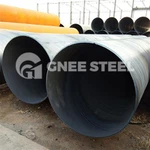


API 5L X60 Steel Pipe
What API 5L Grade X60 Is
The X number is not a strength in MPa. It is the minimum yield strength in thousand psi: X60 means 60,000 psi, which the standard prints as 415 MPa (60,200 psi) after conversion. The same grade appears in ISO 3183 as L415, where the number is the MPa value - which is why the two designations never line up to the last digit.
The API 5L X60 material is a micro-alloyed carbon steel - not an alloy pipe and not stainless. Niobium, vanadium and titanium are held below about 0.15 % combined to reach 415 MPa without a heavy carbon addition, and that is what keeps the carbon equivalent low enough to weld in the field. An X60 pipe is therefore defined by three things at once: the strength floor, the delivery condition, and the product specification level.
API 5L X60 Equivalent Material
The API 5L X60 equivalent material in other systems is the same steel under a different number, and the numbers differ by exactly the rounding discussed above:
| System | Designation | Where it does not line up |
|---|---|---|
| API 5L / ISO 3183 | X60 / L415 | Same document, two numbering systems |
| GB/T 9711 | L415 | Chinese national adoption of ISO 3183 |
| EN 10208-2 | L415MB / L415QB | M = TMCP, Q = quenched and tempered; yield ceiling 415–605 MPa is tighter than API's 565 |
| CSA Z245.1 | Grade 414 | Named on the 414 MPa conversion, not 415 |
| DIN 17172 | StE 415.7TM | Withdrawn; superseded by EN 10208-2, still on older drawings |
| ASTM A106 / A53 | - | Not equivalent. Different product standard, no toughness requirement, no PSL structure |
API 5L X60 PSL1 vs PSL2
The API 5L X60 PSL1 vs PSL2 question is the one that changes the invoice, and it is not a quality grade - it is a specification level. PSL1 sets composition and room-temperature strength. PSL2 adds a yield ceiling, mandatory impact testing, a carbon equivalent limit, full-length weld inspection and pipe-by-pipe traceability.
Four criteria decide it, in this order:
Consequence of failure. Gas transmission in a populated area, offshore, or anything an operator's integrity management plan covers - PSL2.
Design temperature. Below about 0 °C, PSL1 has no impact requirement at all, so nothing on the certificate tells you it is tough.
Owner specification. Most IOC and national pipeline specifications call PSL2 by default; a PSL1 quote is then non-compliant before price is discussed.
Traceability. If the QA file must map test results to an individual pipe, PSL1 cannot deliver it.
| Requirement | API 5L X60 PSL1 | API 5L X60 PSL2 |
|---|---|---|
| Yield strength | 415 MPa min, no maximum | 415 – 565 MPa |
| Tensile strength | 520 MPa min, no maximum | 520 – 760 MPa |
| Yield-to-tensile ratio | Not specified | ≤ 0.93 |
| Carbon equivalent | Not required | CEIIW ≤ 0.43 or Pcm ≤ 0.25, reported |
| API 5L X60 PSL2 impact | Not required | 0 °C: 27 J average, 20 J single |
| Weld NDT | Sampling | Full length |
| Traceability | Heat number | Pipe number |
| Delivery condition | Mill's option | Must be stated: R, N, M or Q |
That last row matters at quotation stage. An API 5L X60Q order is quenched and tempered; X60M is thermomechanically rolled and only applies to welded pipe; X60N is normalised. The suffix is part of the order, not a mill preference.
API 5L X60 Chemical Composition
The API 5L X60 chemical composition differs between PSL1 and PSL2 - and, inside each level, between seamless and welded pipe. Table 3 keeps all four columns apart because quotes that collapse them are quoting something the mill will not roll.
| Element, % max | PSL1 seamless | PSL1 welded | PSL2 seamless | PSL2 welded |
|---|---|---|---|---|
| Carbon | 0.28 | 0.26 | 0.24 | 0.22 |
| Manganese | 1.40 | 1.40 | 1.40 | 1.40 |
| Phosphorus | 0.030 | 0.030 | 0.025 | 0.025 |
| Sulphur | 0.030 | 0.030 | 0.015 | 0.015 |
| Silicon | - | - | 0.45 | 0.45 |
| Nb + V + Ti, combined | - | - | 0.15 | 0.15 |
| Carbon equivalent | Not required | Not required | 0.43 IIW / 0.25 Pcm | 0.43 IIW / 0.25 Pcm |
The C–Mn swap nobody quotes
Manganese is capped at 1.40 %, but the standard allows that ceiling to rise by 0.05 % for every 0.01 % of carbon left below its own limit - up to 1.75 % for L415. So a heat at C 0.18 % may legally run Mn near 1.70 %. Ask for both actuals, not the limits. A certificate showing C and Mn each "within limit" can still describe a much harder steel to weld than the one you designed around.
Mechanical Properties and the Two Numbers That Get Rounded
The API 5L X60 yield strength is 415 MPa minimum. In PSL2 there is also a ceiling of 565 MPa, and that ceiling is not decoration: it is what keeps the pipe weldable and gives it strain capacity in a settling soil. The API 5L X60 tensile strength is 520 MPa minimum, 760 MPa maximum in PSL2.
| Property | PSL1 | PSL2 |
|---|---|---|
| Yield strength, Rt0.5 | 415 MPa min (60,200 psi) | 415 – 565 MPa |
| Tensile strength, Rm | 520 MPa min (75,400 psi) | 520 – 760 MPa |
| Yield-to-tensile ratio | Not specified | ≤ 0.93 |
| Elongation | Formula, see below | Formula, see below |
| Charpy impact, 0 °C | Not required | 27 J avg / 20 J single |
| DWTT, welded OD ≥ 508 mm | Not required | ≥ 85 % shear average |
The API 5L X60 SMYS - specified minimum yield strength - is therefore 415 MPa, and it is the number design uses. But a large share of published tables print 414 MPa. That is not a different steel: 414 is 60,000 psi converted directly, while 415 is 60,200 psi, the figure the standard actually prints. The same slide produces 517 instead of 520 and 758 instead of 760. One page, one convention - mixing them makes a bid comparison meaningless before a single pipe is rolled.
Elongation Is a Formula, Not a Number
API 5L does not give X60 a fixed elongation percentage. It gives e = 1 940 × A0.2 / U0.9, where A is the test specimen's cross-sectional area in mm² and U is the specified minimum tensile strength in MPa. Change the specimen and the requirement changes:
| Specimen | A, mm² | Calculated minimum |
|---|---|---|
| Full-section or strip specimen (maximum area) | 485 | 24 % |
| Round bar, 12.7 mm | 130 | 18 % |
| Round bar, 9.1 mm | 65 | 16 % |
This is why a buyer who compares "18 %" on one certificate with "24 %" on another has learned nothing about the steel. Compare the specimen, then the number.
Size Range, Weight and Where Seamless Stops
The API 5L X60 specification covers pipe from NPS 1/2 upward, but the commercial range is narrower than the standard. Seamless X60 runs to about NPS 24 (OD 610 mm); beyond that the piercing and hot-expansion route stops being economic, and the same grade has to be ordered as LSAW or SSAW. Grade is not the constraint - product form is.
| NPS | OD, mm | API 5L pipe schedule | WT, mm | API 5L X60 weight, kg/m | Route |
|---|---|---|---|---|---|
| 6" | 168.3 | SCH 40 | 7.11 | 28.3 | Seamless |
| 8" | 219.1 | SCH 40 | 8.18 | 42.5 | Seamless / ERW |
| 12" | 323.9 | SCH 40 | 10.31 | 79.7 | Seamless / LSAW |
| 16" | 406.4 | SCH 40 | 12.70 | 123.3 | Seamless / LSAW |
| 20" | 508.0 | SCH 40 | 15.09 | 183.4 | LSAW / SSAW |
| 24" | 610.0 | SCH 40 | 17.48 | 255.4 | Seamless limit / SSAW |
For anything above 610 mm, the conversation moves to spiral welded pipe - same grade, same 415 MPa floor, different inspection and different price base.
API 5L Pipe Tolerance
The API 5L pipe tolerance is set as a percentage, not in millimetres, and one of the two directional values is the single most misquoted figure in this product:
| Item | Tolerance | Note |
|---|---|---|
| Pipe body OD | ± 0.75 % | 610 mm → ± 4.58 mm |
| Pipe end OD | Tighter than body, by size band | Per Table 10; confirm for your OD |
| Wall thickness | +15 % / −12.5 % | One-sided advantage to the mill; the minus side governs design |
| Length | − 0 / + 100 mm | SRL 5–7 m, DRL 11–13 m |
| Straightness | 0.15 % of length | Check at the ends, not mid-joint |
| Single pipe mass | +10 % / −3.5 % | Why the weighbridge never matches the table exactly |
Key Specifications: What an X60 Order Can Cover
Everything above gives the standard's minimums. This table gives the supply envelope - the lines an X60 order can actually be written against. A specification that stops at "API 5L X60, PSL2" is not orderable, because the mill still does not know the product form, the end finish, or who witnesses the test:
| Item | What can be supplied | Why the order has to say it |
|---|---|---|
| Standard and edition | API Spec 5L 46th edition, or ISO 3183:2019 (technically identical) | The edition governs every table on this page; a PO naming only "API 5L" leaves it open |
| Grade and suffix | X60 / L415, option M (thermomechanical), N (normalised), Q (quenched and tempered), QS (Q plus the sour annex) | The suffix is a mill route, not a label - it cannot be added after the pipe is rolled |
| Product level | PSL1 or PSL2 | PSL2 brings impact testing, a carbon equivalent ceiling and, on welded pipe, full-length seam NDT |
| Product form | Seamless NPS 1/2–24 · HFW/ERW to 24 · LSAW 16–56 · SSAW 24–120 | Same 415 MPa floor in all four; the inspection route and the price base are not the same |
| Outside diameter | 21.3–610 mm seamless · 406–1,422 mm LSAW · up to 3,048 mm SSAW | Past 610 mm the grade does not change but the certificate route does |
| Wall thickness | 3.2–25 mm seamless in routine production; heavier by agreement | The design uses nominal minus 12.5 %, not nominal - see Table 7 |
| Length | SRL 5–7 m or DRL 11–13 m; fixed lengths by agreement | Fixed length is a cutting decision, and it changes the yield per tonne |
| Pipe ends | Plain, or bevelled 30° +5°/−0° with a 1.6 mm ± 0.8 mm root face; plastic caps | Bevel and root face are the most common site complaint and the one thing a photo cannot show |
| Delivery condition | As-rolled, normalised (N), TMCP (M), quenched and tempered (Q) | Two heats of the same grade weld differently; the condition belongs on the certificate |
| Coating | Bare, shop primer, 3LPE to DIN 30670-1 / ISO 21809-1, FBE, 3PP, concrete weight coat | The pipe MTC does not prove the coating - it is a second specification and a second certificate |
| Inspection | Hydrostatic test, CVN impact (PSL2), seam NDT (PSL2 welded), dimensional check; third-party witness on request | Witness has to be booked against the production date, not the shipping date |
| Marking and documents | Stencil per joint - standard, grade, size, heat number, mill mark - plus an EN 10204 3.1 MTC | The heat number is the only thread running from a bundle back to a test record |
Four rows decide whether two quotes are comparable at all: product form, PSL, delivery condition and inspection scope. Two suppliers can both offer "X60 PSL2, 12 m, 3LPE" and be offering different pipes - one ERW with seam NDT, one seamless without - a spread on tonnage plus two different welding procedures at the tie-in.
X60 vs X65 vs X52 vs X70
The X60 vs X65 question is usually asked by someone whose wall calculation came out awkward. The difference between X60 and X65 pipe is 35 MPa of minimum yield and a different wall in the same pressure class - which is why the two are never swapped without re-running the design:
| Grade | Yield, MPa | Tensile, MPa | When it is the right answer |
|---|---|---|---|
| X52 / L360 | 360 – 530 | 460 – 760 | Lower pressure, easier field welding, more mill capacity |
| X60 / L415 | 415 – 565 | 520 – 760 | The default for medium-to-high pressure transmission |
| X65 / L450 | 450 – 600 | 535 – 760 | One wall step thinner than X60 at the same pressure |
| X70 / L485 | 485 – 635 | 570 – 760 | Large-diameter, long-distance; TMCP welded only in practice |
Step up a grade only when the wall saving pays for the tighter welding window. Above X60 the carbon equivalent ceiling does not move but the mill has less room to reach strength without alloying, and field welding at X70 with a heavy wall is where projects lose schedule. If the design is comfortable at X60, staying there is usually the cheaper decision.
Welding: Carbon Equivalent Sets the Preheat
API 5L X60 welding is decided before the first arc by one number on the certificate: CEIIW = C + Mn/6 + (Cr + Mo + V)/5 + (Ni + Cu)/15.
CE ≤ 0.40 - ambient preheat is normally enough on thin wall; the risk is moisture, not hardness.
CE 0.40 – 0.43 - preheat 50–100 °C once wall exceeds about 12 mm, and hold an interpass limit.
CE above 0.43 - outside the PSL2 limit. Either the heat is non-conforming or the WPS needs a qualified high-CE procedure.
The mechanism behind the ceiling is the micro-alloying itself. Niobium, vanadium and titanium are what let X60 reach 415 MPa at 0.10 % carbon, but in a fast-cooling HAZ their carbonitrides do not re-dissolve, and hardness climbs exactly where the residual stress is highest. That is why a PSL1 X60 heat with a high Mn-for-C substitution can be harder to weld than a PSL2 heat of the same grade - and why the actual C and Mn values, not the limits, belong in the welding procedure.
Sour Service: X60S, X60Q and What the Suffix Does Not Buy
X60 sour service is a separate qualification route, not a grade. It means NACE MR0175 / ISO 15156 compliance, hydrogen-induced cracking testing to NACE TM0284, sulphide stress cracking testing to NACE TM0177, and a hardness ceiling of 250 HV10 (about 22 HRC).
The suffix question, answered
X60Q vs X60QS - one letter, and it is not a strength step. Q is the quenched-and-tempered delivery condition; QS adds the sour-service annex on top of it. A certificate marked X60Q tells you nothing about HIC resistance. If the line carries wet H₂S, the qualification has to be in the purchase order from the start: steel rolled without the sour route cannot be tested into it afterwards, because the resistance comes from composition control and inclusion shape, not from an inspection.
API 5L X60 Line Pipe test and inspection


We supply API 5L X60 seamless to NPS 24 and LSAW or SSAW above it, PSL1 or PSL2, with impact testing run at the temperature you name and sour qualification written into the order rather than added afterwards.
FAQ
Does API 5L set a hardness limit for X60?
Not for general service. The only ceiling in play is the sour-service one - 250 HV10, roughly 22 HRC - and it belongs to the ISO 15156 / NACE MR0175 pair rather than to the pipe specification. On a line pipe certificate, hardness is normally a supplementary requirement the buyer adds, and it behaves like a welding acceptance item rather than a mill property.
Can X60 pipe be used at −20 °C or −45 °C?
Yes, if toughness at that temperature is ordered and tested. The standard Charpy requirement for PSL2 is stated at 0 °C; colder testing is a project addition and must appear in the purchase order together with its energy level. PSL1 carries no impact requirement of any kind, so low-temperature service there rests on assumption.
What does the "5L" in API 5L stand for?
It is the API standard number for line pipe - the "L" denotes line pipe, distinguishing it from standards for other product forms. The specification is jointly maintained with ISO 3183, which is why every requirement can be cited twice, once in API numbering and once in ISO numbering.
Is X60 pipe available with 3LPE or FBE coating?
Yes, and the coating is a second specification on the same order - DIN 30670-1 or ISO 21809-1 for 3LPE, not API 5L. One point of sequence matters more than the coating type: all mill tests, including hydrostatic and full-length NDT, must be completed before coating, because coated pipe cannot be inspected the same way afterwards.
Is API 5L X60 the same as ASTM A106 Grade B?
No. They share a strength neighbourhood and nothing else. A106 is a high-temperature service specification with no impact requirement and no PSL structure; API 5L is built around pressure containment and toughness. A106 Grade B is often offered where a line pipe was specified, and its certificate will not support the substitution.
Can I order X60 in small quantities or mixed sizes?
Seamless X60 is stocked in common sizes, so small quantities are practical in the middle of the range. Mixed sizes are possible, but each size carries its own minimum heat quantity - four sizes usually means four heats. PSL2 with sour requirements is the least flexible combination: quantities rise and lead time extends, because testing is per heat.
What is the difference between X60Q and X60QS?
Delivery condition versus sour qualification. Q is quenched and tempered; QS is quenched and tempered plus the sour-service annex. The strength requirements are identical - what changes is composition control, inclusion shape control, hardness ceiling and the HIC/SSC test programme. A Q certificate is not evidence of sour capability.
Can X60 pipe be bent on site?
Cold field bending is normal practice up to modest angles, and API 5L pipe is made for it, but the bend consumes ductility: the outside wall thins and ovality increases. Above roughly 3° per diameter, or where the wall is heavy, an induction bend made from the same heat is the safer route. Either way the bend specification belongs in the order, not in the field instruction.
Hot Tags: api 5l x60 steel pipe, China api 5l x60 steel pipe manufacturers, suppliers, 904 Brushed Polished Welded Stainless Steel Tube Pipe, 316 Stainless Steel Round Tube, UNS S32750, RA 330 Super Duplex Stainless Steel Pipe, 31803 Pipe For Fluid Transportboiler, EFW Tubes
Previous
ASTM A178 ERW Boiler TubesYou Might Also Like


Send Inquiry