




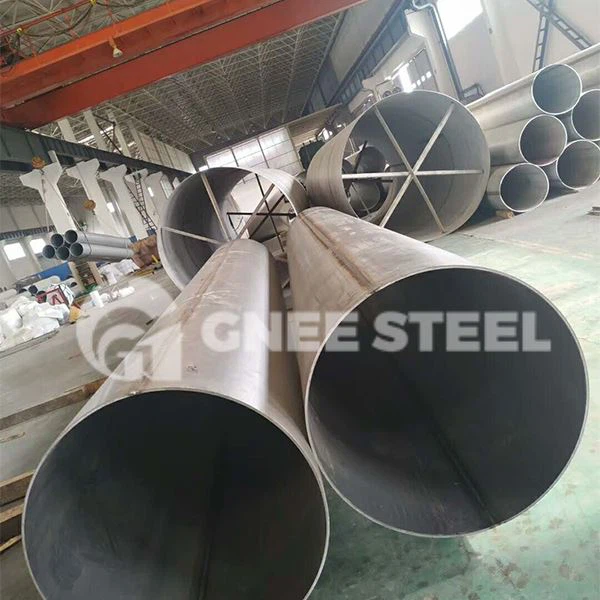


ASTM A213 Stainless Steel EFW Tubes
Type: EFW Stainless Steel Pipe
O.D.: 8" NB TO 110" NB
Length:Single Random Length, Double Random Length And Customize Size
A213 FEW SS Pipe Description
A213 welded pipe standard specifies the requirements for carbon steel and alloy steel pipes used in boilers and heat exchangers. It encompasses various grades including: 304, 304L, 304LN, 304H, 309S, 310S, 316, 316H, 316Ti, 316L, 316LN, 317L, 321, 321H, 347, 904L, SMO 254, 347H, ALLOY 254, 6MO, 6MOLY, UNS S31254, and others. According to the A213 specification, pipes must undergo ultrasonic testing. A213 stainless steel welded pipes are commonly used in industries such as chemical, and food processing.
A213 Stainless Steel Welded Pipe Specification
| Grades | 202, 304, 304L, 304LN, 304H, 309S, 310S, 316, 316H, 316Ti, 316L, 316LN, 317L, 321, 321H, 347, 904L, SMO 254, 347H, ALLOY 254, 6MO, 6MOLY, UNS S31254 ETC. |
| Type | WELDED / COLD DRAW / ERW / EFW / HOT FINISH / COLD FINISH |
| Outer Diameter Size | WELDED / ERW- 10 MM TO 114.3 MM OD |
| Wall Thickness | 0.8 MM TO 4 MM WALL THICKNESS |
| Length | 01 Meter to 12.5 Meters, Customize Size. |
| Ends | Plain Ends, Beveled Ends |
| Coating | Mechanical Polish, Electropolish, Satin Finish, Passivated |
| Other Testing | Product Analysis, Flattening Test, Stabilizing Heat Treatment, Intergranular Corrosion Test, Grain Size Test, Dual Grade, PWHT (POST WELD HEAT TREATMENT), Flare Test, Bend Test, Hardness Test, Tensile Test etc |
| Value Added Services | Draw / Expansion / Heat Treatment / Annealed / Machining / Sand Blasting / Shot Blasting / Bright Annealed |
| Packaging | Loose / Bundle / Plastic Cloth Wraps / Wooden Box / Plastic End Caps / Beveled Protector |
A213 Welded Stainless Pipe


Non-destructive testing (NDT) of A213 Stainless Steel Welded Pipes
Non-destructive testing (NDT) includes methods such as ultrasonic testing (UT), radiographic testing (RT), dye penetrant testing (PT), and magnetic particle testing (MT).
1. Radiographic Testing
Radiographic testing is a method of flaw detection that utilizes the penetration and attenuation properties of radiation in materials. Depending on the type of radiation used, it can be divided into three categories: X-ray radiography, gamma-ray radiography, and high-energy radiography. Each type of radiographic testing has different methods for displaying defects, including ionization, fluorescent screen observation, photography, and industrial television. Radiographic inspection is primarily used to detect internal defects such as cracks, incomplete penetration, porosity, and slag in welds.
2. Ultrasonic Testing
Ultrasonic waves propagate through metals and other homogeneous media, and reflections occur at interfaces between different media. Therefore, ultrasonic testing can be used to inspect internal defects. Ultrasonic testing can detect defects in any welding material and any part of the structure, and it can sensitively locate defect positions. However, it is relatively difficult to determine the nature, shape, and size of defects using ultrasonic testing alone. Therefore, ultrasonic testing is often used in conjunction with radiographic testing.
3. Magnetic Particle Testing
Magnetic particle testing detects defects by utilizing the magnetic flux leakage generated by magnetizing ferromagnetic A213 stainless steel pipes. Depending on the method of measuring magnetic flux leakage, it can be divided into magnetic particle inspection, magnetic induction inspection, and magnetic recording inspection, with magnetic particle inspection being the most widely used.
Magnetic particle testing can only detect defects on the surface and near-surface of magnetic A213 stainless steel pipes. It can only provide quantitative analysis of defects, and the nature and depth of defects can only be estimated based on experience.
4. Dye Penetrant Testing
Dye penetrant testing utilizes the permeability of certain liquids to discover and display defects. It includes two methods: color inspection and fluorescent inspection, which can be used to inspect the surface defects of both ferromagnetic and non-ferromagnetic materials.
Hot Tags: astm a213 stainless steel efw tubes, China astm a213 stainless steel efw tubes manufacturers, suppliers, Haynes 230 Welded Stainless Steel Pipe, 321 Stainless Steel Round Tube, Precision Inner Diameter Seamless Steel Tubes 317, 2507 Stainless Steel Tube, S31254 High Quality Super Duplex Steel Pipe, ASTM B36 19 321 Industrial Stainless Steel Pipes
You Might Also Like


Send Inquiry