


What is Slip-On Flange?
Slip-on Flange (SO Flange) refers to a type of flange connected to vessels or pipelines via fillet welds. It falls under the category of "loose" or "arbitrary" flanges. During design, its integrity with the straight pipe section determines whether it is evaluated as an integral or loose flange. The flange ring comes in two types: with or without a neck. Compared to weld neck flanges, slip-on flanges have simpler structures and lower material consumption but offer less rigidity and sealing performance. They are widely used for connecting medium- and low-pressure vessels and pipelines.
Features of Slip-on Flanges:
Space and weight savings: They reduce space requirements and weight while ensuring leak-free joints with excellent sealing performance.
Compact design: The sealing diameter is reduced, leading to a smaller sealing surface area.
Improved sealing: Gaskets are replaced with sealing rings to ensure precise sealing surface alignment, requiring minimal pressure for sealing.
Smaller bolts: With reduced pressure demands, bolt size and quantity can be minimized, resulting in a lightweight design (70%–80% lighter than traditional flanges).
Industrial significance: These flanges offer superior performance by reducing mass and space, making them highly valuable in industrial applications.
Sealing Principle of Slip-on Flanges:
Initial sealing: The two sealing surfaces squeeze the flange gasket via bolts to create a seal. However, this also risks seal failure.
Maintaining sealing: High bolt force is required to sustain sealing, necessitating larger bolts and nuts.
Challenges: Larger bolts increase flange bending risk, requiring thicker flange walls, which leads to heavier and bulkier structures-a critical issue in offshore environments where weight is a major concern.
Inefficiency: Slip-on flanges are inherently less effective in sealing, as 50% of bolt load is used for compressing the gasket, leaving only 50% for pressure containment.
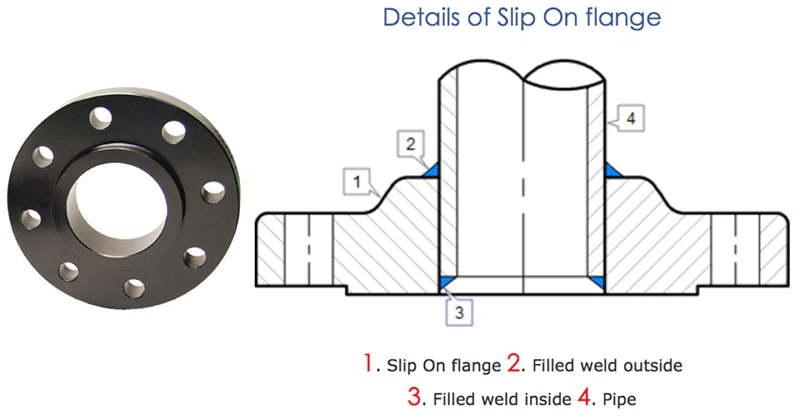
Specification
DN15-DN2000
Slip-On Flange Pressure Grade
PN series: PN2.5Mpa~PN40Mpa;
Class series: Class150~Class1500;
Slip-On Flange Standard
National standard of the People's Republic of China: GB/T 9116-2010 Steel Slip-On Flange;
Chemical industry standards of the People's Republic of China: PN series (European system) in HG/T20592~20635-2009, Class series (American system) in HG/T20592~20635-2009;
Slip-On Flange Materials
Carbon Steel Flange: ASTM A105, 20#, Q235, 16Mn, ASTM A350 LF1, LF2 CL1/CL2, LF3 CL1/CL2, ASTM A694 F42, F46, F48, F50, F52, F56, F60, F65 ,F70;
Stainless Steel Flange: ASTM A182 F304, 304L, F316, 316L, 1Cr18Ni9Ti, 0Cr18Ni9Ti, 321, 18-8;
Alloy Steel Flange: ASTM A182 F1, F5a, F9, F11, F12, F22, F91, A182F12, A182F11, 16MnR, Cr5Mo, 12Cr1MoV, 15CrMo, 12Cr2Mo1, A335P22, St45.8/Ⅲ;
Sealing Surface Types For Slip-On Flanges
RF (Raised Face);
FF (Flat Face);
MFM (Male-and-Female Face);
F (Female Face);
M (Male Face);
TG (Tongue and Groove Face);
Among them, the uneven surface (MFM) is a matching use;


