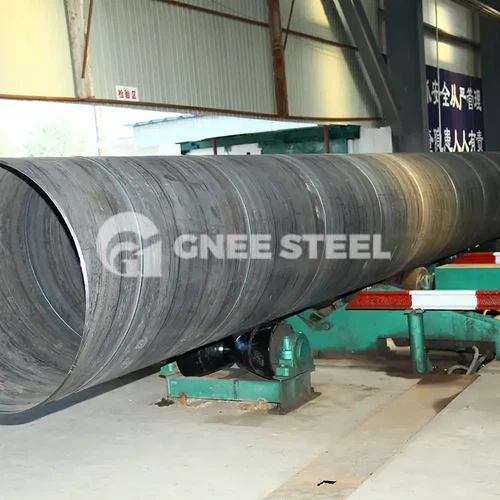
Double-sided submerged arc welding spiral steel pipe process: steel plate into the production line, the first full-plate ultrasonic inspection; 1. Milling: milling machine through the two edges of the steel plate on both sides of the milling machine, so as to achieve the required width, edge parallelism and bevel shape;
2. Pre-bending: the use of pre-bending machine for pre-bending of the plate edge, so that the edge of the plate has a curvature to meet the requirements of the curvature;

3. Forming: JCO molding machine in the first half of the pre-bent steel plate through a number of step stamping, then the other half of the steel plate is also bent, pressed into the "C" shape, and finally form an open "C" shape. Half of the steel plate through a number of step stamping, pressed into a "J" shape, and then the other half of the steel plate is also bent, pressed into a "C" shape, and finally form the opening of the "O" shape
4. pre-welding: after molding the steel pipe seam and gas shielded arc welding (MAG) for continuous welding;
5. internal welding: the use of longitudinal multi-wire submerged arc welding in the inside of the straight-seam steel pipe for welding; external welding: the use of longitudinal multi-wire submerged arc welding in the spiral submerged arc welding Welding on the outside of the steel pipe;
6. Ultrasonic inspection Ⅰ: 100% inspection of spiral steel pipe internal and external welds and welds on both sides of the base material;
7. X-ray inspection Ⅰ: 100% of the internal and external welds X-ray industrial television inspection, using image processing system to ensure the sensitivity of the flaw detection;
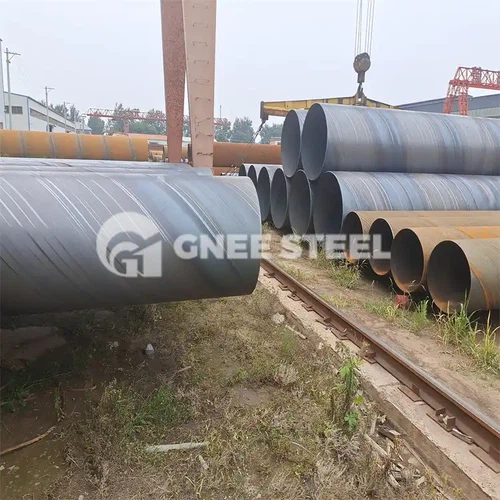
8. Expansion: the full length of the straight-seam steel pipe for the expansion of the steel pipe in order to improve the dimensional accuracy of the steel pipe, and to improve the distribution of internal stresses in the steel pipe.
9. Hydrostatic test: in the hydrostatic testing machine on the expanded steel pipe root by root inspection to ensure that the steel pipe to meet the standard requirements of the test pressure, the machine has an automatic record and storage function;
10. chamfering: the inspection of qualified steel pipe pipe end processing, to achieve the required size of the end of the pipe bevel;
11. ultrasonic inspection Ⅱ: once again root by root ultrasonic inspection to check the straight seam welded steel pipe in the expanded diameter, hydraulic pressure, may produce defects;
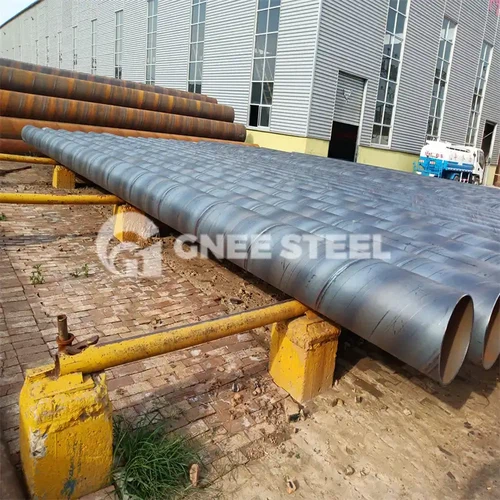
12. X-ray inspection Ⅱ: X-ray industrial TV inspection and tube end weld filming of steel pipe after expansion and hydrostatic test;
13. Pipe end magnetic particle inspection: this inspection is carried out to find out the defects of the pipe end;
14. Anti-corrosion and coating: qualified steel pipe according to the user's requirements of anticorrosion and coating. In addition to the above inspection items, according to the API standard and other related standards and some users' special requirements, it is also necessary to carry out destructive inspection and other inspections on steel plates and steel pipes, including the sampling of physical and chemical properties of incoming raw materials, and 100% appearance inspection of steel plates.