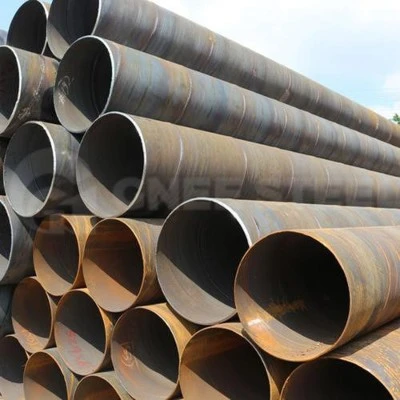
The following are some key technical requirements and steps about spiral welded pipe bevelling:
1. Bevel design
The bevel of spiral welded pipe usually includes inner bevel and outer bevel, in which the inner bevel is located on the inner wall side of the steel strip, the outer bevel is located on the outer wall side of the steel strip, and the blunt edge is located between the inner bevel and the outer bevel. The outer bevel of the outer bevel is usually designed as 45°-60° to increase the spatial position of the weld filler metal and effectively reduce the weld height, thus reducing the cost of corrosion protection of pipeline steel pipe. The inner bevel angle of the inner bevel is designed to be 30°-38°.
2. Bevelling
In the bevelling process, you need to use cutting equipment to cut the edge of the steel strip into the required V or U-shaped bevel, to ensure that the bevel angle and thickness of the blunt edge meet the design requirements. Depending on the thickness of the strip, the design and processing parameters of the bevel are adjusted accordingly. For example, for steel strip thicknesses between 10mm and 25.4mm, the depth of the outer bevel and the thickness of the obtuse edge of the outer bevel will be different to ensure weld quality and pipe life.
3. Preparation before welding
Before welding, the bevel needs to be cleaned and polished to remove dirt and rust around the bevel to ensure a clean and close fit during the welding process. At the same time, the bevel is ground until a metallic luster appears but without hurting the bevel angle to avoid welding defects.
4. Welding implementation
The welding implementation process needs to be carried out in strict accordance with the welding process instruction, including the selection of parameters such as welding current, voltage, welding speed, etc., as well as the planning of the welding sequence to ensure the uniformity of the weld and the minimisation of welding defects.
GNEE SSAW Welded Pipe for Sale