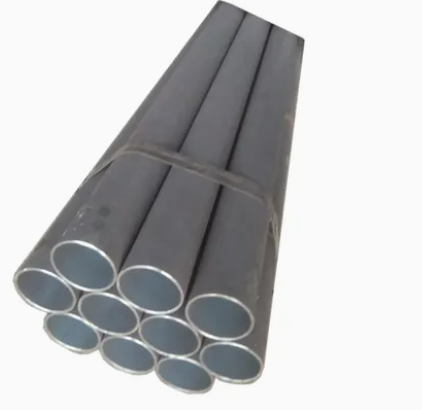
1. **What is ASME SA 335 grade P22?**
* ASME SA 335 grade P22 is a specification for seamless ferritic alloy-steel pipe intended for high-temperature service. It falls under the ASME Boiler and Pressure Vessel Code (BPVC) Section II, Material Specifications. P22 pipe is commonly used in power plants, refineries, and petrochemical plants for applications like high-pressure steam lines, headers, and superheaters where temperatures exceed those suitable for carbon steel. It is equivalent to ASTM A335 grade P22.
2. **What is P22 material grade?**
* P22 is a material grade designation within specifications like ASME SA 335 and ASTM A335. It refers to a specific chromium-molybdenum (Cr-Mo) alloy steel composition, primarily 2.25% Chromium and 1% Molybdenum. P22 is classified as a low-alloy steel offering significantly better high-temperature strength, creep resistance, and oxidation resistance compared to carbon steels. It is widely used for pressure-containing parts in elevated temperature service.
3. **What is the composition of ASTM A335 GR P22?**
* The chemical composition of ASTM A335 Grade P22 (equivalent to ASME SA335 P22) is specified as follows (values in weight percent, maximum unless noted as range):
* Carbon (C): 0.05 - 0.15%
* Manganese (Mn): 0.30 - 0.60%
* Phosphorus (P): 0.025% max
* Sulfur (S): 0.025% max
* Silicon (Si): 0.50% max
* Chromium (Cr): 1.90 - 2.60%
* Molybdenum (Mo): 0.87 - 1.13%
* Other elements (like Cu, Ni, V, etc.) have specific limits but are generally present only as residuals.
4. **What is the hardness of ASTM A335 P22?**
* The hardness of ASTM A335 P22 pipe depends on its heat treatment condition (typically normalized and tempered or annealed). The specification itself does not mandate a single hardness value but sets maximum hardness limits to ensure weldability and resistance to hydrogen-induced cracking (HIC), especially important for sour service. Common requirements include:
* **Maximum Hardness:** Often specified by the purchaser, common maximum limits are 197 HBW (Brinell) or 92 HRB (Rockwell B) or 22 HRC (Rockwell C) for the base material after heat treatment.
* **Typical Hardness Range:** In the normalized and tempered condition (most common for service), hardness typically falls within the range of **140-190 HBW**. Actual hardness depends on the specific tempering temperature used.
* **Hardness for Welding:** For welding procedure qualification and fabrication, maximum hardness limits in the weld Heat Affected Zone (HAZ) are often imposed (e.g., 241 HBW / 22 HRC max). Achieving this usually requires strict control of preheat, interpass temperature, and Post Weld Heat Treatment (PWHT).
5. **What is the difference between P11 and P22?**
* P11 and P22 are both Cr-Mo alloy steel grades within the ASTM A335/ASME SA335 specification for high-temperature pipe. The key differences are:
* **Chromium Content:** P11 has a lower chromium content (1.00 - 1.50%) compared to P22 (1.90 - 2.60%).
* **Molybdenum Content:** Both have similar molybdenum ranges (P11: 0.44 - 0.65%, P22: 0.87 - 1.13%).
* **High-Temperature Performance:** The higher chromium and molybdenum content in P22 provides significantly better:
* **Oxidation Resistance:** Especially important above ~565°C (1050°F).
* **Creep Strength:** Resistance to deformation under stress at high temperatures over long periods.
* **Tensile & Yield Strength:** Generally higher at elevated temperatures compared to P11.
* **Applications:** P11 is used for moderate high-temperature service (e.g., up to ~540°C / 1000°F). P22 is used for more severe high-temperature service (e.g., main steam lines, superheaters in power plants, typically 540°C - 580°C / 1000°F - 1075°F).
* **Weldability & PWHT:** Both require preheat, controlled interpass temperature, and PWHT. However, P22 generally requires slightly more stringent procedures and higher PWHT temperatures due to its higher alloy content. Its higher hardenability makes it more susceptible to hydrogen cracking if procedures aren't followed correctly.