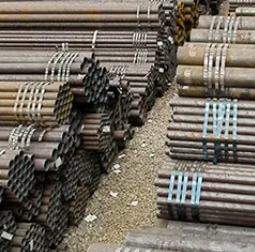
1. **What is EFW welded pipe?**
EFW stands for **Electric Fusion Welding**. It's a general term for pipes made by welding processes where an electric arc is used to melt both the filler metal and the base metal along the joint. The most common type under this category is **Submerged Arc Welded (SAW)** pipe, where the arc is submerged under a layer of flux. EFW/SAW pipes are typically used for larger diameters and thicker walls, common in pipelines and structural applications.
2. **What does ERW stand for in welding?**
ERW stands for **Electric Resistance Welding**. It's a process where high-frequency electrical current is passed through the edges of the steel strip (skelp) being formed into a pipe. The resistance to the current generates intense heat, melting the edges which are then pressed (forged) together under pressure to create a solid-state weld without adding filler metal.
3. **Is ERW pipe galvanized?**
**Not necessarily.** ERW refers specifically to the *welding process* used to manufacture the pipe. An ERW pipe can be made from uncoated steel ("black pipe") or it can be galvanized *after* welding. Galvanization (coating with zinc) is a separate process applied for corrosion protection. So, ERW pipes *can be* galvanized, but not all are.
4. **What is the difference between seamless and welded steel pipes?**
* **Seamless Pipe:** Made by piercing a solid billet of steel to create a hollow shell, then elongating it through rolling and drawing processes. It has **no welded seam** along its length.
* **Welded Pipe:** Made by forming flat steel plate or strip (skelp) into a cylindrical shape and then welding the edges together (using processes like ERW, EFW/SAW, etc.). It **has a welded seam**.
**Key Differences:**
* **Seam:** Seamless has none; Welded has one.
* **Strength/Uniformity:** Seamless pipe generally has more uniform strength characteristics around its circumference and is often preferred for high-pressure applications. The weld seam can be a potential weak point (though modern welding is very reliable).
* **Size/Cost:** Seamless is limited in diameter and generally more expensive. Welded pipe can be produced in very large diameters and is usually more cost-effective.
* **Surface/Internal Finish:** Seamless often has a rougher internal surface. Welded pipe can have a smoother finish but may have weld bead irregularities inside/out.
* **Wall Thickness:** Seamless tends to have more variation in wall thickness; Welded pipe has more consistent wall thickness.
5. **Does ERW pipe have a seam?**
**Yes, ERW pipe has a seam.** It is manufactured by forming strip steel and welding the longitudinal edges together using the Electric Resistance Welding process. This welded joint runs the entire length of the pipe and is known as the weld seam or fusion line. However, modern ERW processes produce a very fine, almost invisible seam that is often as strong as the base metal itself.