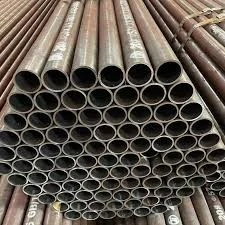
Q1: What pretreatment is required before welding?
Before welding, the pipe ends must be beveled (such as a V- or U-groove) to ensure good fusion. The surface must be cleaned to remove oil, rust, and mill scale, typically by grinding or chemical cleaning. For thick-walled pipe, preheating (100-200°C) may be necessary to prevent cold cracking. Welding consumables (electrodes or wires) must match the chemical composition of the steel pipe, such as E7018 electrodes or ER70S-6 wires. Furthermore, the welding environment should be dry to avoid moisture-induced porosity.
Q2: What welding methods and materials are recommended?
Common welding methods include manual metal arc welding (SMAW), submerged arc welding (SAW), gas shielded arc welding (GMAW/MIG), and tungsten inert gas welding (GTAW/TIG). SMAW and GMAW are more convenient for on-site installation, while SAW is suitable for large-scale factory production. Regarding welding consumables, low-carbon steel wire (such as ER70S-6) or low-hydrogen electrodes (such as E7018) provide good strength and toughness. Welding parameters should be adjusted according to the wall thickness to avoid overheating and lack of fusion. Post-weld visual inspection and non-destructive testing are recommended.
Q3: How can common welding defects be avoided?
Common defects include porosity, slag inclusions, lack of fusion, and cracks, which can be reduced by optimizing the welding process. Porosity is often caused by wet electrodes or insufficient shielding gas, so the welding consumables should be kept dry. Slag inclusions can be avoided by increasing the current and cleaning slag between passes. Lack of fusion can be addressed by adjusting the welding angle and speed. Cold cracking can be prevented by preheating and post-heating followed by slow cooling. Post-weld visual inspection should be performed, and X-ray or ultrasonic testing should be performed if necessary.
Q4: How do cold and hot working affect properties?
Cold working (such as cold drawing) can improve the dimensional accuracy and surface finish of steel pipes, but it can also reduce ductility and increase residual stresses. Hot working (such as hot rolling) improves material uniformity but may result in scale and dimensional variation. Cold-worked steel pipes typically require annealing to restore toughness, while hot-working may require normalizing to refine the grain size. Users should select the processing method based on the end use. For example, cold drawing is suitable for precision mechanical components, while hot rolling is often used for structural pipes.
Q5: How is post-weld heat treatment performed?
Post-weld heat treatment (PWHT) is primarily used to relieve weld residual stresses and improve toughness. A typical process involves holding at 600-650°C for 1 hour per inch of thickness, followed by slow cooling. PWHT is necessary for thick-walled pipes or highly restrained welds to prevent delayed cracking. Hardness testing is required after heat treatment to ensure that the hardness does not exceed standard limits (usually below 200 HB). If full heat treatment is not possible, local heating or vibration aging can be used as alternatives.