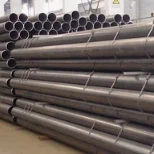
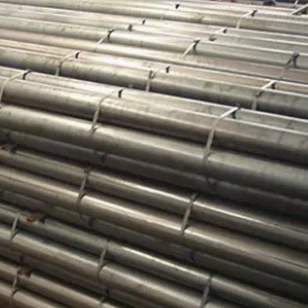
1. **What is an ASTM A312 pipe?**
ASTM A312 is a standard specification for **seamless, welded, and heavily cold worked austenitic stainless steel pipes**. These pipes are designed for high-temperature and general corrosive service applications. Common uses include chemical processing, oil and gas, power generation, food & beverage, and pharmaceutical industries.
2. **What is the difference between ASTM A312 and 316L?**
* **ASTM A312** is a **standard specification** that defines the manufacturing requirements (dimensions, tolerances, testing, etc.) for austenitic stainless steel pipes.
* **316L** is a specific **stainless steel alloy grade** characterized by its low carbon content and addition of molybdenum for improved corrosion resistance, especially against chlorides and acids.
* **Key Difference:** A312 is the *rulebook* for making certain types of stainless pipes. 316L is the specific *material* (chemical composition) used to make pipes conforming to standards like A312. You can have an ASTM A312 pipe made from 316L stainless steel.
3. **What is the difference between ASTM A358 and ASTM A312?**
* **ASTM A312:** Covers seamless, welded (any method), and heavily cold worked austenitic stainless pipes. It's the most general standard.
* **ASTM A358:** Specifically covers **electric-fusion-welded (EFW) austenitic stainless steel pipes** intended for *high-temperature service* and corrosive applications. Pipes under A358 are made with filler metal added.
* **Key Differences:**
* **Welding Method:** A358 is *exclusively* for EFW pipes (with filler metal), while A312 covers EFW pipes *plus* seamless pipes, other welded types (like ERW without filler), and cold-worked pipes.
* **Scope:** A358 pipes are specifically intended for high-temperature service and often have stricter testing requirements (like 100% radiography for certain classes) compared to standard A312 EFW pipes. A312 has broader general application.
* **Wall Thickness:** A358 typically covers pipes with *thinner walls* relative to their diameter compared to the seamless pipes in A312.
4. **What is the strength of ASTM A312?**
The strength of ASTM A312 pipes varies significantly depending on the specific stainless steel grade (e.g., 304, 304L, 316, 316L, 321, 347) and whether they are annealed or cold worked. Here are typical minimum strength values for common *annealed* grades:
* **Tensile Strength:** Generally ranges from **75 ksi (515 MPa)** for grades like 304L/316L to **80 ksi (550 MPa)** for grades like 304/316/321/347.
* **Yield Strength (0.2% Offset):** Generally ranges from **30 ksi (205 MPa)** for grades like 304L/316L to **35 ksi (240 MPa)** for grades like 304/316/321/347.
* **Important:** Cold worked pipes (designated TP304H CW, etc.) have significantly higher strengths. *Always consult the specific A312 revision and the grade's requirements for exact minimum strength values for a given application.*
5. **What are ASTM pipe grades?**
ASTM pipe grades are specific material designations defined within ASTM International standards. They indicate:
* The **chemical composition** (alloy elements and their percentages).
* The required **mechanical properties** (tensile strength, yield strength, hardness).
* The required **manufacturing process** (seamless, welded type).
* The intended **performance characteristics** (e.g., corrosion resistance, high-temperature strength, low-temperature toughness).
* **Examples:**
* **Carbon Steel:** A106 Grade B, A53 Grade B, A333 Grade 6.
* **Stainless Steel (Austenitic):** A312 TP304/304L, TP316/316L, TP321, TP347.
* **Stainless Steel (Duplex/Ferritic):** A790/A928 UNS S31803 (2205), UNS S32205, UNS S32750.
* **Alloy Steel (High-Temp):** A335 P11, P22, P91.
* **Alloy Steel (Low-Temp):** A333 Grade 3, Grade 6.