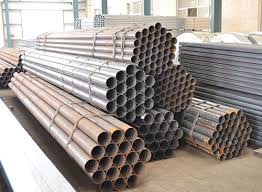
1. What is a carbon steel pipe, and what is its main composition?
A carbon steel pipe is a cylindrical hollow pipe made of carbon steel, which is an alloy primarily composed of iron (Fe) and carbon (C), with small amounts of other elements such as manganese (Mn), silicon (Si), phosphorus (P), and sulfur (S). The carbon content is the key factor determining its properties-usually ranging from 0.05% to 1.70% by weight. Unlike stainless steel, carbon steel does not contain a high percentage of chromium or nickel, which makes it more cost-effective but less resistant to corrosion in certain environments.
2. What are the main classifications of carbon steel pipes?
Carbon steel pipes can be classified in several ways based on different standards: (1) By carbon content: Low carbon steel pipes (C ≤ 0.25%), medium carbon steel pipes (0.25% < C ≤ 0.60%), and high carbon steel pipes (C > 0.60%). (2) By manufacturing process: Seamless carbon steel pipes (produced by hot rolling or cold drawing without welding seams) and welded carbon steel pipes (produced by welding steel plates or strips, including ERW, LSAW, and SSAW pipes). (3) By application: Industrial carbon steel pipes (for oil, gas, and chemical industries), construction carbon steel pipes (for water supply, drainage, and structural support), and mechanical carbon steel pipes (for machine parts and equipment).
3. What is the difference between seamless carbon steel pipes and welded carbon steel pipes?
The core difference lies in the manufacturing process and performance: Seamless carbon steel pipes are made by piercing a solid steel billet and then rolling or drawing it into a hollow pipe, so they have no welding seams. They have higher strength, better pressure resistance, and uniform wall thickness, making them suitable for high-pressure, high-temperature, and corrosive environments (such as oil and gas transmission). Welded carbon steel pipes are made by welding steel coils or plates, with a visible welding seam. They are cheaper to produce, have higher production efficiency, and are suitable for low-to-medium pressure applications (such as water supply, drainage, and general industrial pipelines). In terms of service life, seamless pipes generally have a longer service life in harsh environments, while welded pipes perform well in ordinary working conditions.
4. What are the common standards for carbon steel pipes used in international markets?
The most widely used international standards for carbon steel pipes include: (1) ASTM (American Society for Testing and Materials): Such as ASTM A106 (seamless carbon steel pipe for high-temperature service), ASTM A53 (welded and seamless carbon steel pipe for pressure and non-pressure service), ASTM A333 (seamless carbon steel pipe for low-temperature service). (2) API (American Petroleum Institute): Such as API 5L (specification for line pipe for oil and gas transmission), which is widely used in the oil and gas industry. (3) EN (European Standard): Such as EN 10210 (seamless steel tubes for pressure purposes) and EN 10219 (welded steel tubes for pressure purposes). (4) JIS (Japanese Industrial Standard): Such as JIS G 3454 (seamless carbon steel pipes for pressure service) and JIS G 3452 (welded carbon steel pipes). These standards specify the material, dimensions, mechanical properties, and testing requirements of carbon steel pipes to ensure their quality and safety in different applications.
5. What is the temperature range that carbon steel pipes can withstand?
The temperature resistance of carbon steel pipes depends on their carbon content and heat treatment. Generally, low-carbon seamless carbon steel pipes (such as ASTM A106 Grade B) can withstand temperatures ranging from -29°C to 427°C (-20°F to 800°F). Medium-carbon steel pipes have a slightly higher temperature resistance, up to 450°C to 500°C, but their toughness decreases at high temperatures. High-carbon steel pipes have poor high-temperature performance and are usually not used in high-temperature environments. When used in low-temperature environments (below -29°C), special low-temperature carbon steel pipes (such as ASTM A333 Grade 6) should be selected to avoid brittle fracture. It should be noted that long-term exposure to temperatures above 450°C will cause oxidation and creep of carbon steel pipes, reducing their service life.