



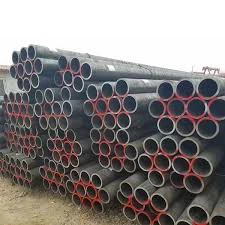
SA671 C100 Carbon Steel Boiler Steel Pipe
Introduction
ASTM A671 C100 is a high-strength, electric-fusion-welded carbon steel plate pipe primarily used for high-pressure and elevated temperature service in boilers and pressure vessels. It is part of the ASTM A671 specification, which covers custom-fabricated cylindrical steel pipes formed from plate and welded by an automatic arc process.
The "C" in C100 designates that the pipe is fabricated from plate material (as opposed to coil), and the "100" indicates its minimum specified yield strength of 100 ksi (690 MPa) at room temperature. This grade is designed for applications requiring superior strength and reliability in demanding environments.
Key Characteristics
Material: High-strength carbon steel.
Manufacturing Process: Electric-Fusion-Welded (EFW) from steel plates. Common weld types include Double-Welded Butt Joint (Class 1 through 12, depending on degree of radiography).
Key Property: Very high yield and tensile strength.
Typical Service Temperature: Up to approximately 650°F (343°C). For higher temperatures, allowable stress values from the applicable construction code (e.g., ASME BPVC) must be consulted.
Primary Application: Critical high-pressure piping in power generation boilers, petrochemical plants, and heavy industrial pressure vessels.
Standards: ASTM A671, often ordered to meet ASME BPVC requirements.
Chemical Composition (ASTM A671 C100, %)
| Element | Maximum Percentage (%) | Notes |
|---|---|---|
| Carbon (C) | 0.22 | Controlled for weldability and strength. |
| Manganese (Mn) | 1.35 | Enhances strength and hardenability. |
| Phosphorus (P) | 0.035 | Impurity, kept low for toughness. |
| Sulfur (S) | 0.035 | Impurity, kept low for weldability. |
| Silicon (Si) | 0.15 - 0.40 | Deoxidizer, improves strength. |
| Chromium (Cr) | 0.25 | May be present as a residual element. |
| Nickel (Ni) | 0.25 | May be present as a residual element. |
| Molybdenum (Mo) | 0.08 | May be present as a residual element. |
*Note: The steel is made to fine-grain practice and is fully killed. The plate material typically conforms to ASTM A515, A516, or similar specifications. Product analysis tolerances apply.*
Mechanical Properties
| Property | Value (Imperial) | Value (Metric) | Test Condition |
|---|---|---|---|
| Yield Strength (min) | 100 ksi | 690 MPa | Room Temperature |
| Tensile Strength (min) | 115 ksi | 795 MPa | Room Temperature |
| Elongation (min, %) | 16 | 16 | In 2 inches (50mm) Gauge Length |
| Impact Toughness (KV) | 20 ft-lb avg (27 J) | 20 ft-lb avg (27 J) | At specified test temp (often -20°F / -29°C or higher) |
*Impact Test Note: Charpy V-notch impact testing is optional for C100 unless specified in the purchase order. The required test temperature depends on the design service temperature and governing code. For low-temperature applications, lower-strength grades like C60/C70 may be more suitable.*
Heat Treatment
The finished pipe weld seam must be stress-relieved after welding, unless the weld is made using a process and with preheat/post-weld heat treatment that results in an "as-welded" structure with properties meeting the specification requirements. Full body normalizing or tempering may also be specified.
Non-Destructive Examination (NDE)
NDE is a critical requirement for A671 pipes. The specification defines several "Classes" based on the extent of radiography of the longitudinal weld seam:
Class 12: 100% radiography of weld length.
Class 22: Spot radiography (approx. 2% of weld length).
Class 32: No radiography required (for non-critical applications).
The required class is specified by the purchaser based on the design code.
Typical Applications
Main Steam Lines & Hot Reheat Lines in high-pressure fossil fuel power plants.
Boiler Headers and Manifolds requiring high pressure containment.
High-Pressure Process Piping in petrochemical and fertilizer plants.
Heavy-Wall Pressure Vessels and reactor shells.
Geothermal Power Plant Piping.
Comparison with Other Grades
| Feature | SA671 C100 | SA671 CC60/70 | SA333 Gr.6 |
|---|---|---|---|
| Strength Level | Very High (100 ksi YS) | Medium-High (60/70 ksi YS) | Moderate (35 ksi YS) |
| Primary Purpose | High-Pressure & High-Temperature Service | General Boiler/Pressure Vessel Service | Low-Temperature Toughness |
| Key Property | Tensile/Yield Strength | Weldability & General Strength | Impact Toughness at -45°F (-43°C) |
| Typical Temp Range | Elevated Temperatures (up to ~650°F) | Elevated Temperatures | Sub-zero to Ambient |
| Impact Test | Optional (unless specified) | Not required by base spec | Mandatory (at design low temp) |
| Cost | Higher (due to higher alloy/processing) | Moderate | Moderate (cost added by impact testing) |
Standards & Certification
Primary Standard: ASTM A671 - Standard Specification for Electric-Fusion-Welded Steel Pipe for High-Pressure Service at Moderate Temperatures.
Construction Code: Almost exclusively used in accordance with the ASME Boiler and Pressure Vessel Code (BPVC), Section I (Power Boilers) or Section VIII (Pressure Vessels).
Certification: Supplied with a comprehensive Mill Test Certificate (MTC) conforming to EN 10204 Type 3.2, including plate mill certs, chemical analysis, mechanical tests, NDE reports, and heat treatment records. Full traceability is essential.
Critical Note: SA671 C100 represents a specialized, high-performance material. Its selection, welding procedure qualification, and fabrication must strictly adhere to the applicable ASME BPVC section and involve detailed engineering review due to its high strength and associated welding considerations (preheat, post-weld heat treatment, etc.).


