


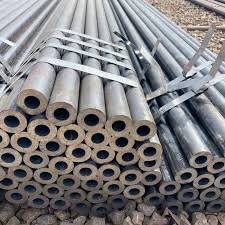

Overview
SA-213 T91 is a chromium-molybdenum alloy steel, specifically designed for high-temperature service. It is one of the most widely used grades in the construction of modern, high-efficiency power plants. The "T" designation signifies it is a seamless tube.
Its primary advantage is its exceptional creep strength (resistance to deformation under long-term exposure to high stress and temperature) compared to earlier grades like T22 (2.25Cr-1Mo).
Key Characteristics & Advantages
High-Temperature Strength: Can operate continuously at metal temperatures up to about 625°C (1157°F). This allows for higher steam pressures and temperatures, leading to greater power plant efficiency.
Excellent Creep and Rupture Strength: Its microstructure is stabilized to resist deformation and failure over long periods (100,000+ hours) at high stress and temperature.
Good Oxidation & Corrosion Resistance: The 9% Chromium content provides much better resistance to steam oxidation and hot corrosion (sulfidation) than low-alloy steels like T11, T12, and T22.
Good Thermal Fatigue Resistance: Can withstand the cyclic stresses induced by heating and cooling.
Weldability: It is weldable, but requires strict control of procedures and post-weld heat treatment (PWHT).
Chemical Composition (ASTM A213/A213M Standard)
The composition is critical to achieving the desired properties.
| Element | Composition (%) |
|---|---|
| Carbon (C) | 0.08 - 0.12 |
| Manganese (Mn) | 0.30 - 0.60 |
| Phosphorus (P) | 0.020 max |
| Sulfur (S) | 0.010 max |
| Silicon (Si) | 0.20 - 0.50 |
| Chromium (Cr) | 8.00 - 9.50 |
| Molybdenum (Mo) | 0.85 - 1.05 |
| Vanadium (V) | 0.18 - 0.25 |
| Niobium (Nb) | 0.06 - 0.10 |
| Nickel (Ni) | 0.40 max |
| Aluminum (Al) | 0.02 max |
| Nitrogen (N) | 0.030 - 0.070 |
Why these elements?
Cr & Mo: Provide solid solution strengthening and corrosion resistance.
V & Nb (Cb): Form fine, stable carbides and carbonitrides that provide the key precipitation strengthening and inhibit dislocation movement at high temperatures.
N: Works with V and Nb to form the strengthening carbonitrides and helps stabilize the microstructure.
Mechanical Properties (ASTM A213/A213M Standard)
| Property | Requirement |
|---|---|
| Tensile Strength | ≥ 585 MPa (85,000 psi) |
| Yield Strength | ≥ 415 MPa (60,000 psi) |
| Elongation | ≥ 20% (in 2 inches or 50mm) |
| Hardness | ≤ 250 HBW (Brinell) or 265 HV (Vickers) |
Metallurgy & Heat Treatment
The superior properties of T91 are a direct result of a specific heat treatment process:
Normalizing: Heated to a high temperature (approx. 1040-1080°C / 1900-1975°F) to form a homogeneous austenite structure and dissolve the alloying elements.
Tempering: Rapidly cooled (air quenched) and then reheated to a lower temperature (approx. 730-780°C / 1350-1435°F). This tempers the martensite and precipitates the fine, strengthening carbides and carbonitrides of V, Nb, and Cr.
The resulting microstructure is tempered martensite, which is exceptionally strong and stable at high temperatures.
Common Applications
SA-213 T91 pipes are used in the heat transfer sections of boilers and superheaters where temperatures and pressures are most severe.
Superheater Tubes
Reheater Tubes
Waterwall Panels (in high-duty areas of advanced boilers)
High-Temperature Headers and Piping (though these are typically made from the equivalent piping specification, SA-335 P91)
Fabrication and Welding Considerations
Working with T91 requires special care:
Preheating: Mandatory to prevent cold cracking. Typical preheat is 200-250°C (400-480°F).
Welding Consumables: Must use matching chemistry filler metals (e.g., ER90S-B9 for TIG, E9015-B9 for SMAW).
Post-Weld Heat Treatment (PWHT): Absolutely critical. Must be performed within a specific temperature range (typically 730-760°C / 1350-1400°F) for a sufficient time to restore the microstructure and toughness in the heat-affected zone (HAZ). Failure to do so can lead to premature failure.
Controlled Cooling: After welding, the component should be allowed to cool slowly to the preheat temperature before PWHT.
Comparison with Other Grades
vs. T22 (2.25Cr-1Mo): T91 is significantly stronger. This allows for thinner tube walls, improving heat transfer and reducing thermal stress and weight.
vs. T92 / T911: These are advanced 9% Cr steels with the addition of Tungsten (W) and Boron (B), offering even higher creep strength for the most advanced ultra-supercritical (USC) plants. T91 is a predecessor to these grades.
Important Note on "Carbon Steel" Classification
While it is common to refer to T91 as a "boiler steel," calling it a "Carbon Steel" is technically a misnomer. It is a low-alloy steel with a significant amount of alloying elements (totaling over 10%). True carbon steels for boilers (like SA-210 A1/C) have minimal alloy content and are used for lower temperature sections like waterwalls and economizers.
Summary
SA-213 T91 is a foundational material for high-efficiency thermal power generation. Its optimized chemistry and controlled heat treatment deliver an unmatched combination of high-temperature strength, creep resistance, and corrosion resistance for its class, making it the workhorse alloy for critical superheater and reheater tubing.


