


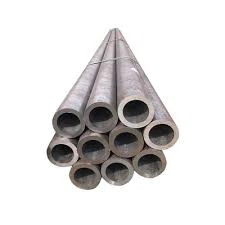

Overview
SA-210A1 is a standard specification for seamless medium-carbon steel boiler and superheater tubes. It is one of the most common and fundamental materials used in the construction of power boilers, industrial boilers, and heat exchangers. The "A1" designation signifies a specific grade within the broader SA-210 standard.
This material is governed by the ASTM A210/A210M standard (the "M" denotes metric units), which is adopted by the ASME (American Society of Mechanical Engineers) Boiler and Pressure Vessel Code as SA-210.
Key Characteristics
Material: Medium-Carbon Steel
Manufacturing Process: Seamless (Mandrel rolled or pierced and drawn). This creates a homogeneous tube without a welded seam, which is critical for high-pressure applications.
Primary Application: Boiler tubes, superheater tubes, and heat exchanger tubes.
Chemical Composition (%)
The composition is carefully controlled to ensure weldability, strength, and structural stability.
| Element | Composition (%) |
|---|---|
| Carbon (C) | 0.13 - 0.19 |
| Manganese (Mn) | 0.45 - 0.65 |
| Phosphorus (P), max | 0.025 |
| Sulfur (S), max | 0.025 |
| Silicon (Si) | ≥ 0.10 |
Note: A higher silicon content improves resistance to oxidation (scaling) and enhances strength at elevated temperatures.
Mechanical Properties
These properties are key to its performance under pressure and heat.
| Property | Value |
|---|---|
| Tensile Strength, min | 415 MPa (60,000 psi) |
| Yield Strength, min | 255 MPa (37,000 psi) |
| Elongation, min | - 30% (on 2-in. gauge length) - 16% (on 8-in. gauge length) |
Key Advantages & Why It's Used
Good Strength at Elevated Temperatures: SA-210A1 maintains its mechanical strength at the operating temperatures typically found in boiler and superheater sections (generally up to ~450°C / 850°F). For higher temperatures, alloy steels like SA-213 T11/T22 are used.
Excellent Thermal Conductivity: As a carbon steel, it efficiently transfers heat from the combustion gases to the water inside the tube, which is the core function of a boiler.
Cost-Effective: It is significantly less expensive than alloy steels, making it the economical choice for sections of the boiler where temperatures are not excessively high.
Good Weldability and Formability: Its medium carbon content makes it relatively easy to weld and bend into the required shapes for boiler construction, compared to higher carbon steels.
Pressure Tightness: The seamless manufacturing process ensures the tube can withstand high internal pressures without leaking.
Common Applications
SA-210A1 tubes are used in areas of a boiler system that are subject to moderate temperatures:
Water-Wall Tubes: The walls of the furnace where water is heated.
Economizer Tubes: Pre-heats the feedwater using the flue gas exiting the boiler.
Generating Bank Tubes: The main section where saturated steam is produced.
Low-Temperature Superheater Sections: (The initial stages).
Heat Exchangers in various process industries.
Comparison with Other Common Boiler Tube Grades
It's helpful to see how SA-210A1 compares to its close relatives.
| Grade | Type | Key Difference | Typical Use Case |
|---|---|---|---|
| SA-210 A1 | Medium-Carbon Steel | The baseline, general-purpose grade. | Most boiler sections with moderate temperatures. |
| SA-210 C | Medium-Carbon Steel | Higher Manganese (0.93-1.35%). This gives it higher strength than A1. | Used where higher strength is needed without moving to an alloy steel. |
| SA-178 C | Electric Resistance Welded (ERW) | Similar chemistry to A1, but welded, not seamless. Cheaper but for lower pressure/temperature. | Low-pressure boilers, non-critical heat exchangers. |
| SA-213 T11 / T22 | Chromium-Molybdenum Alloy Steel | Contains Cr (1.25%) and Mo (0.5%). Much better high-temperature strength and creep resistance. | High-temperature superheaters and reheaters. |
Important Considerations
Temperature Limit: While it performs well at moderate temperatures, SA-210A1 should not be used in high-temperature superheater sections where metal temperatures exceed ~455°C (850°F). At these temperatures, its strength drops significantly, and oxidation becomes a concern.
Corrosion: It is not corrosion-resistant. The internal water chemistry must be properly treated to prevent scaling and corrosion. External corrosion from flue gases can also be an issue if not managed.
Standards Compliance: When used in pressure equipment, it is essential that the material is supplied with the proper certification (e.g., Mill Test Certificate) to verify it meets the requirements of the ASME code.
In summary, SA-210A1 is a workhorse material for the power and process industries, providing an optimal balance of strength, thermal conductivity, manufacturability, and cost for a wide range of boiler and pressure tube applications.


