


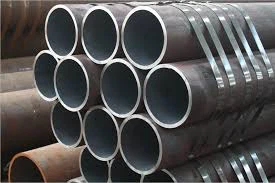
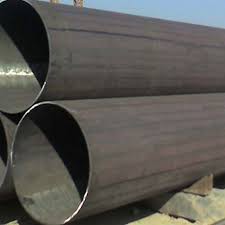
What is S275 Carbon Steel Pipe?
S275 is a non-alloy, low carbon structural steel grade defined by the European standard EN 10210 and EN 10219. The "S" stands for "Structural Steel," and the "275" indicates the minimum yield strength of 275 MPa (Megapascals) for thicker sections (≤ 16mm).
Pipes made from S275 steel are primarily used in structural applications where high strength and good weldability are required.
Key Characteristics & Mechanical Properties
The properties can vary slightly based on the manufacturing standard (hot-finished vs. cold-formed) and the wall thickness.
1. Mechanical Properties (Typical for EN 10210-1 - Hot Finished):
| Thickness (t) | Yield Strength (ReH), min (MPa) | Tensile Strength (Rm), (MPa) | Elongation, min (%) |
|---|---|---|---|
| t ≤ 16 mm | 275 MPa | 410 - 560 MPa | 22 |
| 16 mm < t ≤ 40 mm | 265 MPa | 410 - 560 MPa | 22 |
| 40 mm < t ≤ 63 mm | 255 MPa | 410 - 560 MPa | 22 |
| 63 mm < t ≤ 80 mm | 245 MPa | 410 - 560 MPa | 21 |
*Note: For cold-formed pipes (EN 10219), the yield strength values are generally higher due to the cold-forming process.*
2. Chemical Composition (Approximate, by weight %):
The composition is controlled to ensure weldability and mechanical properties.
Carbon (C): 0.21% max
Manganese (Mn): 1.50% max
Silicon (Si): 0.55% max
Phosphorus (P): 0.035% max
Sulfur (S): 0.035% max
The low carbon content is a key factor in its excellent weldability.
3. Key Features:
Good Strength-to-Weight Ratio: Offers a solid balance of strength without being excessively heavy.
Excellent Weldability: Can be easily welded using all standard methods without pre- or post-heating in most cases.
Good Machinability: Relatively easy to cut, drill, and machine.
Ductility: Can undergo significant deformation before failure, which is a safety advantage in structures.
Cost-Effective: A widely available and economical choice for many structural projects.
Manufacturing Standards and Designations
S275 pipe is produced under two main European standards, which define the manufacturing process:
EN 10210: Hot Finished Structural Hollow Sections
Process: The pipe is formed and shaped at high temperatures (above the recrystallization point).
Characteristics: Softer, more normalized microstructure, better resistance to fatigue, and no residual stresses from cold-working. The corners have a larger radius.
Common Designation: S275J2H or S275J0H. The "J2" and "J0" indicate impact toughness (Charpy V-Notch) at -20°C and 0°C, respectively.
EN 10219: Cold Formed Structural Hollow Sections
Process: The pipe is formed from sheet or strip at room temperature, which work-hardens the steel.
Characteristics: Higher yield strength, sharper corners, and potentially higher residual stresses.
Common Designation: S275J2H (Cold formed) or similar.
Equivalent Grades in Other Standards:
US ASTM A500: Grade B is a very close equivalent, though the exact chemical and mechanical properties differ slightly.
Chinese GB/T 6728: Q275 is a general equivalent.
Common Applications
S275 steel pipes are ubiquitous in construction and engineering:
Building Frames: Columns, beams, and trusses in commercial and industrial buildings.
Structural Supports: For platforms, walkways, and mezzanines.
Architectural Structures: Roofing supports, canopies, and exposed structural elements.
General Mechanical Engineering: For frames and supports in machinery and equipment.
Infrastructure Projects: Used in bridges, stadiums, and other large-scale constructions.
S275 vs. S355: A Key Comparison
This is the most common comparison in structural steel. S355 is a higher-strength steel.
| Feature | S275 Steel | S355 Steel |
|---|---|---|
| Minimum Yield Strength | 275 MPa (for t ≤ 16mm) | 355 MPa (for t ≤ 16mm) |
| Tensile Strength | 410 - 560 MPa | 470 - 630 MPa |
| Carbon Content | Lower (~0.21% max) | Slightly Higher (~0.22% max) |
| Weldability | Excellent | Very Good (but may require more care) |
| Cost | Lower | Higher |
| Weight for Same Load | Higher (requires thicker sections) | Lower (can use thinner, lighter sections) |
When to Choose Which?
Choose S275: For cost-sensitive projects where weight is not a critical constraint, and where excellent weldability is a top priority.
Choose S355: When you need to minimize weight (e.g., in long spans or high-rise buildings) or where higher load-bearing capacity is needed, justifying the higher material cost.
Summary
S275 Carbon Steel Pipe is a versatile, economical, and widely used structural material. Its combination of good strength, easy fabrication, and excellent weldability makes it a default choice for a vast range of construction and engineering applications, from simple support frames to complex architectural structures. When selecting it, pay close attention to the manufacturing standard (EN 10210 vs. EN 10219) based on your project's requirements for strength, tolerances, and stress state.


