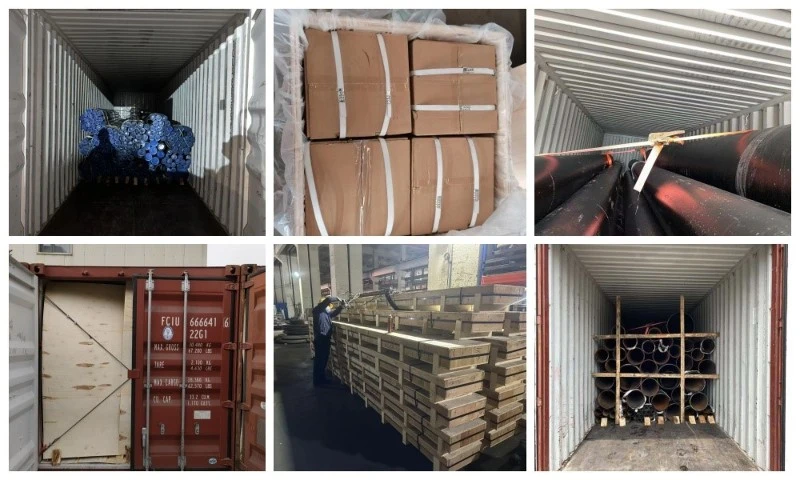
Q345B welded steel pipe larger diameter spiral pipe description
Q345B spiral pipe is a spiral seam steel pipe made from strip steel coils through room temperature extrusion and automated double-wire double-sided submerged arc welding. Its production encompasses key stages such as raw material inspection, forming and welding, and non-destructive testing, including strip pretreatment, weld gap control, internal and external submerged arc welding, and ultrasonic testing, ensuring weld quality and pipe performance. Finished products must undergo hydrostatic testing and beveling before being put into use, meeting all required standards.
Chemical Composition Table (Melting Analysis, %)
| Element | Standard Requirement (GB/T 1591-2018) | Typical Value (Reference) |
|---|---|---|
| Carbon (C) | ≤ 0.20% | 0.15~0.18% |
| Silicon (Si) | ≤ 0.55% | 0.20~0.40% |
| Manganese (Mn) | 1.00~1.60% | 1.20~1.50% |
| Phosphorus (P) | ≤ 0.035% | ≤0.025% |
| Sulfur (S) | ≤ 0.035% | ≤0.020% |
| Vanadium (V) | 0.02~0.15% (optional) | 0.03~0.08% |
| Niobium (Nb) | 0.015~0.060% (optional) | 0.02~0.04% |
| Carbon Equivalent (Ceq) | ≤ 0.44% (Ceq = C + Mn/6 + (Cr+Mo+V)/5 + (Ni+Cu)/15) | 0.38~0.42% |
Spiral Welded Pipe Performance (GB/T 9711-2017 PSL1/L245)
| Property | Requirement | Test Method |
|---|---|---|
| Tensile Strength (Rm) | 460~670 MPa | API 5L Annex H |
| Yield Strength (Rt0.5) | ≥ 245 MPa (L245 grade) | API 5L Annex H |
| Flattening Test | No cracking at 80% D | API 5L Annex D |
| Impact Test (0°C) | ≥ 27J (weld/HAZ/base) | ASTM A370 |
| Hydrostatic Test | ≥ 95% SMYS for 5~10 sec | API 5L Annex F |
| Hardness (HV10) | ≤ 248 (Carbon steel) | ISO 6507-1 |
Production Process
(1) Raw materials, namely steel strip coils, welding wire, and flux, undergo rigorous physical and chemical testing before being used.
(2) The ends of the steel strip are butt-welded using single-wire or double-wire submerged arc welding. After being rolled into steel pipes, automatic submerged arc welding is used for further welding.
(3) Before forming, the steel strip undergoes leveling, edge trimming, edge planing, surface cleaning, conveying, and pre-bending.
(4) The pressure of the hydraulic cylinders on both sides of the conveyor is controlled by an electric contact pressure gauge to ensure stable conveying of the steel strip.
(5) External or internal control roller forming is used.
(6) A weld gap control device is used to ensure that the weld gap meets welding requirements. Pipe diameter, misalignment, and weld gap are all strictly controlled.
(7) Both internal and external welding use Lincoln Electric welding machines from the USA for single-wire or double-wire submerged arc welding to obtain stable welding specifications. (8) All welds are inspected using an online continuous ultrasonic flaw detector, ensuring 100% non-destructive testing coverage of the spiral welds. If defects are found, an automatic alarm is triggered and a mark is sprayed, allowing production workers to adjust process parameters and eliminate defects promptly.
(9) Steel pipes are cut into individual sections using an air plasma cutter.
(10) After being cut into individual pipes, the first three pipes of each batch undergo a strict first-pass inspection system. This involves checking the mechanical properties, chemical composition, fusion status, surface quality of the weld, and non-destructive testing to ensure the pipe manufacturing process is up to standard before formal production begins.
(11) Areas with continuous ultrasonic flaw detection marks on the weld are manually inspected using ultrasonic and X-ray methods. If defects are found, they are repaired and then re-inspected using non-destructive testing until the defects are confirmed to be eliminated.
(12) All butt welds on the strip steel and the pipes containing T-joints intersecting with the spiral welds are inspected using X-ray television or radiography. (13) Each steel pipe undergoes a hydrostatic pressure test, with radial sealing applied. The test pressure and time are strictly controlled by a computer-controlled hydrostatic pressure monitoring device. Test parameters are automatically printed and recorded.
(14) The pipe ends are machined to ensure accurate control of end face perpendicularity, bevel angle, and blunt edge.
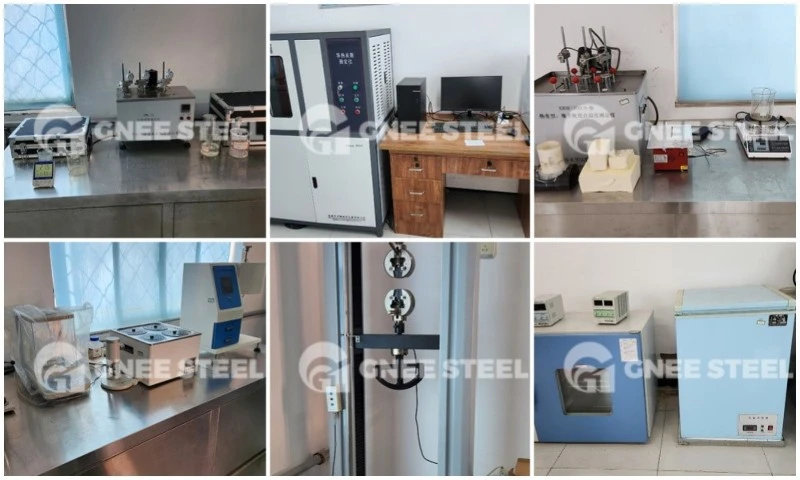
Test and inspcetion
Packaging and shipping