



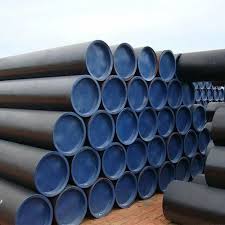
At a Glance: What is Q125 Seamless Pipe?
Q125 is a seamless steel pipe grade defined by the API (American Petroleum Institute) specification 5CT. It is one of the highest strength grades used for OCTG (Oil Country Tubular Goods), which includes products like casing and tubing.
The "Q" stands for "Quenched and Tempered," which is the heat treatment process required to achieve its high strength and toughness. "Seamless" means the pipe is formed from a solid cylindrical steel billet, creating a product with no welded seam. This makes it exceptionally strong and reliable for critical, high-pressure applications.
Key Characteristics and Specifications
1. API 5CT Standard
Q125 is strictly governed by the API 5CT standard, which ensures consistent chemical composition, mechanical properties, dimensional tolerances, and testing procedures. It is crucial to source Q125 pipes from API-licensed manufacturers to guarantee performance.
2. Grade and Category
Grade: Q125
Category: This is a premium grade and falls into the high-strength categories of API 5CT. It is more demanding than common grades like J55, K55, N80, and L80.
3. Mechanical Properties
The "125" in Q125 refers to its minimum yield strength of 125,000 psi (862 MPa). Its key mechanical properties are:
| Property | Value | Notes |
|---|---|---|
| Minimum Yield Strength | 125,000 psi (862 MPa) | This is the stress at which the material begins to deform plastically. |
| Maximum Yield Strength | 150,000 psi (1,034 MPa) | There is an upper limit to ensure adequate toughness. |
| Minimum Tensile Strength | 135,000 psi (931 MPa) | The stress at which the material will fracture. |
| Hardness (HRC) | Maximum 42.0 (for C-90 and above, including Q125) | Controlled to prevent sulfide stress cracking (SSC) in sour service. |
4. Heat Treatment
Q125 must be Quenched and Tempered (Q&T). This process involves:
Quenching: Heating the steel to a very high temperature and then rapidly cooling it. This creates a very hard but brittle microstructure (martensite).
Tempering: Re-heating the quenched steel to a lower temperature to reduce brittleness and increase toughness while maintaining high strength.
5. Sour Service Capability
Standard Q125 is not automatically rated for sour service (environments containing H₂S, which can cause sulfide stress cracking). However, special versions like Q125-S are available. The "S" designation means the pipe has undergone additional testing and has stricter controls on chemistry, hardness, and heat treatment to resist SSC.
Advantages of Seamless Q125 Pipe
Exceptional Strength: Its high yield strength makes it ideal for deep wells, high-pressure formations, and challenging drilling conditions.
High Pressure Integrity: The absence of a weld seam eliminates a potential weak point, making it the best choice for containing extreme internal and external pressures.
Superior Impact Toughness: The Q&T process gives it excellent resistance to shock loading and brittle fracture.
Consistent Wall Thickness: The seamless manufacturing process allows for very uniform wall thickness around the circumference, which is critical for pressure containment and threading.
Common Applications
Q125 seamless pipe is used in the most demanding oil and gas applications:
Deepwater and Ultra-Deepwater Wells: Where external pressures are immense.
High-Pressure/High-Temperature (HPHT) Wells: To withstand extreme downhole conditions.
Casing and Tubing in Critical Zones: Used as production casing or tubing in the reservoir section where pressure and corrosion risks are highest.
Tie-Back Strings and Liners: For well completion and integrity in complex well designs.
Comparison with Other Common OCTG Grades
| Grade | Min. Yield Strength (psi) | Typical Use Case | Key Difference from Q125 |
|---|---|---|---|
| J55 / K55 | 55,000 | Shallow, low-pressure wells | Much lower strength, less expensive. |
| N80 | 80,000 | Standard, general-purpose casing | Good balance of strength and cost. |
| L80 | 80,000 | Sour service applications | Similar strength to N80 but SSC resistant. Not as strong as Q125. |
| P110 | 110,000 | High-pressure wells | High strength, but Q125 is stronger and has better toughness. |
| Q125 | 125,000 | Deep, HPHT, critical wells | Highest standard grade, superior strength/toughness combination. |
Important Considerations When Sourcing Q125
API Monogram: Always look for the API monogram on the pipe, which certifies it was manufactured to the exacting API 5CT standard.
Sour Service Requirement: If your well has H₂S, you must specify Q125-S.
Cost: Q125 is a premium product and is significantly more expensive than lower-grade OCTG. It is used only when its superior performance is absolutely necessary for the safety and success of the well.
In summary, Q125 Seamless Steel Pipe is a high-performance, quenched and tempered OCTG grade designed for the most challenging downhole environments in the oil and gas industry, offering unmatched strength and pressure integrity where failure is not an option.


