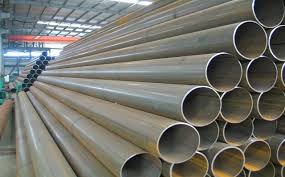
What is the main production process of straight seam welded pipe?
The production of straight seam welded pipe begins with uncoiling of steel coils, eliminating curling stress through a leveler, and then shearing the steel plate into the required width. The forming stage uses high-frequency welding (ERW) or submerged arc welding (SAW) processes to curl and weld the steel plate into a tube. Finally, it is cooled, sized, cut and inspected to ensure dimensional accuracy and weld quality. Key links include welding temperature control and non-destructive testing of welds.
What is the difference between high-frequency welding (ERW) and submerged arc welding (SAW)?
ERW heats the edge of the steel plate through high-frequency current and welds under pressure. It is suitable for thin-walled pipes and has high efficiency; SAW is used for thick-walled pipes. The arc melts the metal under the flux layer, and the weld strength is higher but the speed is slower. ERW has low cost but may produce unfused defects. SAW is suitable for high-pressure pipelines but the equipment is complex. The choice depends on the purpose of the pipe and the thickness requirements.
How to control the weld quality of straight seam welded pipes?
Welding current, voltage and speed need to be strictly monitored to avoid incomplete penetration or porosity. Use ultrasonic or X-ray to detect internal defects in the weld and visually check for surface cracks. Calibrate equipment regularly and use high-purity shielding gas (such as flux in SAW). Process parameters need to be adjusted according to material thickness, for example, thick plates need to reduce welding speed to ensure penetration.
What is the role of sizing and straightening in production?
Sizing adjusts the outer diameter of the pipe through multiple sets of rollers to ensure that it meets the tolerance standard (such as API 5L). Straightening eliminates bending stress during welding and cooling and improves straightness. Both directly affect the mechanical properties and use and installation of the pipe, especially the long-distance transmission pipeline requires strict control of ovality (usually ≤0.5%).
What are the environmental protection measures in production?
Use electrostatic precipitator equipment to treat welding fumes, and use circulating water system to cool rollers to reduce wastewater. Use low-sulfur flux to reduce harmful gas emissions and recycle scrap steel. Some factories are equipped with waste heat recovery devices to optimize energy consumption and meet ISO 14001 standards.