Q1: What are the key production steps of spiral welded pipes?
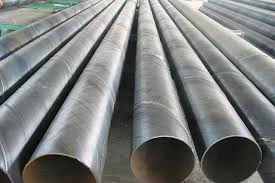
The production of spiral welded pipes starts with unwinding the steel coil, and the steel strip is flattened and adjusted to the required width by a leveling machine. Subsequently, the steel strip is curled into a spiral shape at a certain angle (usually 15°–45°) by a spiral forming machine. After forming, the weld is welded by submerged arc welding (SAW) to ensure high strength and sealing. After welding, the pipe is subjected to ultrasonic or X-ray inspection to detect defects. Finally, the pipe is cut to length as required, hydrostatically tested, and anti-corrosion coating (such as 3PE, FBE, etc.) is applied according to application requirements.
Q2: What is the difference between spiral welding and straight seam welding?
Spiral welding is to continuously curl the steel strip at a spiral angle, and the weld is distributed in a spiral line; while straight seam welding (such as LSAW) is parallel welding along the axis of the steel pipe. Spiral welded pipes can produce pipes with larger diameters (up to 4 meters) and any length, and the spiral weld can disperse the pressure more evenly. Straight welded pipes are more suitable for thick-walled or high-pressure environments, but the cost is higher. Both processes use submerged arc welding, but spiral welded pipes have a higher material utilization rate and are especially suitable for medium and low-pressure transmission pipelines.
Q3: What materials are commonly used for spiral welded pipes?
Spiral welded pipes are mainly made of carbon steel (such as ASTM A36, API 5L B-X80 grade) because of their high strength and ease of welding. For high-temperature environments, low-alloy steel containing chromium and molybdenum can be used. In corrosive environments, pipes are coated with 3PE (three-layer polyethylene) or FBE (fusion-bonded epoxy powder) anti-corrosion layers. Stainless steel spiral welded pipes are less common, but have specific applications in the chemical industry. Material selection requires a comprehensive consideration of pressure, temperature and use environment.
Q4: What are the advantages of spiral welding technology?
Spiral welding can produce large-diameter pipes with uniform wall thickness economically and efficiently. The continuous forming process reduces material waste and allows flexible adjustment of pipe length. The stress distribution of spiral welds is better than that of straight welds, and is particularly suitable for withstanding internal pressure fluctuations. In addition, spiral welded pipes can produce wide pipes with narrower steel strips, reducing the cost of raw materials. For medium and low pressure transportation (such as water, oil and gas), spiral welded pipes are one of the most cost-effective options.
Q5: What are the limitations of spiral welded pipes?
Spiral welded pipes are not suitable for ultra-high pressure (such as >20 MPa) scenarios, and their weld strength is usually lower than that of seamless pipes or straight seam welded pipes. The welding process needs to be precisely controlled, otherwise defects such as lack of fusion are prone to occur. Thick-walled (>25mm) spiral welded pipes are more difficult to produce and may have ovality deviations. In addition, the on-site repair of spiral welds is more complicated than straight welds, requiring professional equipment and processes.