


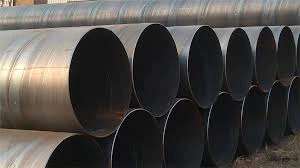


P265TR1 SSAW Steel Pipe: Technical Specifications and Overview
Product: P265TR1 Steel Pipe
Manufacturing Process: SSAW (Spiral Submerged Arc Welding)
1. Introduction
P265TR1 SSAW steel pipe is a type of welded steel pipe manufactured using the Spiral Submerged Arc Welding process. The designation "P265TR1" is derived from the European standard EN 10219 (Cold formed welded structural hollow sections of non-alloy and fine grain steels), which specifies the technical delivery conditions for cold-formed welded structural hollow sections.
"P" stands for "Pressure" or "Structural" application.
"265" indicates the minimum yield strength (ReH) of the steel in MPa (265 MPa or ~265 N/mm²).
"TR" stands for "Tube".
"1" refers to the delivery condition, which is typically "as welded" for SSAW pipes.
These pipes are primarily used in structural applications such as building frames, bridges, pylons, and other supporting structures, as well as for low-pressure fluid transmission.
2. Key Features of SSAW Pipes
Spiral Seam: The weld seam runs in a helix around the pipe's circumference. This allows for the production of large diameters from narrower steel plates or coils.
High Strength: The spiral weld design can often distribute stress more evenly around the pipe compared to a straight seam, potentially offering better resistance to circumferential stress.
Flexibility in Sizing: SSAW process is highly adaptable and can produce a wide range of diameters using the same width of steel strip, simply by adjusting the forming angle.
Cost-Effective for Large Diameters: It is generally more economical to produce large-diameter pipes using the SSAW method.
3. Technical Specifications Table
The following table summarizes the key technical specifications for P265TR1 SSAW steel pipes based on common standards and manufacturing practices.
| Parameter / Characteristic | Specification & Details |
|---|---|
| Applicable Standard | EN 10219-1 / EN 10219-2 |
| Steel Grade | P265TR1 (Equivalent to S265J0H per EN 10219) |
| Delivery Condition | As welded (Condition 1) |
| Yield Strength (ReH), min | 265 MPa (265 N/mm²) |
| Tensile Strength (Rm) | 360 - 510 MPa |
| Elongation (A), min | ≈ 24% (Specific value depends on thickness) |
| Chemical Composition ( typical max %) | Carbon (C): 0.20%, Silicon (Si): 0.50%, Manganese (Mn): 1.40%, Phosphorus (P): 0.035%, Sulfur (S): 0.030% |
| Outside Diameter (OD) | Commonly from 406 mm (16") up to 2540 mm (100") or even larger |
| Wall Thickness (WT) | Commonly from 6.0 mm up to 25.4 mm (varies with diameter) |
| Length | Typically 6 meters, 12 meters, or as per customer request (max length ~12-18m) |
| Welding Process | Submerged Arc Welding (SAW) - inside and outside welds |
| End Finish | Plain end (PE), beveled end (BE), or squared end |
| Testing & Inspection | Non-Destructive Testing (NDT): 100% ultrasonic testing of the weld seam. Hydrostatic test upon request. Mechanical tests (tensile, bend, impact), chemical analysis. |
| Surface Protection | Bare (uncoated), primed, or painted as required. |
| Main Applications | Structural supports, piling, bridge construction, water pipelines, foundation piles, wind turbine towers. |
4. Important Notes
Standards: While EN 10219 is a common reference, these pipes can also be manufactured to other international standards such as API 5L (for line pipe) or ASTM A252 (for piling), which would have different grade designations and mechanical properties.
Certification: Pipes should be supplied with a Mill Test Certificate (MTC) or Inspection Certificate 3.1 according to EN 10204, which verifies that the product complies with the order requirements and the specified standard.
Tolerances: Dimensions (OD, WT, length, straightness) are subject to manufacturing tolerances as defined in the applicable standard (e.g., EN 10219-2).
Consult Manufacturer: For critical projects, always consult the manufacturer for the exact specifications, testing procedures, and suitability for the intended application.


