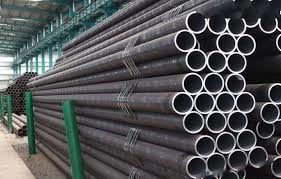

1.What is the yield strength of Q355B welded pipe, and why is it important?
The minimum yield strength of Q355B welded pipe is 355 MPa, which is a critical mechanical property indicating the stress at which the material begins to deform permanently (plastic deformation). This value is determined through tensile testing, where a sample of the pipe is pulled until it starts to yield. Yield strength is important because it defines the maximum load or pressure the pipe can withstand without losing its original shape, making it a key parameter for structural and pressure-containing applications. For example, in bridge supports or high-pressure pipelines, the pipe must not yield under operational loads to prevent structural failure or leaks. The 355 MPa yield strength of Q355B is significantly higher than lower-grade steels like Q235B (235 MPa), allowing engineers to design lighter structures with thinner walls while maintaining safety margins. It also ensures the pipe can handle dynamic loads, such as vibrations or sudden pressure spikes, without permanent deformation.
2.What is the tensile strength range of Q355B welded pipe?
The tensile strength of Q355B welded pipe typically ranges from 470 MPa to 630 MPa, as specified in standards like GB/T 1591. Tensile strength is the maximum stress the material can withstand before breaking, measured during tensile testing by dividing the maximum load by the original cross-sectional area. This range ensures that Q355B pipes have sufficient ductility to stretch and deform before failure, which is crucial for applications where sudden loads or impacts may occur. The higher end of the range (630 MPa) provides a safety buffer, allowing the pipe to absorb energy without fracturing. For welded pipes, the tensile strength of the weld seam is also tested to ensure it matches or exceeds that of the base metal, ensuring the entire pipe behaves uniformly under stress. This balance of strength and ductility makes Q355B suitable for both structural and pressure-bearing uses.
3.How is the impact toughness of Q355B welded pipe tested, and what are the requirements?
The impact toughness of Q355B welded pipe is tested using the Charpy V-notch test, which measures the energy absorbed by the material when struck by a pendulum. Samples are taken from the pipe, including the weld seam and heat-affected zone (HAZ), and a V-shaped notch is machined into them. The samples are then cooled to 20°C (the specified temperature for Q355B) and struck by the pendulum, with the energy absorbed (in joules) recorded as the impact value. For Q355B, the minimum impact energy requirement is typically 34 joules for each of three test specimens, as per standards like GB/T 1591. This ensures that the pipe, including the welded area, can withstand sudden impacts or shock loads without brittle fracture, even at moderately low temperatures. The test is critical because welded seams can sometimes be more brittle than the base metal due to heat treatment during welding, so verifying impact toughness ensures the entire pipe maintains reliable performance in service.
4.What is the elongation percentage of Q355B welded pipe, and what does it indicate?
The elongation percentage of Q355B welded pipe is typically a minimum of 20%, measured during tensile testing. Elongation is the percentage increase in length of a sample before it breaks, calculated by dividing the change in length by the original length and multiplying by 100. This property indicates the ductility of the material-its ability to stretch and deform without breaking. A 20% minimum elongation means Q355B pipes can undergo significant plastic deformation, which is important for applications where the pipe may be subjected to bending, forming, or thermal expansion. For example, in structural applications, pipes may need to flex slightly under load without fracturing, and high elongation ensures this flexibility. In welded pipes, elongation is also measured at the weld seam to ensure the joint can deform as much as the base metal, preventing premature failure at the weld. This ductility, combined with high strength, makes Q355B a versatile material for various engineering uses.
5.How do the mechanical properties of Q355B welded pipe compare to its seamless counterpart?
The mechanical properties of Q355B welded pipe are generally comparable to those of Q355B seamless pipe, as both are made from the same grade of steel. Both have a minimum yield strength of 355 MPa, tensile strength in the 470–630 MPa range, and similar impact toughness and elongation values. However, there can be slight differences in the weld area of welded pipes: if the welding process is not properly controlled, the weld seam may have slightly lower ductility or toughness due to heat-induced changes in microstructure. Seamless pipes, made from a single billet without a weld, have uniform properties throughout, which can be advantageous in highly critical applications like high-pressure oil and gas transport. That said, modern welding techniques (e.g., ERW, SAW) with proper annealing ensure welded pipe seams meet or exceed the mechanical properties of the base metal, making them suitable for most applications where seamless pipes are used, often at a lower cost.