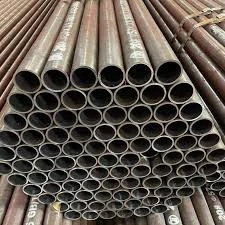
What are the main chemical compositions of ASTM A333 Gr.3 steel pipe?
ASTM A333 Gr.3 is a nickel alloy steel. Its key chemical components include carbon (C), manganese (Mn), phosphorus (P), sulfur (S), silicon (Si), and most importantly, nickel (Ni). The nickel content typically ranges from 3.18% to 3.82%, which is the core element that imparts its excellent low-temperature toughness. Other elements, such as carbon, are kept to low levels (≤0.19%) to maintain good weldability and toughness. This precise chemical balance ensures the material's reliability in extremely cold environments. Therefore, chemical composition is fundamental to ensuring compliance with the requirements of the ASTM A333 standard.
What are the unique mechanical properties of ASTM A333 Gr.3 steel pipe?
The material's mechanical properties are designed to ensure safe operation at low temperatures. Its room temperature tensile strength requirements are a minimum of 450 MPa and its yield strength a minimum of 240 MPa, providing a solid foundation of strength. More crucial is its exceptional impact toughness. The standard requires that the average of three specimens tested in a Charpy V-notch impact test at an extremely low temperature of -101°C (-150°F) must be no less than 18 J (13 ft-lbf). This high toughness is the fundamental reason for its resistance to low-temperature brittle fracture. Therefore, the core of its mechanical properties lies in the perfect combination of strength and toughness.
Why is nickel (Ni) so important for A333 Gr.3?
Nickel is one of the most critical alloying elements for improving the low-temperature toughness of steel. Its addition modifies the steel's crystal structure and lowers its ductile-brittle transition temperature (DBTT), allowing the material to maintain toughness and ductility at temperatures that would normally make carbon steel brittle. In A333 Gr.3, a nickel content of approximately 3.5% significantly refines the grain size and stabilizes the austenite phase, effectively preventing crack initiation and propagation at low temperatures. Without sufficient nickel, the steel would not meet the standard's required -101°C impact energy value. Therefore, nickel is the key element that determines its low-temperature service performance.
What is the difference between A333 Gr.3 and other common low-temperature steel pipe grades, such as Gr.6?
The primary differences lie in the alloy system and applicable temperature range. A333 Gr.6 is a carbon-manganese steel that contains no nickel. Its minimum design temperature is approximately -45°C, and its toughness is achieved through rigorously controlled rolling and heat treatment. Gr.3, on the other hand, is an alloy steel containing approximately 3.5% nickel. Its minimum design temperature can reach -101°C, and its performance far exceeds that of Gr.6. However, due to the inclusion of precious metal nickel, Gr.3 is typically much more expensive than Gr.6. Therefore, the choice depends on the specific design temperature and economic considerations.
What are the common manufacturing processes for ASTM A333 Gr.3 steel pipe?
This pipe is typically manufactured using either seamless or welded processes. Seamless pipe is produced by piercing a round billet and then rolling or drawing it. It has no welds and offers uniform properties throughout. Welded pipe is made by coiling steel plates or strips and welding them using methods such as submerged arc welding (SAW). The weld area undergoes rigorous nondestructive testing and heat treatment to ensure that its properties are consistent with those of the parent material. Regardless of the process, the final steel pipe must undergo a normalizing heat treatment to refine the grain size and homogenize the structure, thereby achieving optimal low-temperature impact toughness.