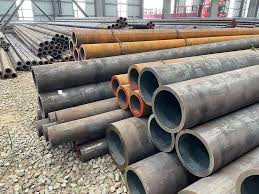
Question 1: What are the steps involved in the production process for ASTM A335 P11 steel pipe?
The production process includes steelmaking, continuous casting or forging, piercing, hot rolling or cold drawing, heat treatment, and final inspection. The steelmaking stage requires strict control of alloy composition to ensure that the material properties meet the specified standards. Piercing and hot rolling are used to form the initial tubular structure, while cold drawing improves dimensional accuracy. Heat treatment is a critical step and typically includes normalizing and tempering. Final inspection includes dimensional, chemical composition, and mechanical property testing.
Question 2: Why is heat treatment so important for ASTM A335 P11 steel pipe?
Heat treatment optimizes the material's grain structure and mechanical properties through normalizing and tempering. Normalizing eliminates work hardening and improves uniformity, while tempering enhances toughness and reduces residual stresses. Unheat-treated steel pipe may fail prematurely due to internal stresses. Heat treatment also improves weldability and creep resistance. It is a core step in ensuring that steel pipe meets ASTM standards.
Question 3: How do cold drawing and hot rolling processes differ in their impact on the performance of P11 steel pipe?
Cold drawing produces steel pipe with higher dimensional accuracy and a smoother surface finish, but may result in work hardening. Hot-rolled steel pipe offers higher production efficiency but with wider dimensional tolerances. Annealing is typically required after cold drawing to restore plasticity, while hot-rolled steel pipe can proceed directly to heat treatment. Choosing a process requires a balance between cost, accuracy, and performance requirements. Both processes must meet the requirements of ASTM A335.
Question 4: What are the nondestructive testing methods for ASTM A335 P11 steel pipe?
Common nondestructive testing methods include ultrasonic testing (UT), eddy current testing (ET), radiographic testing (RT), and magnetic particle testing (MT). UT detects internal defects such as inclusions or cracks; ET is suitable for surface and near-surface defects; RT comprehensively assesses weld quality; and MT detects surface cracks. Together, these methods ensure the integrity and safety of the steel pipe.
Question 5: How are dimensional tolerances of ASTM A335 P11 steel pipe controlled during manufacturing? Dimensional tolerances are controlled through precision rolling mills, dies, and in-line measurement systems. Cold drawing can achieve even tighter tolerances, such as ±0.1 mm for outer diameter. Hot-rolled steel pipes have slightly wider tolerances, but still must comply with ASTM A335. Regular sampling and testing are performed during production, along with real-time monitoring using tools such as laser diameter gauges. Final inspection verifies parameters such as wall thickness, ovality, and length.