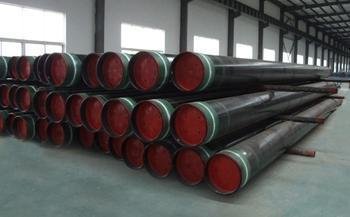
1. What is N80Q oil casing?
N80Q oil casing implements API 5CT standard. It is a steel pipe used to support the well wall of oil and gas wells to ensure the normal operation of the entire oil well during the drilling process and after completion. Each well uses several layers of casing according to different drilling depths and geological conditions. After the casing is lowered into the well, cement is used for cementing. Unlike oil pipes and drill pipes, it cannot be reused and is a one-time consumable material.
2. What is the basis for the strength calculation of N80Q oil casing?
At present, the strength calculation of N80 oil casing is carried out according to the API BUL 5C3 specification of the American Petroleum Institute. However, this calculation formula is based on a large amount of physical experimental data and is derived by mathematical regression method. It fails to reflect the influence of the wall thickness error of oil casing on strength.
3. What are the requirements for wall thickness and outer diameter accuracy of N80Q oil casing?
The American Petroleum Institute API stipulates that the wall thickness error of oil casing is 0 - 12.5t%, and the national standard is ±12.5t; the outer diameter error is 0.5D% - 1.0D%, and the national standard is ±1.0D. Strict regulations on dimensional accuracy such as wall thickness and outer diameter are to meet the use requirements.
4. What are the mechanical properties of N80Q oil casing?
High strength: N80 grade is the API (American Petroleum Institute) rating for steel grades, which means that its yield strength is at least 80,000 pounds/inch² (about 553 MPa), which is more pressure-resistant than conventional casing and can withstand greater formation pressure.
Wear resistance: The casing needs to withstand wear during drilling. N80 material has excellent wear resistance and impact resistance, which can extend its service life.
Hardness and toughness: N80 casing has moderate hardness and good toughness and plasticity. It can not only ensure strength but also absorb certain deformation before breaking, thereby improving safety.
Corrosion resistance: Through special treatment, N80 casing has a certain corrosion resistance and adapts to the complex geological environment underground.
Thermal stability: It can still maintain good mechanical properties at high temperatures to ensure stable performance in drilling operations.
5. What are the types and characteristics of N80Q oil casing couplings?
The coupling types include long round threads, etc. Special buckle threaded joints can be divided into integral joints and coupling joints. Its characteristics include:
Sealing technology: Through the design of elastic and metal sealing structure, the joint gas sealing resistance reaches the yield pressure in the pipe body.
High connection strength: Through the thread design, the special buckle greatly improves the stress distribution of the joint. The connection strength of the coupling joint reaches or exceeds the strength of the pipe body, which basically solves the problem of slippage.
Anti-wear and anti-bonding technology: Through the selection of materials and the improvement of surface treatment technology, the thread bonding problem is basically solved. The casing is buckled three times and the oil pipe is buckled ten times without bonding.
Corrosion resistance: By optimizing the structure, the stress distribution of the joint is more reasonable.
6. What are the production processes of N80Q oil casing?
Baosteel's oil casing processing process can be used as a reference. First, carbon steel or alloy steel raw materials are selected, and after strict smelting and heat treatment, their strength and corrosion resistance are improved. Then, seamless steel pipe billets are produced through continuous casting technology4. At the same time, different refining processes such as LF-VD-RH-LF and LF-RH can also be used for production, among which the LF-RH process can produce products with higher purity and cleanliness.