


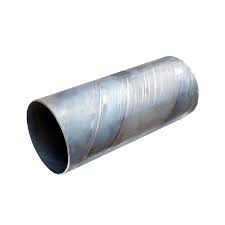
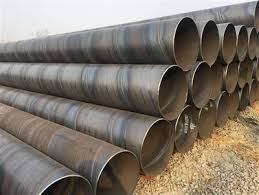
GB/T 3091 Q355B is a standard and widely used high-strength material specification for manufacturing Spiral Submerged Arc Welded (SSAW) steel pipes [citation:1, citation:3, citation:4, citation:5, citation:6]. This combination is a common product offered by numerous Chinese manufacturers for applications requiring higher strength than standard carbon steel grades, such as medium-pressure fluid transmission, structural supports, and industrial infrastructure [citation:4, citation:8].
The designation "GB/T 3091 Q355B Spiral Submerged Arc Pipe" combines a high-strength low-alloy structural steel grade (Q355B) with the standard quality level, produced using the economical spiral welding process for large-diameter applications requiring enhanced mechanical properties . Q355B is the replacement grade for the former Q345B, with slightly adjusted chemical composition and mechanical properties [citation:8, citation:9].
📋 Key Specifications for GB/T 3091 Q355B SSAW Pipe
The table below summarizes the primary specifications for this product, based on comprehensive industry data [citation:1, citation:2, citation:3, citation:4, citation:5, citation:6, citation:8, citation:9].
| Attribute | Description |
|---|---|
| Standard | GB/T 3091: "Welded steel pipes for low pressure liquid delivery" (current version: GB/T 3091-2015) [citation:2, citation:4, citation:5, citation:9, citation:10]. |
| Scope | Applicable to water, air, heating steam, gas, and other low-pressure fluid transmission [citation:2, citation:4, citation:5, citation:10]. |
| Steel Grade | Q355B: A high-strength low-alloy structural steel grade. The "Q" stands for "屈服强度" (yield strength), "355" indicates the minimum yield strength in MPa, and "B" denotes the quality grade with specified impact requirements at room temperature (+20°C) [citation:4, citation:8]. |
| Base Material Standard | GB/T 1591: Low-alloy high-strength structural steels (current version: GB/T 1591-2018, which replaced Q345 with Q355) [citation:6, citation:8, citation:9]. |
| Manufacturing Process | Spiral Submerged Arc Welding (SSAW/HSAW/SAWH) : Formed from hot-rolled steel coil at room temperature, with the weld seam running continuously in a spiral. Welded using double-sided automatic submerged arc welding (inside and outside) [citation:1, citation:4, citation:5, citation:6]. |
| Chemical Composition (max %) [citation:4, citation:8] | Carbon (C): ≤ 0.20% (max) Manganese (Mn): 1.50-1.60% (max) Silicon (Si): ≤ 0.50% (max) Phosphorus (P): ≤ 0.035% (max) Sulfur (S): ≤ 0.035% (max) *Note: Actual values per GB/T 1591-2018 may have tighter controls* |
| Mechanical Properties (min) [citation:4, citation:7, citation:8] | Yield Strength (t ≤ 16mm): 355 MPa Yield Strength (t > 16mm): 345 MPa Tensile Strength: 470-630 MPa Elongation (D > 168.3mm): ≥ 20-22% Charpy Impact: 27-34 J minimum at +20°C [citation:4, citation:8] |
| Typical Size Range [citation:1, citation:3, citation:4, citation:5] | Outside Diameter: 219 mm to 4064 mm (approx. 8" to 160") for SSAW Wall Thickness: 6 mm to 28 mm (common range 6-25.4 mm) [citation:1, citation:4] Length: 3 m to 12 m standard; up to 18 m available |
| Key Testing Requirements [citation:2, citation:4, citation:6, citation:8, citation:9] | Chemical analysis; tensile test; flattening test; bend test; hydrostatic test (each pipe at 2.5-5.0 MPa) [citation:4, citation:9]; non-destructive testing (ultrasonic or X-ray of weld seam - standard practice) [citation:4, citation:6]; Charpy impact testing required for Grade B at +20°C [citation:4, citation:8]. |
| Common Applications [citation:1, citation:3, citation:4, citation:5, citation:8] | Medium-pressure oil and gas transmission; natural gas gathering lines; water transmission mains; industrial process piping; structural applications; piling foundations; building construction; bridges; power plant piping; chemical industry pipelines. |
| Certification | Mill Test Certificate typically to EN 10204 Type 3.1 or equivalent, with full test results and traceability records. API monogram, ISO 9001, CE marking available from certified manufacturers [citation:4, citation:8]. |
📊 GB/T 3091 Grade Comparison
Q355B is a high-strength grade in the GB/T 3091 specification, offering significantly higher strength than standard carbon steel grades. The table below shows its position relative to other grades [citation:1, citation:3, citation:5, citation:7, citation:8]:
| Grade | Yield Strength (MPa) min (t ≤ 16mm) | Tensile Strength (MPa) min | Elongation % (D > 168.3mm) | Relative Strength vs. Q235B | Key Feature | Typical Application |
|---|---|---|---|---|---|---|
| Q195 | 195 | 315 | 20 | -17% | Most economical | Non-critical, cost-driven applications |
| Q235B | 235 | 370 | 20 | Baseline | Balanced properties | General construction - MOST COMMON |
| Q275B | 275 | 410 | 18 | +17% | Higher strength | Moderate load-bearing structures |
| Q355B | 355 | 470-630 | 20-22 | +51% | High strength, low alloy | Heavy-duty structural, pressure applications |
📏 Dimensional Specifications
GB/T 3091 specifies the following typical tolerances for SSAW pipes [citation:3, citation:4, citation:7, citation:9]:
| Parameter | Tolerance |
|---|---|
| Outside Diameter (OD ≤ 508mm) | ±0.75% of specified diameter |
| Outside Diameter (OD > 508mm) | ±1.0% of specified diameter |
| Wall Thickness (t ≤ 5.0mm) | ±0.5mm |
| Wall Thickness (5.0mm < t < 15.0mm) | ±0.1t |
| Wall Thickness (t ≥ 15.0mm) | ±1.5mm |
| Straightness (OD > 168.3mm) | ≤ 0.2% of total length |
| Hydrostatic Test Pressure | Formula-based, max 5.0 MPa [citation:4, citation:9] |
| End Finish | Plain ends standard; beveled ends for wall thickness > 4mm (30° angle, 1.6mm root face) |
Standard Diameter Range for SSAW: 219mm to 4064mm (8" to 160") [citation:1, citation:3, citation:4, citation:5]
🔍 Key Points to Understand
What "GB/T 3091 Q355B" Means: This is the Chinese national standard for low-pressure fluid transmission pipes using high-strength low-alloy steel Q355B. The "B" suffix is significant-it guarantees Charpy V-notch impact energy of 27-34 Joules at room temperature (+20°C) , making it suitable for demanding structural applications where toughness is required [citation:4, citation:8].
Q355B vs. Q345B: Q355B is the replacement grade for the former Q345B, introduced in GB/T 1591-2018. Key differences include slightly adjusted chemical composition (tighter controls on P, S) and mechanical properties, with Q355B having a minimum yield strength of 355 MPa (compared to Q345B's 345 MPa) [citation:8, citation:9].
Q355B vs. Q235B: Q355B offers approximately 51% higher yield strength than Q235B (355 MPa vs. 235 MPa) and significantly higher tensile strength (470-630 MPa vs. 370-500 MPa). This makes it ideal for applications requiring higher load-bearing capacity without increasing wall thickness [citation:4, citation:7, citation:8].
International Equivalents: Q355B is roughly equivalent to [citation:4, citation:8]:
ASTM A572 Grade 50 (345 MPa yield)
EN 10025 S355JR (355 MPa yield, 27J at +20°C)
ISO 630-2 S355JR
SSAW Advantages for Q355B: The spiral welding process offers specific benefits for large-diameter, high-strength pipes [citation:1, citation:4, citation:5]:
Large Diameter Capability: Can economically produce pipes up to 160" diameter
Cost Efficiency: Lower cost than longitudinal welding for large diameters
Long Lengths: Up to 18-25m lengths reduce field joints
Material Efficiency: Can use narrower steel strips to produce large-diameter pipes
Weld Quality: Double-sided submerged arc welding ensures full penetration with 100% NDT
🔧 Manufacturing Process for GB/T 3091 Q355B SSAW Pipe
The manufacturing process follows established SSAW production methods with enhanced quality controls suitable for high-strength steel [citation:1, citation:4, citation:5, citation:6]:
| Step | Description |
|---|---|
| 1. Raw Material Preparation | Hot-rolled steel coils meeting Q355B chemistry requirements are leveled, inspected, and edge-milled. Coils must comply with GB/T 1591-2018 [citation:6, citation:8]. |
| 2. Spiral Forming | The steel strip is continuously formed into a cylindrical shape at a specific helix angle at room temperature using five-roll forming technology [citation:1, citation:4, citation:6]. |
| 3. Submerged Arc Welding | Double-sided automatic submerged arc welding (inside and outside) creates the spiral seam with full penetration. Modern lines use multi-wire welding for efficiency [citation:1, citation:4, citation:6]. |
| 4. Non-Destructive Testing | 100% ultrasonic or X-ray inspection of the weld seam is standard practice. Modern facilities use automated continuous UT systems with 100% coverage [citation:4, citation:6]. |
| 5. Hydrostatic Testing | Each pipe individually tested to verify pressure integrity (max 5.0 MPa) [citation:4, citation:9]. |
| 6. Mechanical Testing | Tensile tests, flattening tests, bend tests, and mandatory Charpy impact testing for Grade B at +20°C [citation:4, citation:8]. |
| 7. End Finishing | Ends prepared (plain or beveled) for field welding; beveled ends for wall thickness > 4mm [citation:4, citation:7]. |
| 8. Coating | Optional external coatings (FBE, 3LPE, coal tar epoxy, 8710) and internal linings available for corrosion protection . |
🏭 Applications
GB/T 3091 Q355B SSAW pipes are used in demanding applications requiring higher strength than standard carbon steel [citation:1, citation:3, citation:4, citation:5, citation:8]:
| Application | Description | Why Q355B is Chosen |
|---|---|---|
| Oil and Gas Transmission | Medium-pressure pipelines for crude oil, natural gas | Higher strength allows reduced wall thickness |
| Natural Gas Gathering | High-pressure gathering lines in demanding environments | Enhanced toughness for safety |
| Water Transmission | Large-diameter high-pressure water mains | Higher pressure capability [citation:3, citation:5] |
| Structural Applications | Building frames, bridge supports, piling foundations | 51% higher strength than Q235B [citation:1, citation:4] |
| Industrial Process Piping | Chemical plants, power generation, industrial facilities | Good weldability, corrosion resistance options |
| Marine and Offshore | Port facilities, offshore platforms (with proper coating) | Low-temperature impact properties |
| Special Environments | High-altitude, cold regions, seismic zones | Guaranteed toughness, reliable performance |
📝 Important Considerations
Standard Version: The current version is GB/T 3091-2015. A new version GB/T 3091-2025 will be effective from October 1, 2025, with updated requirements. When ordering, specify the required version year [citation:2, citation:5].
Q355A vs. Q355B: The key difference is impact testing:
Q355A: No mandatory Charpy impact testing
Q355B: Mandatory Charpy impact testing at +20°C, 27-34J minimum [citation:4, citation:8]
Choose Q355B for any application requiring toughness assurance.
Q355C, Q355D, Q355E: Higher grades with impact testing at 0°C, -20°C, and -40°C respectively are available for more demanding applications . If you need guaranteed low-temperature performance, specify the appropriate suffix.
Coating Options: Pipes can be supplied with various coatings [citation:1, citation:4, citation:5]:
FBE/3LPE: For buried pipelines and harsh environments
Coal Tar Epoxy: For marine applications
8710 coating: For industrial applications
Cement mortar lining: For water service
Galvanized: For corrosion protection (OD ≤ 508mm only)
International Approximations: Q355B is roughly equivalent to [citation:4, citation:8]:
ASTM A572 Grade 50 (US standard)
EN 10025 S355JR (European standard)
ISO 630-2 S355JR (International standard)
Typical Price Range (as of 2025 estimates): Q355B SSAW pipes range from ¥3,700 to ¥3,800 per ton depending on order quantity, with volume discounts available .
Complete Specification: When ordering, specify [citation:1, citation:4, citation:5]:
GB/T 3091, Grade Q355B, SSAW (spiral welded), Size (OD x WT), Length, End Finish
Standard version: [e.g., GB/T 3091-2015]
Coating requirements: [e.g., bare, FBE, 3LPE]
Any supplementary requirements (impact testing temperature, NDT level)
📝 Summary
GB/T 3091 Q355B Spiral Submerged Arc Welded pipes are the standard high-strength choice for demanding applications under the Chinese national standard for low-pressure fluid transmission [citation:1, citation:3, citation:4, citation:5, citation:8]. With minimum yield strength of 355 MPa – approximately 51% higher than Q235B – these pipes offer an excellent balance of strength, weldability, and cost for medium-pressure oil and gas transmission, heavy-duty structural applications, piling foundations, and industrial infrastructure [citation:4, citation:8].
The "B" quality grade guarantees Charpy impact toughness of 27-34 Joules at room temperature (+20°C), making Q355B suitable for demanding applications where impact resistance is required [citation:4, citation:8]. This is the key difference from Q355A, which has no mandatory impact testing.
Available in diameters from 219mm to over 4000mm with wall thicknesses to 28mm and lengths up to 18m, these pipes are produced using the cost-effective SSAW manufacturing process with double-sided submerged arc welding, ensuring reliable weld quality [citation:1, citation:4, citation:5, citation:6].
Q355B is the premium grade in the GB/T 3091 family, equivalent to international grades such as ASTM A572 Grade 50 and EN 10025 S355JR. For applications requiring even higher low-temperature performance, consider Q355C (0°C), Q355D (-20°C), or Q355E (-40°C) grades .
When ordering, ensure you clearly indicate the complete standard with version year, grade Q355B, manufacturing process (SSAW), required dimensions, and any coating or supplementary requirements based on your specific application [citation:1, citation:4, citation:5].


