


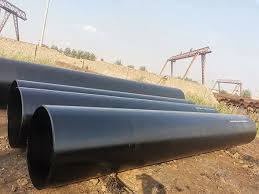

GB/T 1591-2009 Grade A Longitudinal Submerged Arc Welding (LSAW) Pipe
Yes, GB/T 1591-2009 Grade A steel is a recognized material grade for manufacturing Longitudinal Submerged Arc Welded (LSAW) pipes. This corresponds to the Q345A steel grade, which is a widely used low-alloy high-strength structural steel in China for general construction, engineering structures, and low-pressure fluid transmission applications .
The key specifications are summarized in the following table:
Key Specifications
| Attribute | Description |
|---|---|
| Product Type | Longitudinal Submerged Arc Welded (LSAW) Pipe, manufactured using JCOE, UOE, or similar forming processes . |
| Material Standard | GB/T 1591-2009: Hot-rolled low-alloy structural steels . |
| Common Steel Grade | Q345A. The "Q" stands for Yield Strength, "345" indicates the minimum yield strength in MPa, and "A" denotes the quality grade with no specified impact test requirement . |
| Chemical Composition (Ladle Analysis, max %) | |
| Carbon (C): 0.20 | |
| Silicon (Si): 0.50-0.55 | |
| Manganese (Mn): 1.00-1.70 | |
| Phosphorus (P): 0.035-0.045 | |
| Sulfur (S): 0.035-0.045 | |
| Mechanical Properties (min) | |
| Yield Strength (t ≤ 16mm): ≥ 345 MPa | |
| Yield Strength (16mm < t ≤ 35mm): ≥ 325 MPa | |
| Tensile Strength: 470-630 MPa | |
| Elongation: ≥ 21% | |
| Impact Test: Not required for Grade A . | |
| Typical Size Range | |
| Outside Diameter: 219 mm to 2500 mm+ (approx. 8" to 100"+) | |
| Wall Thickness: 5 mm to 50 mm (thicker walls available on request) | |
| Length: 3 m to 18 m (customizable) | |
| Manufacturing Process | 1. Steel plate selection and edge milling. 2. Edge crimping and forming using JCOE or UOE processes. 3. Internal and external submerged arc welding. 4. Mechanical expanding (for UOE/JCOE). 5. Non-destructive testing (Ultrasonic, X-ray). 6. Hydrostatic testing. 7. End facing and beveling. |
| Common Applications | General structural engineering; building construction; bridge components; vehicles and ships; machinery manufacturing; pressure vessels and storage tanks (non-critical); lifting and transport equipment; low-pressure fluid transmission. |
| Certification | Mill Test Certificate typically provided as per EN 10204 / 3.1 or project requirements. |
📊 Q345 Grade Comparison
The Q345 family has five quality grades (A, B, C, D, E) with progressively stricter controls and impact requirements :
| Grade | Impact Test Temperature | P max (%) | S max (%) | Key Application |
|---|---|---|---|---|
| Q345A | Not required | 0.045 | 0.045 | General structures, non-critical, indoor, economy-driven projects . |
| Q345B | +20°C (27-34J) | 0.035-0.040 | 0.035-0.040 | General construction, mild climate applications . |
| Q345C | 0°C (27-34J) | 0.030-0.035 | 0.030-0.035 | Colder climates, outdoor structures . |
| Q345D | -20°C (27-34J) | 0.030 | 0.025-0.030 | Severe cold environments, demanding applications . |
| Q345E | -40°C (27J) | 0.025 | 0.020 | Extreme cold, critical infrastructure . |
Grade A is the most economical option in the Q345 family, with the least stringent chemical controls and no impact testing requirement . This makes it suitable for applications where low-temperature toughness is not a concern.
🔍 Key Points to Understand
Meaning of "Grade A": In GB/T 1591-2009, the letter A indicates the most basic quality grade. Unlike Grades B through E, Q345A does not require Charpy V-notch impact testing, meaning its toughness is not guaranteed at any temperature . This makes it suitable for static load applications in ambient conditions.
Relationship to Q355: Note that GB/T 1591-2009 has been superseded by GB/T 1591-2018, which replaced Q345 with Q355 (minimum yield strength adjusted to 355 MPa). However, Q345A remains widely referenced in industry and is still produced for projects based on the older standard .
Chemical Composition Variation: The phosphorus and sulfur limits for Q345A can be slightly higher (up to 0.045%) compared to higher grades, reflecting its more basic quality level .
Weldability: Q345A has good weldability due to its low carbon equivalent, making it suitable for common welding methods including submerged arc welding (SAW), which is the process used for LSAW pipe manufacturing .
💡 When to Choose Q345A Grade
Select GB/T 1591-2009 Grade A (Q345A) LSAW pipe when:
The application involves static loads only with no significant dynamic or impact forces .
Operating temperatures are consistently above 0°C (ambient indoor or mild climate conditions).
The project is cost-sensitive and requires an economical material solution.
Impact testing is not required by design specifications or codes.
The application involves general fabrication, structural frames, or low-pressure fluid transmission in benign environments .
For most general construction in mild climates, Grade A (Q345A) provides a cost-effective solution. For applications requiring guaranteed impact toughness (outdoor structures in cold climates, bridges, pressure vessels), higher grades such as Q345C, D, or E should be specified .
📝 Standard Update Note
GB/T 1591-2009 has been superseded by GB/T 1591-2018, which introduced Q355 as the replacement for Q345 with a minimum yield strength of 355 MPa. It is recommended to confirm which version year is required for your project. Current production of Q345A LSAW pipes may still reference the 2009 standard, but the material properties remain consistent with the established Q345 specifications .
In summary, GB/T 1591-2009 Grade A (Q345A) LSAW pipe is the most basic and economical grade in the Q345 family, suitable for general structural and engineering applications where low-temperature impact toughness is not required .


