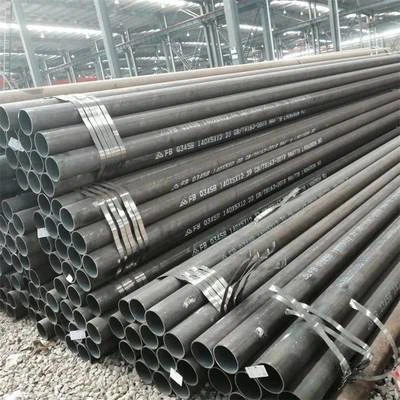
1. What is the basic definition of GB/T 712 FH36 steel pipe?
FH36 is an ultra-high-strength hull structural steel specified in the Chinese national standard (GB/T 712-2023 "Structural Steel for Shipbuilding and Offshore Engineering"). It is of the F-grade quality and suitable for use in extremely low-temperature environments down to -60°C. Its naming convention is as follows:
"F" indicates extreme low-temperature toughness (meets impact resistance at -60°C);
"H36" indicates a minimum yield strength of 355 MPa (36 kgf/mm²) or greater.
This material achieves optimized strength, toughness, and weldability through high-purity smelting (P, S ≤ 0.015%) and advanced TMCP (Thermomechanical Control Process). It is a core material for cutting-edge equipment such as heavy-duty polar icebreakers and deep-sea drilling platforms.
2. What are the core applications of FH36 steel pipe? Polar heavy-duty vessels: Hulls and load-bearing frames of nuclear-powered icebreakers and Arctic LNG carriers;
Ultra-deepwater marine engineering: Key components such as pile legs and jackets for deep-sea drilling platforms exceeding 3,000 meters;
Special military vessels: Due to its explosion resistance and low-temperature toughness, it is suitable for polar patrol vessels and ice-based combat vessels.
3. What are the technological breakthroughs of FH36 compared to EH36 (-40°C)?
Extreme low-temperature toughness: Impact energy (KV2) ≥ 34 J at -60°C, a more stringent requirement than that of EH36 (-40°C);
Alloy design: Adding Ni (0.50%-1.50%) and Mo (0.10%-0.30%) improves low-temperature stability, while Ca treatment is used to modify sulfide morphology;
Process innovation: Combining direct quenching (DQ) and tempering to achieve grain refinement and residual stress control. 4. What are the special requirements for processing and welding FH36 steel pipe?
Welding materials: F-grade matching welding consumables (such as AWS E11018-G) must be used, and preheating to 150-200°C (higher for plate thickness > 30mm) is required before welding.
Forming restrictions: The cold bending radius must be ≥ 5 times the wall thickness, or intermediate-temperature forming (200-300°C) must be used to avoid brittle cracking.
Post-weld treatment: All welds must undergo 100% nondestructive testing (UT+RT) and stress relief annealing (580-620°C).
5. How is FH36 steel pipe strictly inspected? What are the key inspection criteria? Marking Verification: The steel pipe surface must be permanently marked with "FH36," the GB/T 712 standard number, the batch number, and the CCS (China Classification Society) certification mark.
Performance Testing: The Material Certificate (MTC) must include:
Chemical composition (e.g., C ≤ 0.12%, Ni 1.20%-1.50%);
Mechanical properties (yield strength ≥ 355 MPa, tensile strength 490-630 MPa);
-60°C impact test data (average of three specimens ≥ 42 J, single specimen ≥ 31 J);
Non-destructive Testing: Full-scale phased array ultrasonic (PAUT) detection for internal defects, with CT scanning of critical areas for verification.