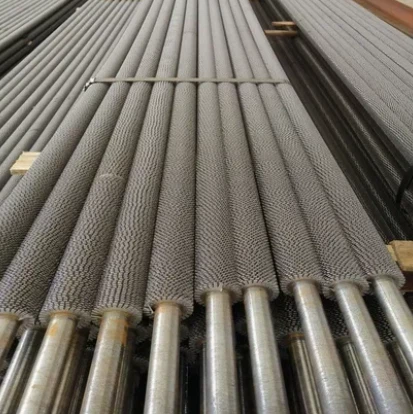

1. What is the difference between fin tube and finned tube?
There is **no technical difference**. Both terms refer to the same component: a base tube with extended surfaces (fins) attached to its exterior. "Finned tube" is more commonly used globally, while "fin tube" is sometimes preferred in specific regions/industries.
2. What is a bare tube?
A **bare tube** is a smooth, unfinned tube with no external enhancements. It's the simplest form of heat transfer tubing, relying solely on its external surface area for heat exchange, typically in liquid-to-liquid applications.
3.What are Finned tubes used for?
Finned tubes **enhance heat transfer** between fluids, especially when one has low thermal conductivity (e.g., air/gas). Common uses:
- Air-cooled heat exchangers (e.g., HVAC condensers, radiators).
- Economizers/heat recovery in boilers.
- Process heaters, chillers, and dryers.
- Power plant condensers and oil coolers.
4. What is the bare tube area?
The **bare tube area** is the **external surface area of the smooth tube alone**, excluding fins. It's calculated as: π × tube diameter × tube length. This is the reference area before finning and is critical for thermal design calculations.
5. What are the disadvantages of finned tube heat exchangers?
- **Fouling**: Fins trap dust/debris, reducing efficiency and increasing maintenance.
- **Corrosion Risk**: Fins create crevices prone to corrosive buildup.
- **Pressure Drop**: Fins disrupt fluid flow, increasing fan/pump energy costs.
- **Cost**: Fabrication (extruded/welded fins) is more expensive than bare tubes.
- **Mechanical Vulnerability**: Fins are easily damaged during handling/cleaning.